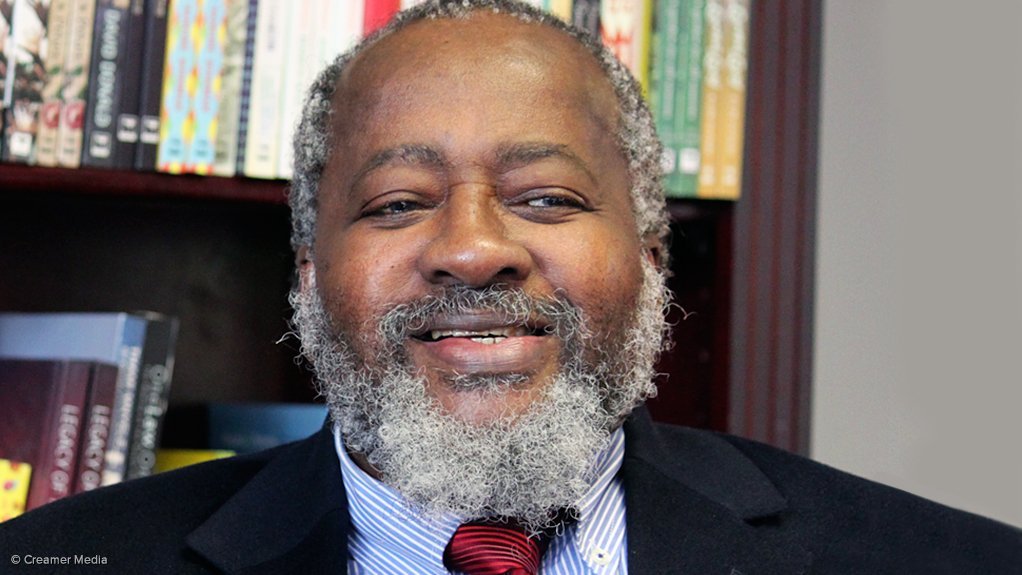
Today, Zweledinga Pallo Jordan turns eighty-four. I write this not merely as a birthday greeting, though the occasion demands one, but as the first entry in a living archive: a series dedicated to the elders of our liberation who still walk among us, whose minds remain fertile ground for the struggle that continues. He, and many others like him, serve as the sages of our nation, our nation’s Council of Elders, the firmaments on our horizon. We have a peculiar habit in South Africa of honouring our freedom fighters in retrospect: in eulogy, in bronze, only once the chair is empty. The Black Library Series begins with a deliberate refusal of that habit. We begin while Comrade Pallo Jordan is still here to read this. And knowing him, to disagree with at least one sentence. I am fully aware that never having sought glory or rewards for his contribution to the struggle, this will embarrass him a tad bit.
The House He Came From
To understand Pallo Jordan, one must first understand the house he came from. He is the son of Archibald Campbell Jordan (poet, novelist, linguist, and one of the towering intellects of African letters), whose novel Ingqumbo Yeminyanya (The Wrath of the Ancestors) remains a landmark of Xhosa literature and a meditation on the conflict between tradition and modernity that still has not resolved itself. His mother, Phyllis Ntantala-Jordan, was a political activist, author, and educator whose own life was an argument against the limits that colonial society placed on black women. Both parents were aligned with the Non-European Unity Movement: a Trotskyist-influenced formation that prioritised class struggle and rigorous political thought above the comfort of easy nationalism. That formation never entirely left their son. To be born into that home was to inherit not merely a surname and shelter, but an entire grammar of resistance.
At seven years old, young Zweledinga was already selling copies of the Torch, the NEUM’s newspaper. He would later break with that political tradition, joining the ANC, not as a repudiation of his upbringing, but as a young man choosing the largest battlefield available. But, typical of him, he was, above all, affirming his fierce intellectual independence, a trait that would characterise him for decades to come.
Into the World
In 1963, the family followed his father to the University of Wisconsin, where Pallo registered for a degree in history. He would study in Britain and the United States, drawing from intellectual traditions across the world without ever losing sight of the country that had expelled his family. By 1975, he was working full-time for the ANC in London, inside the Department of Information and Publicity, the movement’s nerve centre for counter-narrative, propaganda, and the projection of the liberation cause to a world that needed convincing.
In 1977, he moved to Luanda, Angola, to head Radio Freedom, the ANC’s clandestine broadcast voice into the heartland of apartheid South Africa. What Comrade Pallo and his team built there was remarkable: not just a radio station, but an entire communications architecture (posters, cassette tapes, comic books, pamphlets, news sheets), distributed across a hostile continent to keep the flame of resistance alive in the minds of people who had never met a free South African. By 1980, he had moved to Lusaka to head the ANC Research Unit, the movement’s analytical engine.
The Weight of That Succession
In 1989, Pallo Jordan succeeded Thabo Mbeki as Director of Information and Publicity, the movement’s chief narrator, its voice to the world, the custodian of its ideological coherence in the years leading to the most consequential political transition in South African history.
That succession deserves more than a passing mention. Mbeki is widely regarded as the most intellectually formidable leader the ANC produced in the post-Tambo era: a man whose analytical precision and command of political theory set a standard that few in the organisation could approach. That when the movement needed its sharpest communicator, in the critical years before the unbanning and the first democratic elections, it turned to Pallo Jordan. This is not incidental. It is an assessment. The ANC’s own leadership, at the most consequential moment in the struggle’s modern history, judged him the right person for that post. In a movement that took ideas seriously, being chosen to succeed Thabo Mbeki meant something.
Those of us who came into ANC structures in the years that followed understand what that appointment actually meant. Information and publicity was not an administrative role. It was the function that maintained the movement’s argument to the world, and to itself, at the moment when everything was being renegotiated. To be deemed worthy of that function, in that moment, is a judgment from the movement’s own leadership that no credential could replicate and no controversy can erase.
The Price of Principle
What marks Comrade Pallo as exceptional is not merely what he gave to the movement, but what the movement at times cost him. In 1983, he was detained for six weeks in Lusaka, held in what he would later describe as a hokkie, a corrugated iron structure on the outskirts of the city, and interrogated until he nearly died of dehydration. He had fallen foul of Mbokodo, the ANC’s internal security apparatus, accused of exposing an informant network within the Department of Information and Publicity. He was not silenced. He was not broken. He remained, as always, inconvenient to those who preferred loyalty to honesty.
Appointed to the ANC National Executive Committee in 1985, he served as Convenor of the Strategy and Tactics Committee from 1985 to 1989. He played a significant role in the negotiations architecture that led to the unbanning of the ANC and the first democratic elections. He entered Parliament in 1994 and served in Cabinet across three administrations: Posts, Telecommunications and Broadcasting; Environmental Affairs and Tourism; and finally Arts and Culture, where his intellectual sensibility found its most natural institutional home.
A Brand of Intellectualism That Refused to Be Managed
What has always distinguished Comrade Pallo from his contemporaries is a brand of intellectualism that is increasingly rare in public life: one that begins with class analysis, proceeds through historical precision, and arrives at conclusions that owe nothing to political convenience. He was not an intellectual in the honorary sense: the kind that attracts the label without doing the work. He was an organic thinker, in the fullest meaning of the term.
Those who have assessed his body of work most carefully have situated him in formidable company. One analysis holds that of all the organic thinkers produced by the ANC during its thirty years of political exile, Pallo Jordan came closest to emulating the international standing, intellectual status, influential writings, and revolutionary traditions of Frantz Fanon, Amilcar Cabral, or Milovan Djilas. That is not casual praise. Fanon and Cabral are not invoked lightly by serious scholars. What earns Jordan that comparison is the consistency of his method: wherever he writes, individuals and groups are always located within their positions in the political economy. He never abandoned class analysis for the comfort of nationalist abstraction, and he never abandoned African nationalism for the orthodoxies of the international left. His intellectual project insisted on holding both — on understanding the interface between national oppression and capitalist exploitation as the essential terrain of the South African struggle.
He was, furthermore, an anti-Stalinist who held that position steadfastly and independently at a time when the SACP’s Soviet alignment was political orthodoxy within the ANC. That took a particular kind of intellectual courage, not the courage of someone outside the movement throwing stones, but the courage of a man inside it, committed to it, who would not allow his commitment to become a reason for silence.
The Debates That Defined Him
Nothing demonstrates this more clearly than two exchanges that stand as landmarks in the ANC’s intellectual history.
The first was in 1990. When Joe Slovo, then chairman of the South African Communist Party, published “Has Socialism Failed?”, a lengthy attempt to reckon with the collapse of Eastern Europe’s communist regimes while salvaging the SACP’s theoretical framework, Jordan responded with “The Crisis of Conscience in the SACP”. It was a forensic and unsparing critique. Jordan argued that Slovo could not escape the SACP’s own record: that its publications showed “a consistent pattern of praise and support for every violation of freedom perpetrated by the Soviet leadership, both before and after the death of Stalin.” He wrote this not as an outsider, not as an enemy of the left, but as a man who believed the left deserved better than evasion. He was challenging the most powerful ideological formation inside the ANC, at the moment of its greatest vulnerability, because he believed the argument was correct. That is the measure of the man.
I have sat in enough political rooms to understand what that costs. The pressure to align — to calibrate one’s public position to the balance of forces in the room rather than to the balance of the evidence, is the constant undertow of institutional life. Jordan published that critique under his own name, in a movement still deeply entangled with the Soviet world that was fracturing around it. That is not the behaviour of a man managing his career. It is the behaviour of a man who had decided that the integrity of the argument mattered more than the comfort of his standing. The generation of leaders that came after him has not recovered that discipline in the same form. I say that as one of them.
The second was in 2018. When former president Thabo Mbeki published a thirty-page paper on land expropriation (again, not a man whose intellectual authority is lightly dismissed), Jordan publicly declared it “a falsification of ANC principles”. He drew criticism within the ANC for the position. He held it. Two of the movement’s most formidable minds, in open disagreement, in public. That is what serious politics looks like. That culture is not in abundance today.
The Contrarian the Movement Needed
Those who observed him most closely describe him as “the consummate intellectual, contrarian, a bit eccentric”, a man with a flexible intellect for whom loyal support of any one group, idea, or party at all costs was simply not an available option. He was, in the view of some within the ANC, “too temperamental, too forthright, too much of a rebel” to reach its highest offices. I read that verdict not as a failing but as a record.
When the scandal of Jacob Zuma’s Nkandla homestead became a matter of public reckoning, Comrade Pallo was one of the very few members of the ANC National Executive Committee to be publicly and unsparingly critical of the spending. He was similarly outspoken on the Protection of State Information Bill: legislation that most of his NEC colleagues absorbed in silence. He had been consistently critical of the post-1994 ANC’s economic direction, warning of the emergence of a Black bourgeoisie that was mimicking the patterns of Anglo and Afrikaner capital rather than dismantling them. These were not popular positions. He took them anyway. He had done so since 1983 in a hokkie in Lusaka, and he was still doing so decades later from the NEC.
It is worth remembering that Jordan was not alone in that tradition. The ANC in exile produced a generation of thinkers who argued publicly, disagreed loudly, and held their positions under pressure — with Slovo, with Mbeki, with the movement’s own security apparatus when necessary. That culture of robust internal debate was not incidental to the liberation. It was part of what made the movement serious.
In January 1969, long before either man reached the height of his influence, Chris Hani co-signed a 3,000-word memorandum that shook the ANC’s exile leadership to its foundations. He charged that the movement’s senior figures had become “professional politicians rather than professional revolutionaries”: men more consumed with commercial enterprise in exile than with the liberation of the people they claimed to represent. The memorandum cost him his membership. It also forced a reckoning: the Morogoro Conference of 1969, one of the most significant organisational gatherings in the ANC’s history, was partly catalysed by the fact that one cadre had put his critique in writing and refused to retract it. That is the tradition Pallo Jordan inhabited. It did not begin with him. But he may be among the last to have carried it into the democratic era.
Whether that culture of principled internal dissent still exists in that form (and if not, why not) is a question the movement owes itself.
The Gap He Left — and the Question It Raises
In August 2014, following a public controversy, Comrade Pallo Jordan resigned from Parliament. He told the media he was considering whether to “retire from public life and sit it out.” He largely has. And the space that opened when his voice went quiet has not been filled.
Stone Sizani, then ANC Chief Whip in Parliament, described him at the time as “one of the movement’s greatest products, a public intellectual par excellence and a consummate historian.” It was a generous tribute, but it was also an inventory of what was being lost.
Judith February, Senior Researcher at the Institute for Security Studies, asked the harder question directly: should more South African politicians be like Pallo Jordan? It is worth pausing on the fact that the question had to be raised at all: that the kind of politician Jordan represented had become, by 2014, exceptional enough to be specifically named and mourned. A culture of public intellectual engagement in politics; of argument that proceeds from evidence rather than allegiance; of willingness to be wrong in public and to challenge the powerful without the protection of a faction: this culture has been thinning in South African public life for some time. Comrade Pallo Jordan was one of its last serious practitioners in active politics. His absence is not a biographical footnote. It is a loss with consequences.
The Title and the Man
Why Comrade Pallo chose to carry a title he had not formally earned is a question only he can fully answer. What is not in question is that the title was never the source of what made him formidable. His intellectual authority required no credential. It announced itself in every debate he entered, every argument he refused to abandon, every position he held when holding it was inconvenient. The certificate was unnecessary. The mind was the evidence.
To Comrade Pallo, on This Day
Eighty-four years is a long time to remain curious, to remain rigorous, and to remain uncomfortable to those who prefer settled questions. His contribution to the liberation’s intellectual architecture — from the communications infrastructure built in Luanda to the arguments advanced in Lusaka, from the strategy forged in the NEC to the critiques published long after power had ceased to offer him any incentive, is not a minor chapter in the history of our struggle. It is load-bearing.
South Africa has a poor record of keeping its elders in the room. We retire them gracefully and then wonder why the conversation grows shallow. Those of us who came through the ANC’s structures in the years when Jordan was still an active, disruptive presence in them know precisely what has been missing since he went quiet. The debates are shorter. The challenges are fewer. The room is more comfortable, and less useful.
Comrade Pallo Jordan should not be a footnote in the history he helped write. He should be at the table: rigorous, irreverent, necessary. That is what this series is for: to insist, while there is still time, that the people who built the intellectual architecture of our liberation are not yet done being heard.
I am proud to open the Black Library with his name. The library begins with the books he built, and the battles he fought to give this country a future worth reading them in.
“The future is not an accident.”
Dr Malusi Gigaba is a Scholar-Statesman, an ANC NEC Member, a former Cabinet Minister of the Republic of South Africa, a Member of Parliament, and a member of both the Joint Standing Committee on Defence and the Portfolio Committee on Trade, Industry and Competition.