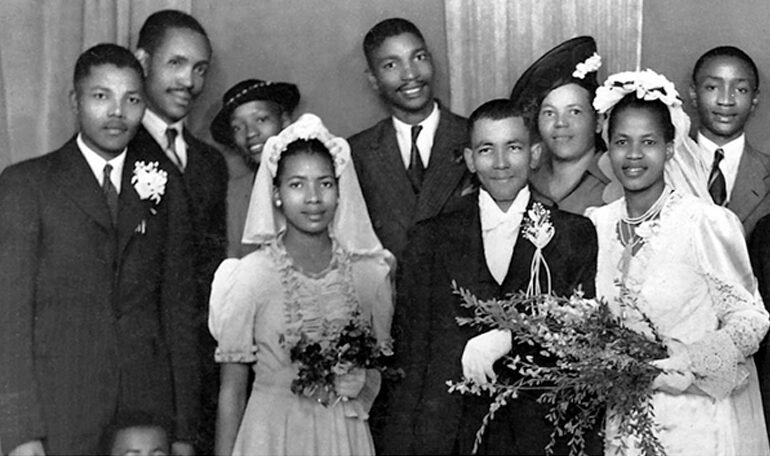
Walter and Albertina Sisulu on their wedding day, 1944.
There is a line in Nelson Mandela’s autobiography that does not receive the attention it deserves. Writing about the first time he met Walter Sisulu, Mandela describes him as the first truly political man he had ever encountered. Not the most educated. Not the most eloquent. Not the most famous. The first truly political man. In a movement that has produced more than its share of orators and theorists and liberators, more than its share of politicians, the highest compliment Mandela could find was not one of those categories. It was this one: political. A man who understood the movement of forces, the architecture of change, and the precise relationship between organisation and outcome, between strategy and tactics.
Tomorrow is Walter Sisulu’s 114th birthday. He was born on 18 May 1912 in Ngcobo, in the Transkei, in a country that did not yet use the word “apartheid” but had long since settled the question of who belonged to it and who did not. He died on 5 May 2003: thirteen days before what would have been his 91st birthday. His state funeral was held on 17 May 2003, the day before that birthday. He was mourned by the country he had helped to free, buried the day before he would have turned ninety-one, and gone six years before his son Max was elected Speaker of the National Assembly. Between those two dates lies one of the most consequential lives in the history of Southern Africa, and one of the least examined.
Perhaps, the latter point was highlighted by President Mbeki, at the Official State Funeral of the late Isithwalandwe / Seaparankoe, when he said:
“While he lived, there were many in our country who knew nothing about him, except perhaps what they had been told or not told by those who had been his jailers. While he lived, there were many who did not understand the unwavering humanism of the cause to which he dedicated his whole life, who were blind to what he did to ensure that his movement and his people remained forever loyal to their humanist calling. When these came to know that there had been such a gentle giant in their midst, hidden from them as though he did not exist, they asked themselves the question — why did we not know?! But there were many others who knew of the place he occupied among the great galaxy of leaders of our people who had given their all, to ensure that all our people and all of Africa was liberated from oppression, from poverty and underdevelopment and the intolerable pain of contempt and humiliation. These knew that Walter Sisulu belonged among those through the generations, who are the best representatives of the unheralded nobility of the masses of our people, the representatives who decided that their lives were worth nothing, unless they dedicated those lives to the service of all our people.”
— President Thabo Mbeki, Official State Funeral of Walter Sisulu, 17 May 2003
The examination matters now more than it might have twenty years ago. The ANC he served is in a condition he would recognise, not because he predicted it, but because he spent his entire adult life trying to prevent it. The organisation has drifted from the discipline that made it capable of governing, as well as from the cohesion that made it an invincible force capable of commanding millions upon millions, beyond this country’s shores into united action in pursuit of decolonisation and a New and Better World. Its political and moral hegemony has waned, albeit not fatally, as it can still, with hard work, be restored.
The names of the founders are invoked regularly, often with little impact or regard as to the essence of their lesson on the present generations. The methods of the founders are studied almost not at all. Walter Sisulu was, above everything else, a calm and impeccable methodologist. Understanding what he built, and how, is not an act of nostalgia. It is an act of institutional survival.
The Man Who Arrived from Ngcobo
Walter Max Ulyate Sisulu arrived in Johannesburg in 1928. He was sixteen years old and had already experienced more disruption than most people of his generation. His mother was Xhosa, his father was a white magistrate’s clerk who played no part in his upbringing. The social position this combination assigned him was an education in itself. He came to the city to work. He worked in a dairy. He worked in a factory. He worked in a bakery. He was dismissed from several of these jobs because he refused to accept the terms of his treatment without comment.
By 1940 he had established a small estate agency on Market Street in Johannesburg. It was not a large enterprise and it did not make him wealthy. What it made him was available. His office became a meeting point, a referral service, an informal community institution. People came to him not primarily because of the estate agency but because he had developed a reputation as a man who knew how to solve problems without panic and who treated every person who walked through the door as a full human being. That reputation, in the Johannesburg of 1940, was rarer than it should have been.
It was through this network that he met Nelson Mandela. Mandela was young, ambitious, studying law, and had recently arrived in the city from the Transkei himself. Sisulu arranged the articles of clerkship that would give Mandela access to legal training at the firm of Witkin, Sidelsky and Eidelman. He also arranged something more important: an introduction to the African National Congress.
Sisulu was also one of the founders of the ANC Youth League in 1944. Like his office, his house, with Mama Albertina Sisulu, was also the meeting point for those young ANC agitators itching for change both in South Africa as well as in the ANC’s politics and organisation. Much of the ideas that eventually came to underpin the ANCYL were conceived at the Sisulus’. He was the glue that held everything and everyone together, the one who would be calm amidst storms, amidst hotheads.
On the occasion of his passing, Mandela would have this to say about him:
“I was drawn inexorably into his circle of friends. We would gather at his Orlando home. His mother was always able to feed us, hordes of us. We nourished ourselves on our conversation — a pot of boiling ideas about freeing our people from bondage, about placing Africa on a pedestal. There was Anton Lembede, who held Master of Arts and Bachelor of Laws degrees; a fiery personality espousing militant African nationalism. There was Peter ‘AP’ Mda with a keen analytical mind. Where Lembede was prone to heady, almost mystical flights of ideas, AP was sparing and judicious with words, a model of simplicity and clarity. There were Oliver Tambo with his sharp mathematical mind, Dr Lionel Majombozi, Victor Mbobo, William Nkomo a medical student, Jordan Ngubane a journalist, David Bopape and so many others. Out of that ferment of ideas and personalities was born the idea of the ANC Youth League (ANCYL). Whenever I cast my mind back I am struck by Xhamela’s qualities. He had little formal education — he left school after standard four. But he was deep in that circle. His home was the centre of our being together. He held his own; he interacted with ease and without a trace of inferiority. He was attracted to each of us, yet he was the magnet that drew us all together. That was his hallmark: an ability to attract and work together with highly competent and talented young men, a ready sounding board for ideas. He was a powerful influence who exuded respect for their talents and a born diplomat. He was courageous and his quiet self-confidence and clarity of vision marked him out as a leader among us. When we established the ANCYL in 1944 we elected Walter treasurer. When in 1949 we radicalised the ANC with the adoption of the militant Programme of Action, we elected Walter the Secretary General of the ANC.”
— Nelson Mandela, on Walter Sisulu
This is the pattern that defines Sisulu before 1949. He is not yet Secretary-General. He is not yet famous. He is the man who connects people to the thing they are looking for, who sees the potential in others before they fully see it themselves, and who understands that an organisation is built not in conference halls but in the accumulation of individual acts of trust.
The Architecture of the Programme of Action
By 1949, the African National Congress was thirty-seven years old. It had been founded in Bloemfontein on 8 January 1912, and for most of those decades it had operated on a theory of change that can be described with reasonable accuracy as petitionary. The organisation believed, or at least proceeded as though it believed, that the case for African rights could be made to those in power, that the evidence was compelling enough to shift opinion, and that delegations and letters and formal representations were the appropriate instruments of this argument.
Before we are too harsh on strategies and tactics the founding fathers chose as a means of engagement with the powers-that-be of their time, we would be wise to become contextual: The ANC was formed after generations of intermittent armed conflict, culminating in subjugation by the Boers and British. Given that the Boers had failed militarily against the British a decade earlier, and Bambatha’s 1906 uprising had also ended in defeat, armed struggle was not viable at that time by 1912. Dr John Dube and his comrades faced a key challenge: how to engage the Boers and British after the Union of South Africa consolidated white rule and excluded Africans from public affairs. The ANC had become the political representatives and voice of the self-same “native question” with which the white ruling bloc was preoccupied in South Africa for centuries.
The ANC saw the Union as a lost opportunity for black and white coexistence on equal terms. The Boers and British viewed it differently — as a chance to cement control over a rapidly industrialising economy (fuelled by gold and diamond discoveries) and to reduce Africans to cheap, super-exploited labour without political or basic human rights. This was the underpinning of the “native question”, not just exclusion of the black majority from the economy as beneficiaries, but their use as cheap labour in a system of protracted primitive accumulation.
Given the Union’s infancy in 1912, it is understandable that the ANC chose petitioning over protest, prioritising a place within the political order over a confrontational fight for freedom. Back at that time, petitioning was not seen as polite or ineffectual. White rulers found it distasteful for Africans to question their legislative or administrative authority, especially by approaching the Governor or British parliament. Thus, the ANC’s methods were considered lawful, effective alternatives to war, grounded in a belief that reason and rationality would yield results in civilised nations.
However, time proved that rationality was foreign to South Africa’s Boer and British rulers. In 1912, the ANC aimed to play an active role in Union institutional politics, requiring leadership of wisdom and discipline to engage white rulers as equals. At its inaugural conference in Mangaung, it had to choose from among highly gifted leaders: teachers, lawyers, clergy, and princelings of scattered African royalty. Only time, and concrete material conditions, would occasion a dramatic change in the then existing strategies and tactics towards the defiance campaign, and, ultimately, the armed struggle.
Younger generations, often with the benefits of hindsight and arrogance of youth, are always quick to stand in judgement over the thinking, and strategies and tactics of previous generations without understanding the conditions they faced in their time, or answering, what would they have done differently and better at that time, faced with the same conditions as those faced by those older generations. Unfortunately, this is not how historical questions are resolved.
The 1948 whites-only election had delivered the National Party to government on an explicit platform of segregation intensified into a system. It was no longer possible, even for the most optimistic constitutionalists within the ANC, to maintain that the petition approach had prospects. Not only was the National Party of 1948 more openly racist and segregationist, it also believed in more harsh measures to subjugate the majority and hence its violence was not an accident.
After years of leading the ANCYL, first as its National Treasurer at its founding, Sisulu was subsequently elected Secretary-General of the ANC in 1949. The Programme of Action adopted that same year was the organisational break from the petition era. It committed the ANC to strikes, to civil disobedience, to non-collaboration with unjust structures. The intellectual case for this shift had been argued by the Youth League, which Sisulu had helped to found on 1 April 1944 alongside Mandela, Oliver Tambo, and Anton Lembede, and others.
But the Programme of Action was not merely an argument. It was a plan. Plans require administrators, conveners, record-keepers, people who understand that the distance between a resolution and its execution is where most liberation movements fail.
Having spearheaded this Programme of Action for the ANC, the ANCYL thus volunteered Sisulu to become the chief spearhead for this POA as Secretary General. It understood that the ANC leadership would need time to acclimatise to changing strategies and tactics after decades of a different and more passive approach. It would need someone who had been involved in conceptualising the new strategies and tactics, and who would understand what needs to be done to model ANC structures across the country along this POA if it had to be successfully implemented, not to become a damp squib.
Sisulu understood his mission and mandate. The distinction he drew, implicitly and consistently, was between the leader and the builder. The leader speaks. The leader inspires. The leader frames the terms of the struggle for those who need to understand why they are being asked to sacrifice something. The builder makes it possible for the sacrifice to be organised, sustained, and effective. The leader without the builder produces rhetoric. The builder without the leader produces bureaucracy. Sisulu was, in this taxonomy, a builder who understood leaders, and whose greatest act of building was to bring the two functions into productive relationship with each other.
So effective was he at this new role that by the time the Congress of the People was convened in 1955 in Kliptown, Soweto, the regime had already banished him to house arrest. He watched the Kliptown proceedings from a hideout nearby, unable to attend or even appear in public. That was when Oliver Tambo, yet another eminent member of the famous trio (Mandela, Sisulu and Tambo) was appointed the ANC’s Acting Secretary General.
Liliesleaf, Rivonia, and the Sentence
In 1960 the ANC was banned. The Sharpeville massacre had produced the government’s response: the organisation through which forty-eight years of legal opposition had been conducted was now illegal. Sisulu went underground. He was part of the small group that established Umkhonto we Sizwe, the armed wing, in 1961. He operated clandestinely for two years, continuing to organise, continuing to communicate, continuing to build the structures that made the movement function beneath the surface of a society that had declared it nonexistent.
On 11 July 1963, the South African police raided a farm called Liliesleaf in Rivonia, north of Johannesburg. Walter Sisulu was among those arrested. They had been sold out by some who were close to the action. The documents found at the farm provided the prosecution with most of what it needed. The trial that followed would become one of the defining legal proceedings of the twentieth century.
On 12 June 1964, Sisulu and the other Rivonia Trialists, including Mandela who was already serving a five-year prison sentence for leaving the country without permission and receiving military training abroad, were sentenced to life imprisonment. He was fifty-two years old.
He would be seventy-seven years old when he walked out of Pollsmoor Prison in October 1989, months before Mandela’s release and four years before the country would hold its first democratic election.
Twenty-five years in prison: eighteen of them on Robben Island, the remainder at Pollsmoor after his transfer in April 1982. A quarter century in which the world changed, the struggle continued, and the ANC survived partly because of what Sisulu had built before the gates closed behind him. He did not waste the time. Those who shared the island with him have described, consistently, a man who treated incarceration as a continuation of the work by other means. He taught. He organised. He counselled. He maintained discipline not through authority but through example. He was, on Robben Island, what he had been on Market Street: the man who made the institution function.
What Albertina Built in the Silence
Walter Sisulu met Nontsikelelo Albertina Thethiwe in 1941. She was working as a nurse at Johannesburg General Hospital. He was already active in the ANC. She came into contact with the movement through him, attending meetings, meeting the people who would shape the next decade of South African politics.
They married in 1944. She joined the ANC Women’s League that July. She and Dorah Tamana were involved in the formation of the ANC Youth League.
It would be a misreading of the record to describe Mama Albertina Sisulu’s political life as an extension of her husband’s. She was an institution and a force in her own right.
For twenty-five years while Walter was in prison, she was the one who remained. She was banned, repeatedly. She was detained. She was subjected to house arrest. She was restricted in her movements, her associations, her ability to work. The apartheid state understood, correctly, that she was dangerous, and it attempted through administrative suffocation to reduce her capacity to organise.
It did not succeed.
In 1983, Albertina Sisulu became one of the founding co-presidents of the United Democratic Front: the largest internal coalition of anti-apartheid organisations the country had produced. The UDF was not a symbolic structure. It was a functioning federation of more than six hundred civic organisations, trade unions, student bodies, and community groups. To help establish and lead that structure required precisely the skills her husband had also ably demonstrated across the previous two decades: the ability to build trust across difference, to hold competing interests together around a common purpose, and to do the administrative work that makes collective action possible.
She earned the designation “Mother of the Nation” not through proximity to famous men but through twenty-five years of sustained organising in conditions her husband was not present to share. An icon and a legend of her own, it was no surprise that history will record that she is the one who nominated the first democratically-elected President of the democratic South Africa in 1994 after the first non-racial, non-sexist, general elections.
After years as the UDF’s Co-President, she was part of the first meetings between the unbanned ANC and the apartheid regime to negotiate South Africa’s non-racial, non-sexist and democratic future. She was elected into the ANC NEC, and subsequently into the first non-racial, democratic Parliament of the Republic of South Africa.
The Democratic Inheritance
When South Africa became a democracy in 1994, the Sisulu family’s contribution to that outcome became, in the institutions of the new state, remarkably concrete.
Max Sisulu, Walter and Albertina’s son, served as a member of Parliament and, from 2009 to 2014, as Speaker of the National Assembly. He was the first black person to hold that office, the only man elected as Speaker in the democratic era, in a parliamentary tradition where women have otherwise held the Speakership, and where Lechesa Tsenoli served with distinction as Deputy Speaker from 2014.
Lindiwe Sisulu, their daughter, served in Cabinet across more government portfolios than it is straightforward to list: Intelligence, Housing, Defence, Public Service and Administration, Human Settlements, International Relations and Cooperation, and Tourism. Her ministerial record spans the administrations of four presidents and reflects a range of policy areas that few individuals in the democratic era have navigated.
Zwelakhe Sisulu, their son, served as Chief Executive Officer of the South African Broadcasting Corporation during a period of significant institutional pressure and transition.
Sheila Violet Makate Sisulu, a civil rights activist and former diplomat. She served as South Africa’s Ambassador to the United States of America and since 2003, she has been working for the United Nations World Food Programme.
The family’s record in the structures of the democratic state is, in the democratic era and within a single nuclear family, without clear parallel in South African public life. This is not a claim made for the purposes of decoration. It is a structural observation about the inheritance of political culture, the discipline the Sisulu elders had inculcated among their offsprings. The Sisulus produced multiple generations of public servants not because public service was imposed on them but because they had lived, from childhood, inside a family whose central activity was the construction and maintenance of institutions in the public interest.
That inheritance did not arrive accidentally. It was the product of two people who treated the work of building an organisation as a vocation rather than a career, and who modelled, across decades of sacrifice, what it meant to choose the long project over the immediate return.
What the ANC Cannot Afford to Forget
The ANC today is not the ANC of 1949 or 1964 or even 1994. Organisations change. The conditions that shaped the liberation movement no longer obtain, and it would be both ahistorical and unfair to demand that it remain what it was. Change is not the problem.
The problem is a specific kind of forgetting. The ANC has not forgotten Walter Sisulu’s name. His name appears on streets and institutions and memorial statements with appropriate regularity. What appears to have been forgotten, or at least substantially mislaid, is the distinction he embodied: between the leader and the builder, between the capacity to articulate a position and the capacity to construct the institutional conditions under which that position becomes achievable.
The evidence of what has been lost is not contested. At its peak in 2004, the ANC received almost seventy percent of the national vote. In May 2024, it received forty percent: below a parliamentary simple majority for the first time since 1994. The organisation’s own 55th National Conference, held in Nasrec in December 2022, passed a resolution on organisational renewal that acknowledged what every National Conference since 1997 had already recorded: a deterioration in the political quality of membership, and — in the conference’s own language: a gap between the formulation of policy and its execution. A concern raised at every conference over twenty-five years and not yet resolved is not a diagnosis arriving at a moment of clarity. It is a description of an institution that has continued to produce resolutions without recovering the capacity to implement them.
This is precisely the function Sisulu performed. He was the person who ensured that the gap between resolution and execution did not swallow the organisation. He did not do this through charisma. He did not do this through eloquence. He did it by understanding that an organisation is only as strong as its least visible work: the branch meeting that happens when no one is watching, the membership cultivated before it is needed, the trust built across difference before a crisis tests it. The strength of an organisation is not measured by the quality of its speeches at conference. It is measured by what the branches do in the week after conference ends.
No speech about Walter Sisulu recovers this. No street named after him recovers this. The only thing that recovers it is the deliberate study and application of what he actually did, and the institutional decision to treat the builder’s function as seriously as the leader’s.
Tomorrow
Tomorrow is his 114th birthday. He was born in a country that assigned him, from the moment of his birth, to the category of person whose interests did not count. He spent his life, methodically and without self-dramatisation, working to change the terms of that assignment. He did not live to see the work finished, because the work is not finished. But he lived to see the country hold its first democratic election, to vote in it, and to watch his son take a seat in the Parliament that election produced.
Walter Sisulu did not write the most famous speeches of the liberation struggle. He was not the most quoted figure of his generation, yet that does not efface his immense intellectualism and intellectual contribution to the struggle and movement. He was not celebrated during his lifetime with the frequency that his contribution warranted. He was the person who made it possible for the celebrated figures to operate, by building the organisation that sustained them, by connecting the people who needed to find each other, and by treating the hard administrative work of liberation as a calling rather than a burden.
Xhamela did not occupy any formal position in the democratic South Africa for which he had so vociferously fought. Yet, he was so immersed in it that no serious decision would be taken without consulting him and seeking his opinion about it.
I can attest to this personally.
I remember many times when we were in the ANCYL that we would consult him about many of our programmes and even ideas — when Madiba refused to allow the ANC to fund our National Congress in 1995, and decided that he would not attend it and instructed other ANC leaders also not to. We went to beg Xhamela to speak to Madiba on our behalf, to which he obliged and thus the National Congress was subsequently held in April 1996.
When we decided to undertake the re-interment ceremony for our ANCYL founding President, Anton Lembede in 2002, we consulted Xhamela, Madiba and the ANC leadership to receive their blessings. Both Madiba and Xhamela gave us their blessings and long, invaluable, lectures on Lembede which underlined the deep respect they had continued to hold for their late leader. Reasons of ill-health denied Xhamela the opportunity to attend the ceremony in Mbumbulu in September 2002, but Madiba and Mbeki delayed their flights to the UN General Assembly in order to attend this historic ceremony.
Xhamela would often arrive unannounced at the ANCYL Head Office to check on us and chat to us about political issues, long after his retirement. What an honour this was; we would gather at the office of the ANCYL President to report to him about our programme and just listen to his wisdom. We often felt watched over by a living guardian angel.
The question the ANC faces on the anniversary of his birth is the same question it has faced for a generation: whether it can recover not the memory of the builder, which it has kept, but the practice of the builder, which it has not.
The answer to that question will shape South African public life far more decisively than any speech delivered in his name.
Perhaps, Mbeki was correct to say at his funeral, that:
“One that was as mighty as the baobab has fallen. But because he planted mighty seeds, he has risen again, and will rise again in the tomorrows and the new births that the African sun will bring. That sun will supply, as well, the living energy that will bring to their noble maturity, the little and tender and delicate plants that Walter Sisulu nurtured with such devotion and care, and love.”
— President Thabo Mbeki, State Funeral of Walter Sisulu
Xhamela did not die; he multiplied, he lives, he rises and will rise again, and again, in the tomorrows and the new births that the African sun will bring, supplying the living energy that will bring to their noble maturity, the little and tender and delicate plants that Walter Sisulu nurtured with devotion, care, and love!
“The future is not an accident.”
Dr Malusi Gigaba is a Scholar-Statesman, an ANC NEC Member, a former Cabinet Minister of the Republic of South Africa, a Member of Parliament, and a member of both the Joint Standing Committee on Defence and the Portfolio Committee on Trade, Industry and Competition.