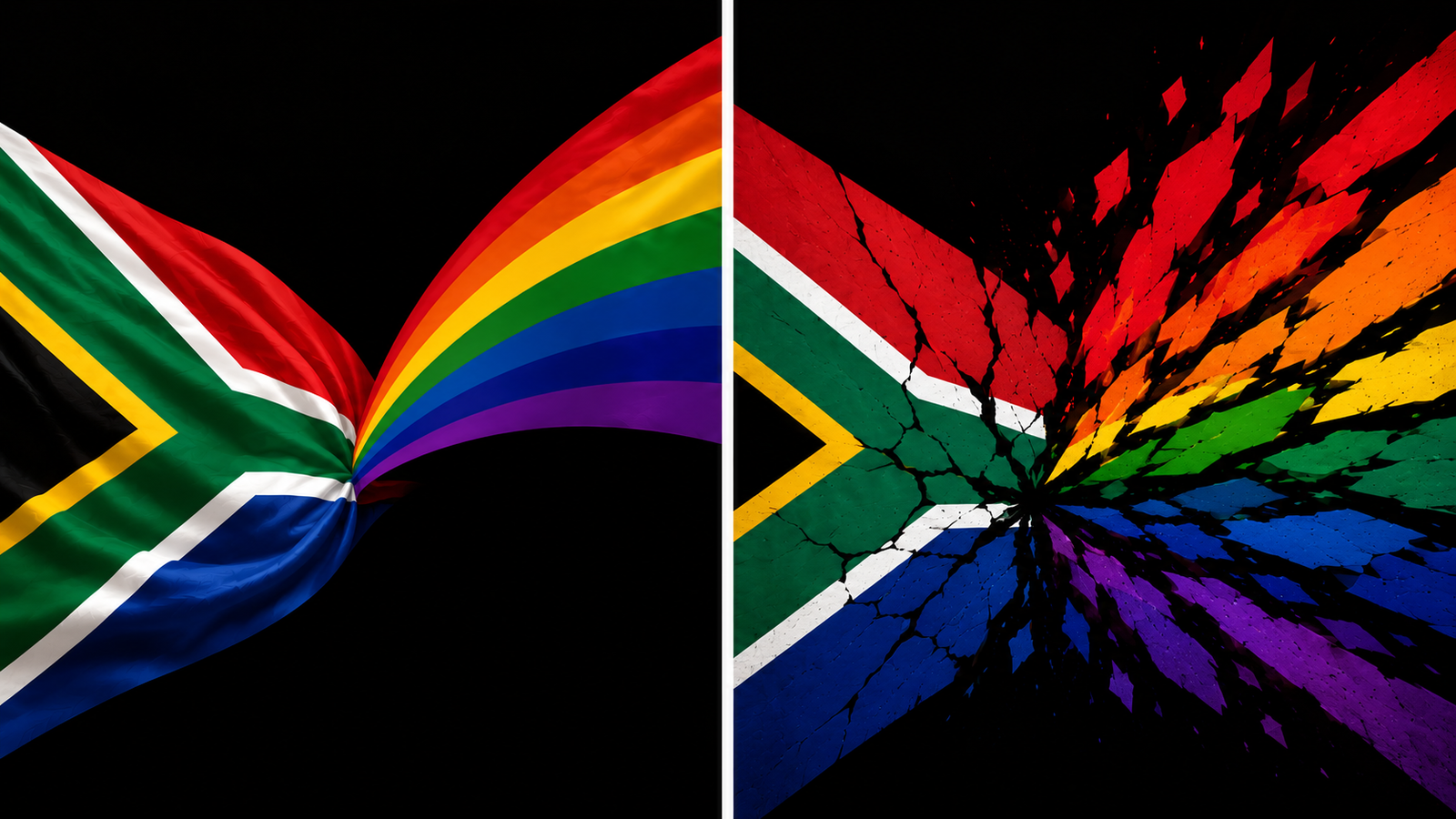
Heritage Day 2026.
I ended the Verwoerd piece, four days ago, with a promise. Whether the country we have built since 1994 still believes its own constitutional answer is the question Heritage Day puts to us this year, I wrote. It is the one I will take up on its eve. Today is that day.
The question is not new. Hendrik Verwoerd answered it with more certainty, justifiably, than anyone before or since. A people, he believed, could keep itself whole only by keeping itself apart. He wrote that answer into the Population Registration Act, No. 30 of 1950, which classified every person in the country by race. He wrote it into the Group Areas Act, No. 41 of 1950, which assigned where each race could live. He wrote it into the Bantu Education Act, No. 47 of 1953, which placed African schooling under his direct control and starved it of resources. He wrote it into the Extension of University Education Act, No. 45 of 1959, which sorted students into universities by ethnic group. And he wrote it into the Promotion of Bantu Self-Government Act, No. 46 of 1959, which abolished Black representation in Parliament and partitioned the country into ethnic homelands. Every one of those laws has been repealed.
The Constitution that replaced them answers the question the other way: we are one people, we hold our rights in common, and no institution of the state may divide us by race or ethnic origin. The 1996 Constitution addressed this in its Preamble:
"We, the people of South Africa, recognise the injustices of our past; honour those who suffered for justice and freedom in our land; respect those who have worked to build and develop our country; and believe that South Africa belongs to all who live in it, united in our diversity. We therefore, through our freely elected representatives, adopt this Constitution as the supreme law of the Republic so as to — heal the divisions of the past and establish a society based on democratic values, social justice and fundamental human rights; lay the foundations for a democratic and open society in which government is based on the will of the people and every citizen is equally protected by law; improve the quality of life of all citizens and free the potential of each person; and build a united and democratic South Africa able to take its rightful place as a sovereign state in the family of nations."
That answer — written into the final Constitution in 1996 — is thirty years old this year. It has never been uncontested, and it has never been more loudly contested than it is now.
What I want to do in this piece is not to revisit the architect. I did that on Sunday. What I want to do is to look at three things that surfaced this past winter, within weeks of one another, and to ask what each of them says about whether we still believe the answer we wrote into our own founding law.
Towards a real union
South Africa's liberation in 1994 meant that it ceased to be what Verwoerd called "a piece of Europe on the tip of the African continent." The general election of that year was an act of repudiation — not merely of apartheid's final form, but of the settlement of 1910, to which Verwoerd was both beholden and a beneficiary. A new South Africa was founded on the principle that all South Africans, Black and white, belonged equally to the country they shared, and that Africans and Black people in general would no longer be condemned by law and the force of arms to serve as the dispossessed labour force of an economy built to exclude them.
From the white minority state established in 1910, it was Africans who bore the heaviest burden. Uncle Walter Sisulu made this point with characteristic clarity: the central feature of South Africa's struggle for freedom was that it was fundamentally African, because African oppression was the pivot on which the entire system of white supremacy turned. Liberating Africans was therefore the precondition for liberating all oppressed groups — including, ultimately, white South Africans themselves, trapped by white supremacy that had hung heavily around their necks for centuries since the advent of the colonisation process.
The new South Africa established in 1994 was thus premised on the values of the Freedom Charter: that "South Africa belongs to all who live in it, black and white, and that no government can justly claim authority unless it is based on the will of all the people"; that "our country will never be prosperous or free until all our people live in brotherhood, enjoying equal rights and opportunities"; and that "only a democratic state, based on the will of all the people, can secure to all their birthright without distinction of colour, race, sex or belief."
1994 was an act of redemption. The Union of 1910 created a single country but not a united nation; it was part of Africa but only an imperialist outpost. Overcoming that legacy created the conditions to forge true unity based on inclusivity. The new nation was to favour the poor and vulnerable of all races, while maintaining the liberation of black people, especially Africans, as its core. New dynamics meant that poor white South Africans, too, required support; to ignore them would contradict the Charter's own logic. The premise was universal: a society that liberates its most oppressed members liberates everyone.
To undo the legacy of 1910, the new South Africa would need to forge a united democratic nation based on unity in diversity and genuine equality; to deepen national unity across every domain — political, social, economic, cultural; to create the conditions for working people to participate as equals; to pursue corrective and affirmative action for the African majority; and to confront the unresolved questions of land dispossession and mineral wealth.
That was the project. These are its tests.
Three developments, one question
The questions Verwoerd's design put to this country have not gone quiet. This past winter three of them surfaced within a few weeks of one another, from different directions, in different registers, and with different intentions. I set them out in the order they arose.
East of the capital: Kleinfontein
East of Pretoria lies Kleinfontein, a settlement established as a home for one cultural community, which has argued in court for recognition of what it calls its right to self-determination. In 2024 the High Court in Pretoria found that the use of the land on which it stands was "wrongful, if not illegal", and ordered the City of Tshwane to enforce the planning and building laws.
On 4 August this year the same court made an order, by agreement between the settlement and the City, under which the City's punitive rates were "reviewed and set aside" and Kleinfontein was to apply to be formally established as a township, with no new building in the meantime. Its supporters called it a victory. Nine days later, the City's deputy mayor said that the settlement had not been authorised by the council and must be set aside. By the end of August, Kleinfontein had lodged its township application — under the name "Kleinfontein Extension 1" — paid the rates the order required, and settled its municipal debts, and the City's counsel had told the judge that he was instructed to apply to have the order set aside. As of this writing, the consent order has not been reported set aside.
I do not propose to adjudicate the legal merits. But the underlying question is not a legal one. It is whether a community can constitute itself on the principle that it will remain culturally separate, and whether the rest of the country is obliged to recognise that separation as a right.
On the eastern outskirts of Pretoria: Akademia
On the eastern outskirts of the same city, a R3.2 billion campus is rising for Akademia, which describes itself as a Christian, classical and independent institution of higher education "vanuit en vir Afrikaanse taal- en kultuurgemeenskappe", from and for Afrikaans language and cultural communities. Construction began in January this year. Its structures are already rising several floors. Occupancy is expected by the end of August 2027, with classes beginning in January 2028. The first phase covers 55,000 square metres and 750 student beds. The formulation is worth pausing on. "Vanuit en vir" — from and for — describes a closed loop: the institution draws from this community and exists for this community. In the South African lexicon, that loop has a name. It is the logic of eie sake, "own affairs", the principle that each community manages its own cultural and educational life, which was the organising architecture of the 1983 tricameral constitution. The Republic of South Africa Constitution Act, No. 110 of 1983, divided Parliament into three chambers — white, Coloured, Indian — and assigned education, welfare and culture to each chamber as "own affairs", while "general affairs" (defence, finance, foreign policy) remained under a white-controlled executive. The architecture was not a concession to diversity. It was a mechanism for maintaining white control while distributing the appearance of self-governance. "Eie sake" was the name the state gave to its refusal to share power over the things that form a people: schools, universities, cultural institutions, the means by which a community reproduces itself across generations.
That is the lineage "vanuit en vir" inherits. It may not intend it. But the structure is the same: an institution that draws from one community and exists for one community, that closes the loop between who teaches and who is taught, who funds and who benefits, who belongs and who does not.
And the word "kultuurgemeenskappe" — cultural communities — does further work that deserves to be named. Afrikaans is spoken as a first language by approximately seven million South Africans. The majority of them are Coloured. The language was born in the Cape, shaped as much by Malay and Khoi influence as by Dutch, and carried through generations of communities that were never white and never welcomed into the Afrikaner cultural project. When Akademia says it exists "vir Afrikaanse kultuurgemeenskappe", the question a scholar must ask is: which ones? If the answer, in practice, is the same communities that were served by the volkseie institutions of the old dispensation — the Broederbond's universities, the FAK's cultural apparatus, the Solidarity movement's network — then "kultuurgemeenskappe" is doing the work that "race" did before the Constitution forbade it. It is a proxy. Not necessarily a conscious one. But a proxy does not need to be conscious to be effective.
The project is funded, its developers say, by voluntary contributions from members of the Solidarity movement, donors and community supporters.
On 10 August, Dr Naledi Pandor, a former Minister of Education, told Dr Mbuyiseni Ndlozi's African Renaissance podcast that the building of "a university that intends to be Afrikaans medium" had drawn public comment from only one person, Professor Jonathan Jansen.
"The rest of us were quiet. We're too complacent with our freedom."
Flip Buys of the Solidarity Movement dismissed her remarks as "paniek-politiek", panic politics.
The Constitution itself settles one part of the argument. Section 29(2) guarantees everyone the right to receive education in the official language of their choice, where reasonably practicable. Section 29(3) guarantees everyone the right "to establish and maintain, at their own expense, independent educational institutions" that do not discriminate on the basis of race. Akademia is, on the face of it, an exercise of that right.
But Dr Pandor was not making a legal argument. She was making a political one. Why, she asked, is only one voice heard when a major institution is being built, at great expense, for one language community? Why is the rest of the country quiet? That is not a question about the right to build. It is a question about whether the rest of us are paying attention to what is being built, and what it means for the country we say we are making together.
I think she is right to ask. The right is not in dispute. The silence is.
The proposal that arrived and departed
And within weeks the same question arrived from the opposite direction. In August, Jacinta Ngobese-Zuma, the founder of the March and March movement, called during a demonstration in Durban for universities along ethnic and linguistic lines: for Zulu, Xhosa, Pedi, Tswana and Tsonga speakers. "Why can't we have our own stuff that we do for ourselves?" she asked.
Zwelinzima Vavi, the general secretary of Saftu, replied that what she was expressing was "a dangerous desire to Balkanise South Africa along ethnic and linguistic lines, to turn our diversity into separate political and territorial enclaves." He went further: "Colonialism and apartheid tried precisely this through segregation, Bantustans and the deliberate manipulation of ethnic identities to divide and rule."
Within days, Ngobese-Zuma walked the proposal back. "I don't think I put it the way I intended to," she said. She claimed her actual intent was to show that multilingual universities could exist alongside Afrikaans ones.
The proposal rose and fell in a matter of days. But the speed of its collapse is itself instructive. The country still has the antibodies. The vocabulary of ethnic separation, when it is spoken plainly and from the other direction, is still recognised for what it is.
The fact remains, however, that the proposals advanced by March and March negate the ideals of a united South Africa and a united Africa. They serve, whether intended or not, as a useful instrument for the advocates of apartheid nostalgia and neocolonialism, as well as for those who seek the secession of the Western Cape from the Republic. Taken to their logical conclusion, the arguments envisage a South Africa diffused in divergent directions, in which each group turns inward to "fix itself", devoid of the human solidarity that would benefit all.
Not the same thing
I will not pretend these are the same thing. A community that has chosen to live apart, a private institution that a community is building at its own expense in its own language, and a proposal withdrawn almost as soon as it was made are different in kind. They differ in intention, in legal standing, and in the seriousness with which they were advanced.
But each of them puts to us, in the month of Verwoerd's birth and death, the question his design was built to answer: can a people keep itself whole only by keeping itself apart? And each of them, in a different way, tests whether we still believe the answer our Constitution gives.
The principle I hold to is this. Language in the classroom is liberation. Mother-tongue instruction, multilingual education, the right to learn and to teach in the language that carries your thought most honestly: these are constitutional rights, and they are hard-won ones. I have written about them before and I will write about them again.
But sorting people into institutions by ethnic origin is not liberation. It is the architecture Verwoerd drew, building on the dismal failures of the Union of South Africa of 1910. Any proposal, in any decade and from any direction, that begins to sort people into institutions by ethnic origin deserves to be measured against the design it echoes, not against the intention it claims.
What Heritage Day asks
President Nelson Mandela made this point with force during a speech at the unveiling of the monument to Enoch Sontonga on Heritage Day, 24 September 1996, when he said: "When our first democratically-elected government decided to make Heritage Day one of our national days, we did so because we knew that our rich and varied cultural heritage has a profound power to help build our new nation."
Heritage Day was written into the calendar to do something that Verwoerd's South Africa said was impossible: to hold a country's past in common. Not to agree on every reading of that past. Not to pretend that we remember the same things. But to say that the past belongs to all of us, and that we are strong enough to carry it together.
That is a harder claim than it sounds. It means that the Afrikaner's memory of the Anglo-Boer War and the African's memory of the Land Act belong in the same national story. It means that the liberation struggle and the losses of those who fought against it are held, not in equivalence, but in a single national reckoning. It means that no community's heritage is so fragile that it can only survive behind a wall.
I do not believe the rainbow-nation metaphor, in its sentimental form, ever did this work. A rainbow is beautiful and brief and requires nothing of anyone. What the Constitution asks is not a rainbow. It is a covenant: that we will build a society based on democratic values, social justice and fundamental human rights. A covenant is not a feeling. It is a promise that binds, and that demands daily maintenance.
The three developments I have set out above are, in their different ways, tests of whether we are still maintaining that promise. Kleinfontein tests whether self-determination can be exercised as cultural separation without reproducing the logic of apartheid's design. Akademia tests whether we are paying attention when constitutional rights are exercised in ways that may concentrate opportunity along the lines the old system drew. The ethnic-universities proposal tested whether the antibodies of 1994 are still alive. They are. The proposal collapsed.
What Dr Pandor said on that podcast is, I think, the sharpest formulation of what Heritage Day demands of us this year. We are too complacent with our freedom. Complacency is not the same as hostility. It is not the same as betrayal. It is a gentler failure, and for that reason a more dangerous one, because it arrives without announcement and leaves without apology.
The answer we wrote
The answer we wrote into our Constitution is that this country belongs to all who live in it, united in our diversity. That sentence is not a description of how things are. It is a commitment to how they must be made to be. It is work, not weather.
Heritage Day is the day the country set aside to ask whether we are doing that work. Not whether we have finished it. Not whether we agree on every part of it. But whether we are still in the business of building a common life, or whether we have begun, quietly and from several directions at once, to give up on that project and to retreat into the communities we came from.
I do not believe we have given up. The speed with which the ethnic-universities proposal was rejected tells me that the instinct for a common life is still strong. But instinct is not enough. Dr Pandor is right. The comments beneath my own Verwoerd piece on Instagram, published four days ago, say as much: among the most engaged responses were those that called the architect of grand apartheid, Hendrik Frensch Verwoerd, "a visionary" and praised "the good old days." If the country can read a forensic account of the system that classified, separated and dispossessed its people, and respond with nostalgia, then the complacency she warns of is not an abstraction. It is here. If only one person speaks when a major institution is being built for one community, the rest of us are not doing the work the Constitution asks of us. And if we are not doing the work, we are living on the inheritance of 1994 without renewing it.
I hope that one day we arrive at the place President Thabo Mbeki described during his keynote address at the African Renaissance Conference in 1998. He told the audience that he had recently met a delegation of Afrikaner youth leaders to hear their views on the future of the country, and that during the course of that meeting they had made a statement "as pregnant with hope as it was elegant in its rendition." Here is what they said: "Yesterday is a foreign country — tomorrow belongs to us!" They were speaking, Mbeki noted, of how the country's transition to democracy had brought them their own freedom; of how their acceptance of themselves as equal citizens with their Black compatriots defined apartheid South Africa and its legacy as foreign to themselves; of how South Africa, reborn, constituted their own heritage.
Verwoerd's answer was that people are safest apart. He was wrong, and the country proved him wrong, and the proof is the Constitution we wrote. His vision was not only narrow; it was retrogressive. It can only constitute a part of our heritage to the extent that it serves as a stark reminder of where narrow-mindedness can lead — to an abyss.
A proper heritage beckons. It is predicated on the recognition that South Africa, reborn, constitutes our collective, and common, heritage. What unites us should not just be braais, biltong and the Springboks. It must be the hard conversation, the bold decisions we make, and the steps we take towards sharing the wealth of the country. Thus will we create a legacy into which all South Africans shall bind themselves, in the common knowledge that every one of us has a role to play, a contribution to make, and a rightful place in the shared destiny of our nation.
But a constitution is not a wall. It holds only as long as the people who live under it choose to hold it. Heritage Day asks whether we are still choosing.
“The future is not an accident.”
Dr Malusi Gigaba is a Scholar-Statesman, an ANC NEC Member, a former Cabinet Minister of the Republic of South Africa, a Member of Parliament, and a member of both the Joint Standing Committee on Defence and the Portfolio Committee on Trade, Industry and Competition.