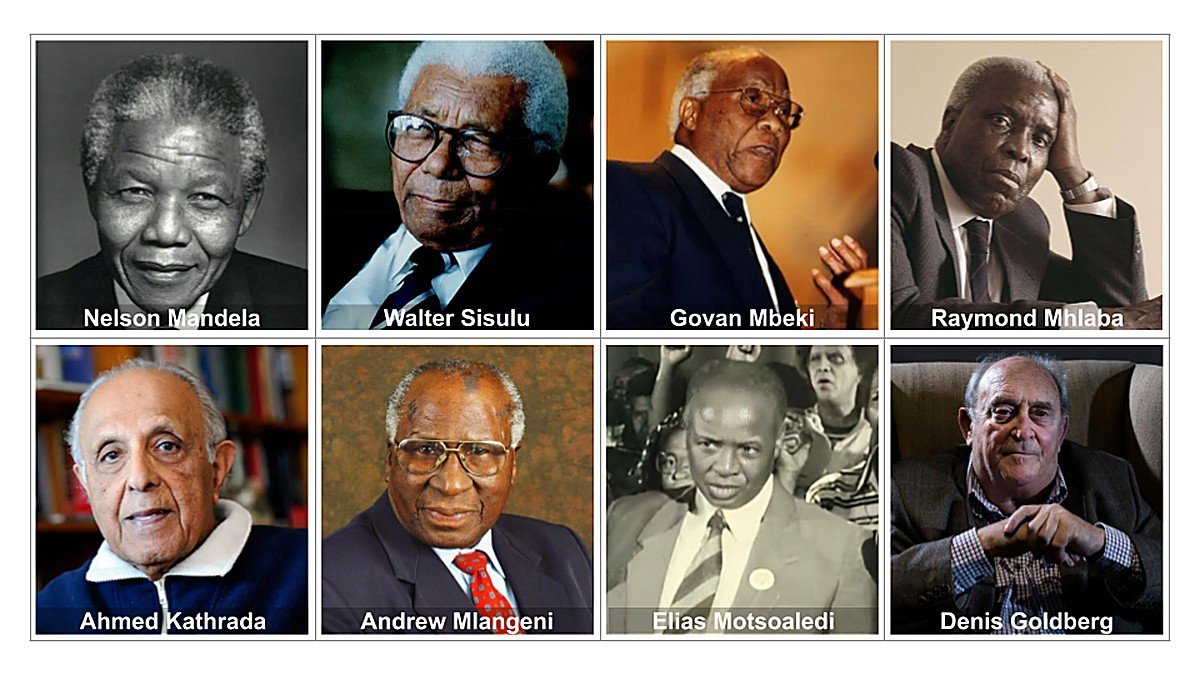
Sixty-two years ago this week, on Friday 12 June 1964, eight men stood in the Palace of Justice in Pretoria and waited to learn whether they would be hanged. They had prepared themselves for the gallows. The question their sentence left behind has never fully closed, and the families who paid for that sentence have every right to ask it plainly. Was the sacrifice worth it?
It is said that when the sentence was passed on the eight men, the silence around the court was such that one could have heard a needle fall and strike the ground. Outside, the crowds rose to the sound of Nkosi Sikelel’ iAfrika. The dread of an anticipated death sentence gave way to relief at the sentence of life. Not that imprisonment for life was a small thing; but it was indubitably better than execution. Their lives had been spared, and their families could in time visit them while they served.
The commitment and the sacrifice
What must not be lost to any of us as we observe this day is that those sentenced in 1964 were fathers and husbands, men of honour whose families now faced a bleak future without them. The sacrifice history had called on them to make was insufferable, yet they would stare it down, committed to paying whatever price freedom demanded. iNkosi Albert Luthuli, in his statement on the sentencing, called them “brave just men” who had turned to other methods only when every lawful avenue had been closed, and who “represent the highest in morality and ethics in the South African political struggle.”
What they were about to surrender was not only the freedom to move, to eat what they wished, to work. They would be separated from their families, would not raise their children or watch them grow, and would be denied even the right to bury their own parents, children and loved ones. This was the reality of the choice they made, and they made it intentionally and conscientiously. Across more than two decades in prison, and twenty-seven years in Mandela’s own case, they would face what no one should ever be made to face.
Three things make me describe that choice as intentional and conscientious. First, they knew that the course they had embarked upon carried a high price if they were caught. The regime had already met the people’s demand for freedom with naked violence, and taking up arms against it would invite a wrath whose full shape could not yet be fathomed at the start of the 1960s.
Second, as they prepared the statement to be read from the dock by Accused Number One, Nelson Mandela, they already knew that death was among the prospects they faced. Mandela’s original draft ended with a direct, personal declaration of his readiness to die for his ideals. According to historical accounts, including Long Walk to Freedom, the original draft ended with the line:
“I have cherished the ideal of a democratic and free society in which all persons live together in harmony and with equal opportunities. It is an ideal which I hope to live for and to achieve. But if needs be, it is an ideal for which I am prepared to die.”
However, upon advice from George Bizos, part of the defence counsel that was led by Bram Fischer, he changed the ending to make it less provocative and more legally strategic. The version actually delivered in court on 20 April 1964 replaced the above with a more subdued phrasing:
“It is an ideal which I hope to live for and to achieve. But, my Lord, if it needs be, it is an ideal for which I am prepared to die.”
The key difference was the insertion of “My Lord” and the slight softening from “if needs be” to “if it needs be.” The substance remained, but the directness was tempered. Mandela later noted in his autobiography that he agreed to the change because his lawyers feared the original wording might be seen as a direct challenge to the court, potentially provoking a harsher sentence. Despite the alteration, the speech became one of the most powerful declarations of the anti-apartheid struggle.
This statement stood out as one of the most daring acts of defiance of the regime, by men who knew its power and its intent very well, who knew how shameless it was, yet who knew their own power, their honour, their intentions and the moral superiority of their cause even more. They stared at death and said, “do your worst”!
Nelson Mandela’s “I am prepared to die” statement from the dock, Rivonia Trial.
Third, in consultation among all the accused and their counsel, they agreed that should the sentence be death, there would be no appeal. This was an act of courage born of a conscious decision to let their lives and their sacrifice, if it came to that, inspire the masses to fight on. These men knew their power, knew the symbol they had become, and understood that the freedom of the oppressed might have to be bought with the lives of those who led them.
The question the families have every right to ask
The Rivonia Trial ran from October 1963 to June 1964. The charge was sabotage, brought under the General Law Amendment Act of 1962, an offence the State could push toward a capital sentence. On 11 June 1964 the court convicted Nelson Mandela, Walter Sisulu, Govan Mbeki, Ahmed Kathrada, Andrew Mlangeni, Elias Motsoaledi, Raymond Mhlaba and Dennis Goldberg. The next day Justice Quartus de Wet passed sentence. He described the principal crime as “in essence one of high treason,” and then he said this:
“Bearing this in mind, and giving the matter very serious consideration I have decided not to impose the supreme penalty, which in a case like this would usually be the penalty for such a crime. But consistent with my duty, that is the only leniency which I can show. The sentence in the case of all the accused will be one of life imprisonment.”
— Justice Quartus de Wet, sentencing the Rivonia accused, 12 June 1964
Life, not death. Seven of the men were flown to Robben Island within hours; Goldberg, the only white prisoner among them, was sent to Pretoria Central, because apartheid segregated even its captives. They had walked in expecting the gallows, ready, as the statement from the dock had shown, to pay with their lives. The worth of what followed cannot be measured cheaply. It has to be weighed at three scales: what it cost the eight and those who loved them, what it bought the country, and what it offered the continent.
For the eight, and for those who waited
At the smallest and most painful scale, the price was enormous. Walter Sisulu entered prison at fifty-two and was released at seventy-seven. Govan Mbeki served twenty-three years before his release in 1987. Andrew Mlangeni, Elias Motsoaledi and Raymond Mhlaba each surrendered the better part of their working lives. The sentence did not fall on the men alone, and on no one did it fall harder than on the women left to carry everything else. Winnie Madikizela-Mandela was detained for 491 days from May 1969, held for months in solitary confinement, and later banished to the remote town of Brandfort for eight years. Albertina Sisulu was banned and detained repeatedly while she held a household and a movement together through her husband’s imprisonment. And Epainette Mbeki, known across the country as MaMbeki, ran the family store in the Transkei and raised four children, among them a future president, through the twenty-three years her husband Govan spent on Robben Island. The arithmetic of that loss can never be made to balance on a ledger.
And yet the men themselves answered the question while they were still inside. None of the eight recanted. None accepted the early release the apartheid state repeatedly dangled in exchange for renouncing the struggle. That refusal is itself an answer. People who believed the sacrifice was wasted do not hold the line for twenty-five years.
For the country
At the scale of the nation, the verdict is clearer than sentiment alone would suggest. The sacrifice bought things that are real and irreversible. It bought a universal franchise, so that the grandchildren of people who could not vote now choose the government. It bought a Constitution that binds the state to the people rather than the people to the state, and a Bill of Rights enforceable in a court. It bought the end of legal apartheid, the dismantling of a statutory order that ranked human beings by colour from birth. These are not small returns, and they are not reversible by ordinary politics. A child born in South Africa today inherits a citizenship the Rivonia generation did not possess and could only imagine.
To say the sacrifice was worth it at this scale is not to say the work is done. The franchise is secured; the dignity it was meant to deliver is not yet secured for every household. The land question that Sol Plaatje named in 1916 remains substantially open. The quality of basic education, the level of youth unemployment, the simple reliability of the state in performing ordinary functions, these are the unfinished portions of the same project. The honest position is therefore twofold. What the eight bought is genuine and permanent. What was meant to follow from it is incomplete.
For the continent
At the widest scale, the example travelled. South Africa’s negotiated transition, and the constitutional order that crowned it, became part of a continental argument about how liberation movements convert themselves into governments without consuming the freedoms they won. The Rivonia defendants had insisted, even in a court whose legitimacy they rejected, on conducting themselves as though the rule of law mattered. When their movement later wrote a constitution, it wrote one that bound itself and not only its enemies. That is a rarer inheritance than it sounds, and it is the part of the South African story that other African nations have studied most closely, both for what it achieved and for where it has fallen short. The continent did not receive a finished model from South Africa. It received a serious attempt, and a standing question about whether the attempt is being honoured.
The question, turned around
So, was the sacrifice worth it? At every scale the answer is the same, and it is yes. The cost to the eight and their families was immense, and they themselves judged it worth paying. The return to the country is real, permanent and beyond the reach of ordinary reversal. The example to the continent is genuine. To pretend otherwise would dishonour both the men and the freedoms their sentence purchased.
But the question, asked honestly, turns around in the hand. The Rivonia Eight settled the worth of their sacrifice on Robben Island, in twenty-five years of refusing to recant. What they could not settle, because it was never theirs to settle, is whether those who inherited the freedom would prove worthy of it. That question is not answered in 1964, or in 1994. It is answered, or failed, in every decision the Republic makes about the land, the schools, the dignity and the capacity of the state. The eight decided what to carry. Whether we have been worthy of what they carried is the only part of the question still open, and it is addressed to us.
"The future is not an accident."
Dr Malusi Gigaba is a Scholar-Statesman, an ANC NEC Member, a former Cabinet Minister of the Republic of South Africa, a Member of Parliament, and a member of both the Joint Standing Committee on Defence and the Portfolio Committee on Trade, Industry and Competition.