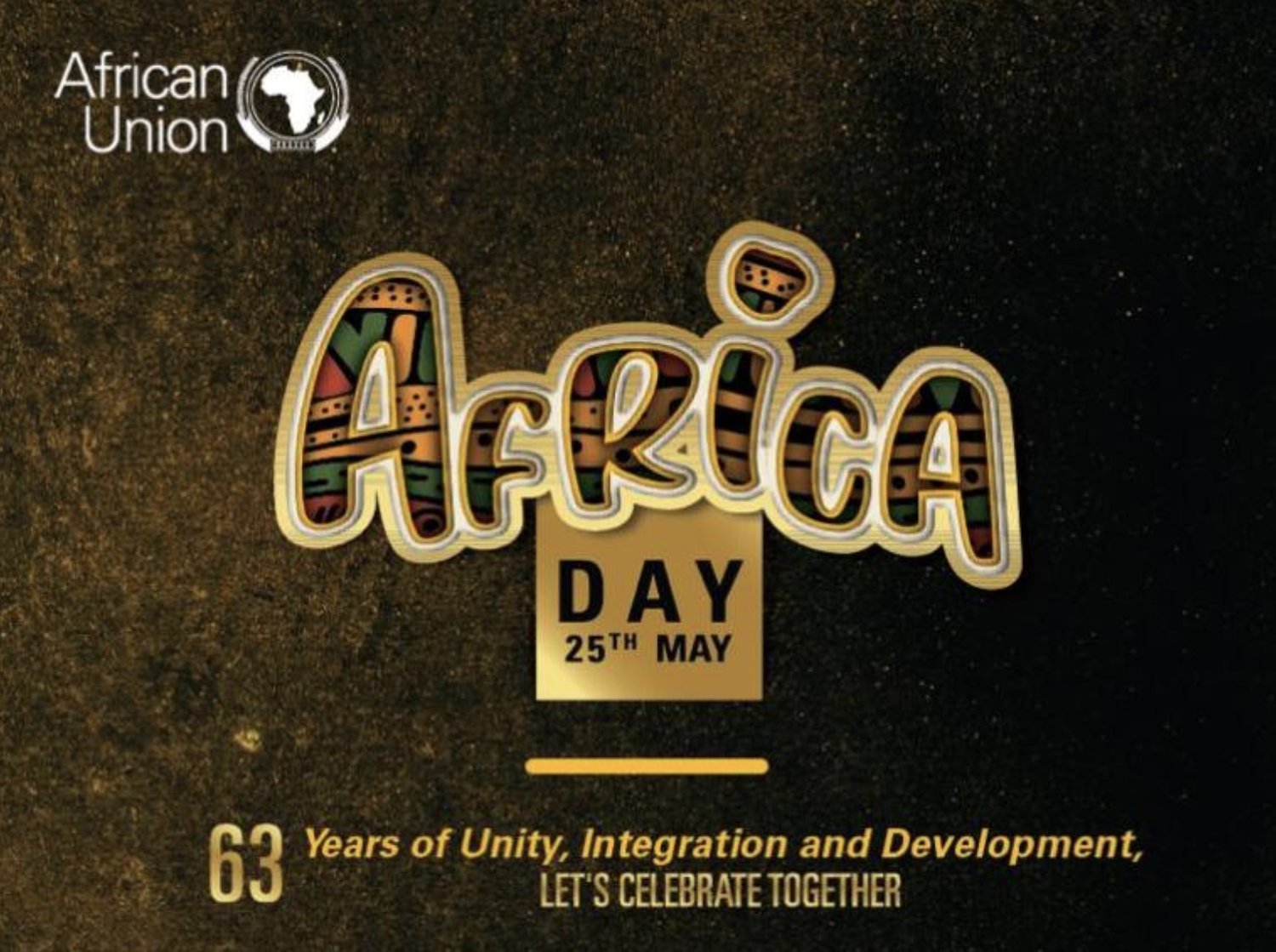
African Union 2026 Africa Day commemorative artwork.
Let us all unite and toil together,
To give the best we have to Africa,
The cradle of mankind and fount of culture,
Our pride and hope at break of dawn.
O, Sons and Daughters of Africa,
Flesh of the Sun and Flesh of the Sky,
Let us make Africa the Tree of Life.
Two anniversaries, one week, an asymmetry that cannot be ignored
On the morning of 25 May 1963, thirty-two African heads of independent states convened in Addis Ababa and signed the Charter of the Organisation of African Unity. The ANC, represented by President Oliver Tambo, was there, already representing the future free and democratic South Africa. The then South Africa, still governed by the National Party and legally structured around the exclusion of its African majority, was not among them. We were not a country those founders could have invited. We were the country whose unfinished liberation they wrote into the Charter as the work that remained.
Sixty-three years later, on the eve of the anniversary that the African Union has chosen to commemorate under the theme of unity, integration, and development, three other things are simultaneously true in the country I serve. The governments of Ghana, Mozambique, and Nigeria have lodged formal diplomatic protests with the South African government over a wave of violence directed at African nationals on South African streets. Human Rights Watch's regional monitor published its own report on the same wave on 20 May. At least seven people have been killed in xenophobic attacks in South Africa since March of this year. The country that the founding generation of the OAU had written into their Charter as the cause they would not abandon is, this week, the country whose conduct toward African nationals has compelled three African sister states to formally object.
I want to write about that asymmetry. The piece is not principally about the marches, the slogans, the social-media campaigns, or those organising the movement against foreign nationals. Those actors will be answered, in time, by the courts that have already begun to constrain their conduct, by their own constituencies, and by the political processes that will, eventually, deliver a verdict on what they have done. The asymmetry I want to write about is older and more difficult. It concerns whether we, the country those thirty-two heads of state had committed themselves to liberating, still understand what was done for us, what is owed in return, and what is being abandoned when, or as, we forget.
Why I write this from inside the record I carry
I write this piece as someone who served as Minister of Home Affairs of the Republic of South Africa between May 2014 and March 2017, and again briefly from February 2018. The institutional architecture of South African migration policy, its enabling assumptions, its operational limits, the gap between its policy ambitions and what has been delivered in the years since, is not a question I can study from a distance. I served inside it. I issued statements from its lectern. The decisions taken in that office, including the decisions I took and the decisions I did not take, sit within the inheritance about which I am writing.
I name this at the outset because the integrity of what follows depends on it. To write about the present migrant question, on the eve of Africa Day in 2026, as though one were standing outside it is a posture I am not entitled to. Whatever else the present moment is, it is also the consequence of policy choices, regulatory drift, and institutional under-investment that began long before March of this year, and that I had a direct hand in shaping during my own tenure. I write not as a commentator but as one of those whose conduct will, in due course, be measured against the standard I am about to invoke.
That position is uncomfortable. I think the discomfort is part of what the moment requires.
What 25 May 1963 actually committed us to
To understand what is being broken, one must first understand what was built.
The Organisation of African Unity, founded in Addis Ababa on 25 May 1963, was a compromise between competing visions of African political unity. What its signatories agreed on, sufficiently to put their names to the document, was the principle that the liberation of the continent was incomplete until every African state had achieved independence and majority rule. The Charter named that explicitly.
South Africa, governed at the time under apartheid, was the largest piece of that unfinished work. African countries, particularly the Frontline States, considered apartheid South Africa the bulwark of colonialism and an outpost of imperialism, and thus the biggest threat facing the African continent. Its policy of political destabilisation and economic strangulation directed at neighbouring countries needed to be ended as a matter of urgency. Everything, and anything, had to be done to achieve this outcome. The national liberation struggle became an urgent campaign of the OAU, both within its own structures and in multilateral international bodies such as the United Nations.
The renowned African scholar and intellectual Adekeye Adebajo has put the assessment plainly:
"But despite its shortcomings, the OAU deserves some credit for its firm and consistent commitment to decolonisation and the anti-apartheid struggles in southern Africa, to which the African diaspora in the US, the Caribbean and Europe contributed massively. The continental body doggedly and uncompromisingly pursued African liberation struggles, furnishing military and diplomatic support to the continent's liberation movements."
Individual African countries not only contributed diplomatic support and resources in the form of money and weapons to support the anti-apartheid struggle; they also gave the lives of their children, their sons and daughters, during the Cuito Cuanavale battle and the SADF's criminal raids in Maseru, Matola, and Gaborone.
The OAU's Liberation Committee, headquartered in Dar es Salaam under the leadership of Tanzanian President Julius Nyerere, became the operational arm of the commitment. It coordinated material, diplomatic, and logistical support for liberation movements across the continent. The African National Congress was prominent among the beneficiaries.
The Frontline States, Tanzania, Zambia, Botswana, Mozambique, Angola, and after 1980 Zimbabwe, operationalised what the OAU had charted. They did so under direct retaliation from the apartheid state. Mozambique's transport infrastructure was sabotaged and its civil war prolonged through external support to Renamo that included South African intelligence and logistics. Zambia's economy was destabilised by Rhodesian and South African action across multiple decades. Angola was subjected to one of the longest external destabilisation campaigns of the late twentieth century, culminating in the confrontation at Cuito Cuanavale in 1988. Tanzania hosted the ANC's Morogoro Conference in 1969 when the movement was in strategic crisis. Zambia hosted the ANC's external mission for nearly three decades. Mozambique allowed Umkhonto we Sizwe to operate from its territory at material cost to Mozambican civilians.
Chris Hani, who survived three apartheid assassination attempts during his time running Umkhonto we Sizwe operations from Lesotho in the early 1980s, described in an Afravision documentary interview what the apartheid state's frenzy in those years cost the host countries themselves:
"They tried to attack the flat where I used to stay — just a flat away from my own. They attacked, convinced that I was in that flat, and killed the locals. So this was a measure of desperation. It was not only in Lesotho — they went across Mozambique and killed refugees and a few of our comrades. They went into Botswana. They had decided that they were going to kill anybody who harboured us, who was unfortunate to stay next to us — whether he was a Mosotho, a Mozambican, a Zimbabwean. That was the nature of the frenzy existing in Pretoria."
None of this was philanthropy. It was strategic solidarity that came at a measurable price, paid in those countries' own blood and their people's lives, their own infrastructure, and their own economic capacity. The states that supported the South African liberation struggle suffered for it. Their own development was retarded by the cost of carrying our struggle alongside their own.
When South Africa joined the Organisation of African Unity in 1994, the country took on more than ceremonial membership. It took on the inheritance of a commitment that had been kept on its behalf, often at enormous expense, by states whose own consolidation as independent nations was complicated and in some cases compromised by the cost of that commitment. The transformation of the OAU into the African Union in 2002, with the addition of the Constitutive Act and its enforcement provisions, was meant to operationalise the next phase. Not merely the completion of liberation, but the construction of an integrated continental order. That phase, twenty-four years into the African Union's existence, is the phase whose progress, or lack of progress, the present moment is testing.
Addressing the OAU in 1994 for the first time as the newly elected President of the liberated South Africa, and having thanked the OAU leaders for their contribution to this titanic effort, President Nelson Mandela said:
"Africa shed her blood and surrendered the lives of her children so that all her children could be free. She gave of her limited wealth and resources so that all of Africa should be liberated. She opened her heart of hospitality and her head so full of wise counsel, so that we should emerge victorious. A million times, she put her hand to the plough that has now dug up the encrusted burden of oppression accumulated for centuries."
He then went on to say:
"The total liberation of Africa from foreign and white minority rule has now been achieved… Finally, at this summit meeting in Tunis, we shall remove from our agenda the consideration of the question of Apartheid South Africa. Where South Africa appears on the agenda again, let it be because we want to discuss what its contribution shall be to the making of the new African renaissance. Let it be because we want to discuss what materials it will supply for the rebuilding of the African city of Carthage."
This was the moment of truth, a summons to us all as Africans to contribute to "the rebuilding of the African city of Carthage." Madiba, democratic South Africa's founding President and a lifelong leader of our liberation struggle, pledged on our behalf that South Africa would only appear again on the OAU (later AU) agenda when we discussed its contribution to the new African renaissance, not yet again as a torment or blight to Africa's pursuit of a better life and decolonisation agenda.
What an elder said this week, and why I take the diagnosis seriously
At the 16th Annual Thabo Mbeki Africa Day Lecture, delivered in Cape Town earlier this week under the theme "Rebuilding African Unity in an Age of Fragmentation: Sovereignty, Solidarity, and the Renewal of Institutions", former President Thabo Mbeki spoke at length about what has gone wrong. I will not quote him directly. The substance of his diagnosis, however, was clear and, in my reading, correct.
The internalisation among South Africans of what continental integration was supposed to mean has, on his assessment, weakened over the past quarter-century. The instinct to see African development as a South African responsibility, an instinct the political leadership of the early democratic period understood as a matter of obligation rather than charity, has been regressing. He told stories from the exile years to illustrate what the relationship had been: a jeweller in Conakry who gave an unprompted gift to a visiting South African foreign minister because she was the foreign minister of the country whose freedom Guinea had supported through the years of Sékou Touré; a Tanzanian state that absorbed a tragic road accident involving a South African driver and the death of its own Prime Minister without converting it into a national grievance against the ANC; a Nelson Mandela who intervened personally to protect the second-term candidacy of a Nigerian president the African community could ill afford to lose; a Mandela who instructed his deputy to fly immediately to Kinshasa rather than wait on protocol around the Congo question.
I am not present in those stories. Mbeki, who carried much of the architecture of that period as Deputy President and later as President, was. The point of the recounting was not nostalgia. It was diagnostic. It was an inventory of a habit of mind and conduct that has thinned in the years since.
Mbeki also performed, in plain terms, the empirical arithmetic that the present moment requires and that the political conversation in South Africa is not performing. The high unemployment on which the present movement against foreign nationals feeds is not, on the evidence, the consequence of undocumented African migration. The South African economy grew strongly between 1994 and 2008, and reversed thereafter. The reversal was not driven by African migration. It was driven by causes whose names the present campaign is choosing not to speak. The fingers, in his summary, are being pointed at the wrong people. The actual culprits, he observed, sit elsewhere, and they sit comfortably enough not to be alarmed by the noise.
I take that diagnosis seriously. I want to extend it from the institutional vantage I happen to carry, because I believe the analysis is incomplete without the part the elder, properly, did not supply: the part about what was done, and what was not done, in the policy machinery I helped run.
The history that arrived at my desk
Before I name my own portion of the record, the conditions I encountered when I took the portfolio require setting down. The migration policy I inherited in 2014 was not a clean piece of paper. It carried the weight of decades.
By 1994, there were two problems with South Africa's immigration policy. The first was that most Black South Africans were still regarded as "immigrants" in their own country, because South Africa was constituted in apartheid law as a white man's country in which Africans were only temporary sojourners. Most Africans were residents of one or another Bantustan, and only came to South Africa to work, to service the needs of the white population. To travel to South Africa as a resident of Transkei, Ciskei, Venda, or Bophuthatswana, you had to carry a passport; and once inside South Africa, a dompas.
The second problem was that Africans from neighbouring states who came to this country were regarded, and called, "aliens", but only Africans. White immigrants were immigrants, and their rights to tour, work, and stay in South Africa derived directly from their racial privilege.
The 1994 dispensation had to deal with this by ending the farce of the Bantustans and conferring upon all South Africans a common nationhood. However, in 1994, we also had to contend with the fact that the policy of regional destabilisation had occasioned asylum movement from Mozambique and Angola into South Africa of the very people regarded as "aliens" in our policy and legislation.
The result was that these people, who had run away from their countries because the apartheid regime and its Western, particularly US, allies were militarily sponsoring UNITA and Renamo to destabilise the region, had to be provisionally provided asylum in South Africa. Many of these people had lived in South Africa for decades and given birth to children who did not know Angola or Mozambique but had become integrated into South African society.
While dealing with this situation, conflict erupted in a number of African countries, including the then Zaire and later Zimbabwe, resulting in another wave of asylum movement towards South Africa. By 2004, when I was honoured to be appointed Deputy Minister of Home Affairs, this challenge was growing, posing a strain on our international migration policy and stretching the resources the Department, and government in general, had to manage what was evidently a growing challenge.
At some point between 1994 and 2004, government decided to regularise the stay of Mozambican nationals in South Africa by offering them, on proof that they had been in the country for over a decade, South African documents. It was clear that these people no longer had intentions to return to their country of origin, and they could not stay in South Africa undocumented. Many were working in the sugarcane plantations and had made home in South Africa.
After the peace deal and general elections in Angola, the Angolan government called on its nationals to return home, and most took the offer. However, those who stayed were thus regularised in South Africa as South African citizens.
When the political conflict started in Zimbabwe, resulting in large movements of people to South Africa, we faced a particular challenge that required an urgent response. The outbreak of violence against foreign nationals in May 2008, beginning in Alexandra and spreading rapidly across the country, resulted in the Department of Home Affairs seeking an urgent policy intervention to manage what had become a strategic emergency. Government agreed that a special permit be issued to Zimbabwean nationals, as their presence in the country went beyond the normal asylum system, to ensure they were given long-term permits that would enable those holding such permits also to work and study while a solution was still being sought in their country.
But, in the course of time, more challenges were already being experienced in our international migration system, with the arrival of nationals from countries in the Horn of Africa and especially those coming from abroad — including Bangladesh, Pakistan, and Sri Lanka.
This was stretching the capacity of the existing Home Affairs immigration systems, exposing the lack of capacity in both human and systems terms. Asylum centres were teeming with large numbers of people, often unmanageable in terms of documenting and taking long to finalise their status in the country and, where necessary, issue them with documents or reject their applications. Many would seek recourse from our courts when their status was rejected, and this would drag for long. In addition, this incapacity and the delays in determining the status of the applicants spawned corruption and criminality.
The Department had once more to address the weaknesses in its systems in an environment where the human resources were plain insufficient to cope with the demand. That was why the Department, during the tenures of my predecessors, introduced the Zimbabwean special permits and sought private sector support to facilitate and expedite visa and permit applications and issuance, while the adjudication for such remained within government.
This is the inheritance that arrived at my desk in May 2014.
The record I carry, named in plain terms
During my first tenure as Minister of Home Affairs, from May 2014 to March 2017, the Department was responsible for the country's migration regulatory architecture. Visa policy, asylum applications, refugee status determination, the management of undocumented migration, the special dispensations covering Lesotho and Zimbabwean nationals, and the institutional relationship between South African migration policy and the country's continental obligations: all of that sat inside the portfolio.
The most significant policy intervention of that tenure was the development of the new White Paper on International Migration, which Cabinet approved in 2017. The 1999 White Paper, which had governed migration policy through the first fifteen years of democracy, had become inadequate to the volume, complexity, and political weight of the work. The new instrument proposed, among other things, a categorical move toward a more open visa regime for African nationals, in alignment with the African Union's Agenda 2063 commitment to free movement of persons on the continent — the very direction this article argues we have since drifted from. It proposed risk-based admission policies, biometric infrastructure for refugee status determination, and a more coherent approach to the asylum system, which had been, and remains, one of the most operationally strained components of the migration apparatus.
The rationale was not casually arrived at. It was debated extensively at AU level over several years and at South African Cabinet over the course of the Green Paper and White Paper consultations in 2016 and 2017. The substantive case was that continental economic integration in the Agenda 2063 frame cannot work without people-movement: the free movement of persons is the labour side of any integrated continental economy, and South Africa, as the continent's most diversified economy, was understood to be a natural anchor of that movement, not an exception to it.
I will not pretend the 2017 White Paper was without flaws. The strongest version of the criticism is that the document attempted to commit the country to a continental free-movement future while simultaneously tightening conditions on the existing asylum and visa regime, and that the operational capacity to deliver either ambition was not adequately resourced. The Department's IT systems were strained, its case-processing backlogs were significant, its officers were under-trained for the volume and complexity of the work, and the relationship between Home Affairs, the South African Police Service, and the courts on questions of immigration enforcement was incoherent in ways that left particular populations, especially asylum-seekers caught in the multi-year backlog, without effective status determination or protection.
While we tried to deal with these challenges within the resources and policy capacity at our disposal, this proved insufficient. To highlight but a few interventions, we engaged extensively with our colleagues in Zimbabwe and Lesotho and agreed on ways to manage movement between our respective countries. We were trying to regularise movement between the countries while sharing a database of travellers so that we could populate our movement control system with an up-to-date database containing the biometric features of the travellers. This would help in a number of ways, to simplify movement and also to be able to deal with instances where crime might have been committed.
The fact is that the borders between South Africa and Zimbabwe (Beitbridge), and South Africa and Lesotho (particularly Maseru), are the busiest land ports of entry. Of course, Beitbridge also involves nationals of countries far beyond Zimbabwe, but that still does not take away the fact of how busy Beitbridge is as a result of regular movement of Zimbabwean nationals.
Realising we faced large numbers of economic migrants and asylum-seekers from Zimbabwe and other neighbouring states, we sought a policy intervention to regularise the movement of such economic migrants. Extensive research was done in this regard, looking at existing policies in other African countries that were equally large receiving countries.
The documentation of Zimbabwean and Basotho nationals through this special regime of special permits reduced significantly the numbers of asylum seekers at our offices and enabled the speedy resolution of many genuine applications. The challenge remained those that had dishonest intentions of simply applying for asylum and then disappearing without completing the process. These would then live "forever" on these temporary permits, until we decided to end this avenue, but ensuring that we could conclude the process in one day or, at worst, within fourteen days.
We also introduced electronic permit renewal systems, in order to reduce the queues in the offices and facilitate efficiency.
This was also, in part, why the idea of the Border Management Agency, subsequently the Border Management Authority (after consulting with labour), came about, in order to create capacity to manage our borders and ports of entry better. The BMA would not replace the SANDF or police, but would work alongside them to ensure our borders were made more secure and the functions of the then Immigration Officers would thus be subsumed within it. This would resolve, were the BMA better funded and capacitated, the problem of grossly understaffed Immigration Offices unable to ensure the effective implementation of our immigration and border management.
In addition, around 2015, I led a delegation to discuss with both the UN High Commissioner for Refugees (UNHCR) and the UN Human Rights Council (UNHRC) the abuse of our asylum environment by asylum-seekers from outside the African continent. Many would fly through various countries and upon arrival at OR Tambo International Airport, tear up their passports and declare that they were applying for asylum in South Africa. There was a lacuna in our legislation and this was a flagrant abuse of our UN Conventions' commitments. We wanted to inform these UN bodies that we were going to change our legislation to deal with this specific issue, but we needed their support to assist us in dealing with the implicated individuals to ensure they did not land in our country, or in cases where we must deport them.
Those problems were inherited, but were also evolving very fast. Some were structural. Some required Treasury allocations that did not arrive. The regulatory vacuum that has, over the years since, allowed political mobilisation against African nationals to expand into a national movement now generating formal protests from sister governments, that vacuum was, in part, the consequence of policy execution that could not be finished over the years.
While the BMA has been formed, the reality is that it still remains under-resourced and under-staffed. The asylum regime remains under-resourced. The lacuna between legislation and resourcing it for effective implementation still exists.
This is not, I expect, a satisfying admission for either of the two camps that the present argument has produced. Those who would prefer a defence of the record will not find one here. Those who would prefer a repudiation of it will not find that either. The record is what it is. I am writing about it on the eve of Africa Day in 2026 because the present moment requires that those of us who held office during the formative years of this democracy be willing to name our portion of what was not done. The cost of silence on the record is that the diagnosis of what has gone wrong is left exclusively to those who never had to operate the machinery in question. That arrangement, I have come to think, has not served the country well.
However, we must face the fact that the problem is not with genuine asylum-seekers or immigrants, documented or not. This brings me to raise six theses in this regard, briefly.
Thesis One: Crime, rampant crime, is not better when committed by a South African but most horrible when committed by a foreign national. The nationality of your robber or someone selling drugs to our children does and must not matter. Our inability to deal decisively with crime in our spaces not just places the victims at risk, but it places innocent immigrants at risk precisely because of their vulnerable status as a group in a country not of their origin.
Thesis Two: The source of the lack of economic growth and development, and of high rates of unemployment and poverty in our country, is not foreign nationals, and neither will their departure be the solution. The causes of unemployment, poverty, and lack of economic growth in our country are structural, and their solution must as well be structural. Even if all foreign nationals in our country were to leave today, that would not bring unemployment and poverty to an end, and neither would it automatically grow the economy and bring development. Neither will the departure of all immigrants, documented and undocumented, solve the problems of service delivery that our governance systems — national, provincial and local — are not able to solve. They will persist until the capacity of government is addressed and effective steps are taken to create an effective, capable, and developmental state at all tiers.
Thesis Three: All these problems of crime and unemployment and poverty are blamed exclusively on African immigrants. Anger is thus directed exclusively at them. This makes Africans in South Africa to be accused of Afro-phobia, and has compelled the elder statesman, President Mbeki, to speak out. The perception is that we hate African immigrants while we do song and dance to welcome and entertain European and other immigrants. Yet we extol African icons like Thomas Sankara, Amilcar Cabral, Robert Mugabe, Joshua Nkomo, and others; we wax lyrical about our Africanness and Africanism; but we turn on fellow Africans quickly, brutally, and without hesitation on crucial matters where that Africanism must be put to the test and demonstrated.
Thesis Four: The perception of South Africans as anti-African can quickly, and will, isolate South Africa from its neighbours both in SADC and in the African continent. This can have the unintended result, therefore — as it isolates us from the region of the primary focus of our international relations and trade policy — of weakening our influence and leadership role on the continent, and forcing us into the arms of, or alliances with, Western countries both politically and economically. Sometimes, we should pause to wonder if the desired outcome of such actions is not precisely this goal, and who funds the movements, and the moments, that produce it.
Thesis Five: Anti-African immigrant mobilisation can quickly escalate to inter-ethnic mobilisation within South Africa. Examples towards this effect abound, and if we are not careful to bring this situation under control, we will lose the plot and find South Africa disintegrating or exploding into inter-ethnic conflict.
Thesis Six: Those who criticise these anti-African immigrant movements, and their methods, are insulted and even threatened, and political parties lurch onto these movements opportunistically to gain support. The pattern of organisation behind these movements, and the question of who funds them, deserves more rigorous public scrutiny than the political conversation has so far given it.
What is actually being decided, and what is being avoided
With that record on the table, I want to return to what is actually being decided in the present moment.
The argument circulating on South African streets, that the undocumented African presence in the country is the principal cause of South African unemployment, the strain on public services, the rise in crime, and the collapse of segments of the inner-city economy, is empirically wrong. There is no serious labour economics literature, in South Africa or elsewhere, that supports the proposition that the removal of undocumented migrants would deliver the employment outcomes the present campaign promises. The actual research, including work done by South African institutions over more than a decade, has consistently found that migrant labour, including informal migrant labour, has a net positive effect on output and employment in the host country, particularly in informal-sector activities that South African nationals are not entering at the rates the campaign assumes.
The accuracy of the analysis is not the same question as the political effectiveness of the campaign. A wrong diagnosis can still mobilise an electorate. That is the history of nativist politics in every country where it has taken hold. The analysis is faulty, but the rage is real. And the rage is real here because the underlying material conditions, unemployment at structural levels not seen elsewhere in the developing world, infrastructure that has decayed under two decades of compounding mismanagement, public service delivery that has in many parts of the country collapsed, those conditions are the actual context in which the movement against foreign nationals has found purchase.
The grievance is legitimate. The diagnosis is wrong. The proposed remedy will not deliver the relief it promises.
What the campaign is doing, in effect, is offering a population that has been failed by the South African state a target it can hit. The actual targets, the architects of the post-2009 economic decline, the operators of the period whose conduct drained an entire generation's worth of fiscal capacity, the political-administrative complex whose decisions produced the conditions the population is now living inside, those targets are protected. They are protected by lawyers, by institutional inertia, by the same political processes that the present campaign is, in some cases, drawing on for cover. The undocumented African nationals on Johannesburg, Tshwane, and Durban streets are easier to reach. They have no lobbyists. They have no protection. They have, in too many cases, no functioning embassies that can credibly guarantee their safety on a Wednesday afternoon. They are visible to the rage in ways the actual causes of the rage are not.
This is not a new pattern. It is the oldest pattern in populist politics: redirect the cost of structural failure onto a target that lacks the institutional capacity to resist the redirection. The countries that have signed the recent diplomatic protests, Ghana, Mozambique, Nigeria, are also countries whose own struggles for liberation and post-colonial consolidation were enabled, in part, by South African solidarity in earlier decades, and who in their own time kept the South African struggle alive when our own state had banned it. The protests are not bureaucratic exercises. They are the formal articulation, between sovereign states, of a continental relationship that the South African government and aspects of South African public conduct are, in this moment, putting at risk.
Whose battles are these, actually
There is a further dimension to the present misdirection that has not, in my view, been adequately surfaced in the public conversation. I take the diagnosis from a recent contribution by the Zimbabwean public intellectual and political-economy analyst Brian Kagoro, in conversation on the African Renaissance Podcast. His framing was characteristically direct: "our people end up fighting battles for somebody else." On my assessment, that is the sharpest available reading of what is actually being decided on South African streets.
The spaza-shop economy that is, in the present moment, the most visible site of confrontation between South African nationals and African foreign nationals is not an economy that competes with formal South African employment. It is an economy that competes with formal South African retail capital. The Somali-owned, Pakistani-owned, Bangladeshi-owned, Ethiopian-owned, and other foreign-national-owned spaza shops in South African townships are operating inside a township economy that, on the established analyses by GG Alcock's Kasinomics and corroborating South African informal-sector research, exceeds one trillion rand in annual turnover. The spaza-shop sector itself, on those same estimates, accounts for approximately R190 billion across more than one hundred thousand outlets, sitting alongside a township fast-food sector worth around R90 billion, a township taxi sector at R50 billion a year, and a stokvel savings economy of R44 billion. The foreign-national-owned spaza network is not threatening, in any meaningful sense, the employment prospects of South African workers in the formal sector. It is threatening the market share of a small number of South African corporate retailers, who would prefer the township-economy spend to be channelled through their stores rather than through the foreign-owned spaza network.
What is happening on the streets, therefore, is something more troubling than a misdirected economic grievance. It is, on Kagoro's framing, South Africans being mobilised in significant numbers to fight what is in effect a market-share contest on behalf of corporate retail capital, against a network of small foreign-owned retailers whose actual offence is to compete more effectively for township consumer spend than the corporate alternative. The poor South African vendor who burns a Somali shopkeeper's stock is not, on the structural arithmetic, advancing his or her own economic position. He or she is advancing the position of corporate balance sheets that will never, in turn, advance theirs.
The further irony, which the same analysis has named, is that the South African corporate sector that stands to benefit from the suppression of foreign-owned spaza competition is the same South African corporate sector that, in its capital-market form, has been one of the principal South African beneficiaries of African continental integration over the past two decades. The MTN Group's 2024 annual results show that South African operations contributed 24.3 per cent of group service revenue, with the remaining three-quarters generated across MTN's twenty other African and Middle Eastern markets. Roughly 86 per cent of the group's 290.9 million subscribers were outside South Africa at year-end 2024. Similar patterns of substantial extra-South African continental exposure can be read off the published results of Standard Bank Group, Naspers and Prosus, and several of the JSE-listed retailers and mining-services groups. South African capital has, in other words, been thoroughly continental for some years. The political conduct of the country has, in the present moment, not caught up.
This asymmetry deserves to be named in plain terms. South African capital benefits from Pan-African integration. South African public conduct is in the process of repudiating it. The two cannot, indefinitely, coexist. The continent will eventually decide which of those two is the more reliable signal of South African intent. The recent diplomatic protests from sister governments suggest that the calculation has already begun.
What Africa Day, in 2026, asks of those who held office
This brings me to what Africa Day, on its sixty-third anniversary, asks of those of us who carry, or who have carried, positions of public responsibility in this country.
It asks, first, that we be honest about what we have inherited. The inheritance is not a slogan. It is not a holiday. It is a continental relationship built at material cost by people who are now mostly dead, and by their successors who are watching what we do with that relationship and drawing their own conclusions. The protests now arriving at the Department of International Relations and Cooperation are the early formal symptoms of a continental opinion that is, in this moment, harder than it has been in many years. We do not have unlimited credit on the African continent. We had, after 1994, a particularly generous line of credit, extended in recognition of what the continent had invested in our freedom. That line is being drawn down. It is not infinite.
It asks, second, that those of us who held office in the years when present conditions were being formed be willing to account for our portion of the inheritance. I have named mine. The honest measure of my generation's answer to the responsibilities we received remains, in my own published self-assessment, somewhere between incomplete and poor. Nothing in the events of the present moment improves that grading. If anything, the events of the present weeks deepen the score.
It asks, third, that the diagnosis of what is wrong in South Africa be returned to its actual subject. The present unemployment, the present strain on services, the present sense of crisis that has been politically mobilised against African nationals, all of this is first and foremost structural, and in the second instance the consequence of choices made by South African political and economic actors over the past two decades. It is not the consequence of African migration. The arithmetic is not difficult. The will to perform that arithmetic honestly, rather than to deflect it onto a population that has no political defence, is the test of whether the public conversation is serious. At present, on the evidence of the streets, it is not.
It asks, fourth, that the architecture of African integration, the regional and continental institutions that the founding heads of state in Addis Ababa, in 1963, set in motion, and that the African Union's Constitutive Act of 2000 attempted to operationalise, be re-invested in by a South Africa that understands what is being asked of it. The Southern African Development Community has, on my own published assessment, drifted toward procedural coordination rather than strategic purpose. The African Union remains under-funded and under-resourced. The Pan-African institutions that the present continental moment requires exist, in too many cases, as aspirations rather than as operational infrastructure. South Africa's two years on the African Union Peace and Security Council and our chairmanship of SADC through the August 2026 Summit are the live institutional tests of whether we can rebuild what has been allowed to drift, and they sit alongside the residue of our G20 presidency, which ran through 2025 and was handed over to the United States in November of that year in circumstances that were neither generous nor reassuring on the durability of South Africa's multilateral standing. The clock on the AU and SADC tests is running. The answer, to date, has not been adequate.
It asks, fifth and finally, that decisive steps be taken to ensure local South African traders are boldly supported, by government and by the business community at large, including the commercial banks. We would be wise, in this regard, to draw lessons from the accumulation strategy of Afrikaner capital led by the Afrikanerbond in the 1940s, which was based on the accumulation of agricultural capital, the harnessing of savings of Afrikaner workers and the petty bourgeoisie, and their centralisation in Afrikaner financial institutions. Even the Afrikaner retail sector depended on these agricultural, commercial, industrial, and financial undertakings. Without a deliberate programme to support Black South African, township, and rural economies through existing government-created small-business funds and other interventions, they become both unsustainable and vulnerable to take-over by those with sustainable sources of affordable funding. The absence, for example, of much-talked-about state and Black-owned banks is a huge impediment to the development of Black entrepreneurship in this country. In addition, the misalignment between our macro- and micro-economic policies that can support Black entrepreneurial development destroys Black entrepreneurs who, unlike many immigrant entrepreneurs, must and do function within the existing financial system.
The chair we have allowed to be moved
Sixty-three years ago, thirty-two African heads of state met in Addis Ababa and committed themselves to a project the country I serve was not yet able to join. They kept the commitment in our absence. They paid for it in their own currency. They held the chair at the table for the day we would arrive.
We arrived. We took the chair. And on the present evidence, we are letting the chair be moved.
On Africa Day in 2026, the question is not whether we will mark the holiday. We will mark it. There will be ceremonies, statements, photographs, speeches. The question is whether the marking corresponds, in any honest way, to the conduct of the country marking it. Africa is watching. Africa has, in this particular moment, particular cause to watch. The continent has, in formal diplomatic terms, already begun to register the gap between our rhetoric and our conduct. The room for that gap to widen further before it begins to cost us materially is not unlimited.
The contract we inherited is not a metaphor. It is a working instrument. It can be honoured, or it can be allowed to lapse. Honouring it requires more than statements on Africa Day. It requires the kind of sustained policy attention that I, in my own tenure, did not adequately deliver, and that the country, in the years since, has not been led to take seriously enough. It requires that the continent's investment in our freedom be returned, not in symbolism, but in conduct. And it requires of the South African public an honest accounting of whose battles, exactly, are being fought when the fight is taken to the spaza shop. They are not, on the structural arithmetic, our battles. They are the battles of capital that does not depend on the outcome, against migrants who do. We deserve a politics that performs that arithmetic accurately.
That is what Africa Day, in 2026, asks of those of us who hold the chair: to "make Africa the Tree of Life."
“The future is not an accident.”
Dr Malusi Gigaba is a Scholar-Statesman, an ANC NEC Member, a former Cabinet Minister of the Republic of South Africa, a Member of Parliament, and a member of both the Joint Standing Committee on Defence and the Portfolio Committee on Trade, Industry and Competition.