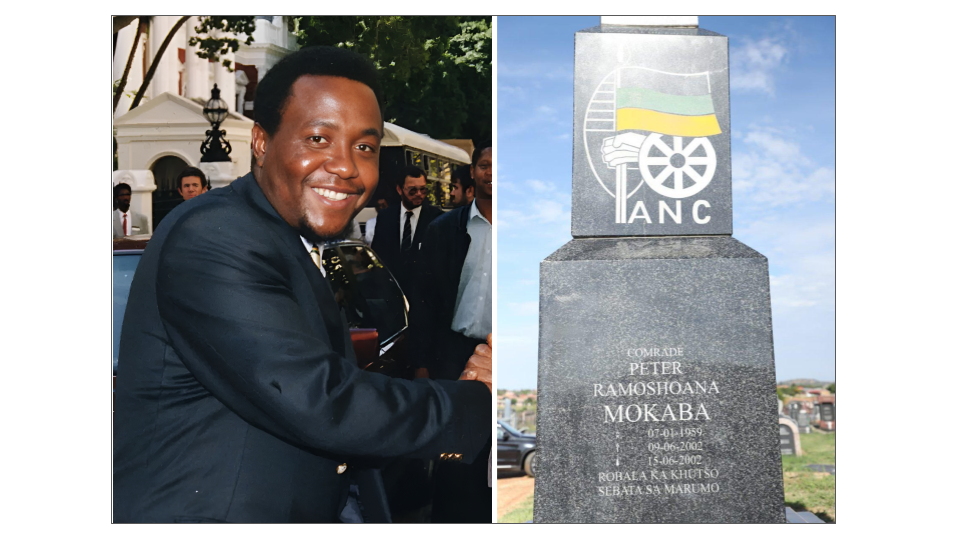
On Saturday 15 June 2002, I joined many South Africans from all walks of life at the University of the North, previously called Turfloop, in Mankweng outside Polokwane, to bury a man of forty-three. Nelson Mandela, Thabo Mbeki and I, among others, delivered the eulogies. Jacob Zuma and Winnie Madikizela-Mandela were among the mourners, and the ordinary people who filled that place had travelled from across the country to be there. We had not gathered in those numbers, and the elders of the movement had not come in person, merely to bury a deputy minister. We had come to bury the voice, conscience and principal representative of a generation. He was the epitome of their resilience and courage.
The man in the coffin was Peter Mokaba. His generation was there. Dipuo Peters, Mlungisi Johnson, Thabang Makwetla, Mnyamezeli Booi, Kgaogelo Lekgoro, Mpho Lekgoro, Billy Masetlha and Febe Potgieter, to mention but a few, were all in attendance to accompany to his final resting place a man they had for years called “President”. Thousands of others whose names we cannot recount were present among the crowds. And so was our own generation, who had taken over the baton of struggle from theirs, who had been led by this group, and who had thus inherited the reins of the ANCYL from them.
Mokaba was buried one day before the anniversary of the uprising that had made his entire political life possible. Twenty-four years separate that burial from tomorrow’s Youth Day, and fifty years separate that day from the morning it commemorates. The proximity of the dates is a coincidence. What is not a coincidence is the question Mokaba’s life still poses to the generation he belonged to, and to the state that generation built. The children of 16 June 1976 made the country ungovernable so that it could one day be free. They stood up to the apartheid regime and stared down a monster that was armed to the teeth and trigger-happy, and proved that the youth were not the cowards the regime had taken them for. They knew they had a future worth fighting for.
The harder task that history handed them next was to convert the energy of revolt into the discipline of government, the militant into the statesman. Few carried the first task further than Peter Mokaba, and his life is a lesson in both the power of that energy and the cost of leaving the second task unfinished.
The voice of a generation
To understand why a former president, a sitting president and his deputy, and the mother of the nation all came to Turfloop, you have to understand what Mokaba had been. He was, more than any other single figure, the personification of militant South African youth in the years when that youth held the front line of the struggle.
He came from the soil of the northern Transvaal, born near what is now Polokwane in 1959. He was seventeen in 1976, and the uprising did not reach him as news; it reached him as instruction. He became a leader of school boycotts and was expelled for it. He was detained under the Terrorism Act in 1977, detained again in 1982, convicted that year for his underground work as a member of Umkhonto we Sizwe, and imprisoned on Robben Island until his sentence was suspended in 1984, some two years in all. By the time he emerged he was not a follower of the struggle but one of its young commanders, hardened by detention and by the discipline of the underground, and carrying the particular authority of a man who had already paid for his convictions.
The year Solomon Mahlangu was executed, in 1979, two new student movements were born: the Congress of South African Students, formed to organise school pupils, and the Azanian Students’ Organisation, formed to organise those at university. The youth turned every setback into a revolutionary advance and allowed no despair in the ranks of the oppressed. Conscious of the gap left by the absence of a national body that reached young people beyond the classroom and the campus, the Congress of South African Students soon began to mobilise for the formation of one, a call that was quickly taken up.
The 1980s built their mass power in three great formations, each completing the one before it. The United Democratic Front was launched at Rocklands hall in Mitchells Plain in August 1983, drawing hundreds of civic, church, labour and student bodies under one banner and giving the internal struggle a national spine. The Congress of South African Trade Unions was founded in Durban in December 1985, gathering organised labour into a single federation with the power to halt the economy. And in March 1987, at the height of the State of Emergency, the South African Youth Congress was founded under the UDF’s wing, drawing some four hundred youth organisations and a claimed membership approaching two million into one force. Mokaba was elected its founding president. At a stroke he became the leader of the largest youth movement the country had ever produced, the youth wing of a rising mass democratic movement that the apartheid state could batter but no longer contain.
These formations were the domestic engine of a strategy the exiled leadership was steadily sharpening. On 8 January 1985, in the National Executive Committee’s anniversary statement, ANC president Oliver Tambo directed the people, and the youth in particular, to render South Africa ungovernable and apartheid unworkable. That June, the movement’s Second National Consultative Conference at Kabwe, in Zambia, adopted the strategy of people’s war and resolved to intensify the armed struggle. The marching orders were issued from exile; it was the mass formations inside the country that carried them out, and none with more reckless courage than the young. SAYCO was, in effect, the standing army of that ungovernability, and Mokaba was its commander.
So fearless were the young in those years that Oliver Tambo would salute them, in 1985, as the Young Lions of the struggle. It was not a comment on their age but a veneration of their courage, and of a role that reached beyond their youth into the future the movement was fighting for. Tambo’s faith in the young ran from his own generation, through those who had joined Umkhonto we Sizwe for the Wankie and Sipolilo campaigns, to the children of the eighties. “A country, a movement, a person that does not value its youth and children does not deserve its future,” he said, and he meant it as strategy as much as sentiment.
The pressure was tightening from outside as much as within. On 2 April 1986, the Nobel peace laureate Desmond Tutu stood before a press conference in Johannesburg and called on the world to apply punitive sanctions against the apartheid government, to help, in his words, “establish a new South Africa: non-racial, democratic, participatory and just.” That October the United States Congress passed the Comprehensive Anti-Apartheid Act over a presidential veto. The young people making the townships ungovernable were never acting alone; they were the domestic edge of a campaign that was isolating Pretoria in every capital that mattered.
He gave that movement its sound. “Roar, young lions, roar” was his cry, and it became the article of faith of a whole generation, the call that told young people their fear was not the final word and that the work of liberation was theirs to finish. It was not a slogan only; it was a theory of who the young were. It said that the youth were not the junior partners of the struggle, waiting their turn behind their elders, but its sharpest instrument, and that the courage of a seventeen-year-old could bend the course of a country. If Peter Mokaba is to be remembered for one thing above all others, it is that roar, and the courage it summoned in millions who had every reason to be afraid.
That firebrand register had a harder edge too, and honesty requires that it be named. At a rally in Khayelitsha in April 1993, in the rawest month of the transition, days after the assassination of Chris Hani, he led a crowd in the chant “Kill the boer, kill the farmer.” The words belonged to a movement on a war footing and a country close to the edge, and they outlived their moment; the movement spent years afterward explaining them. They are part of the record, and so is the man’s larger meaning, and a serious accounting holds both without flinching from either.
I remember it vividly. In those raw days after Hani’s assassination, Mokaba addressed a youth gathering in Soweto, giving voice to our fury and then, in the same breath, reminding us that the leadership had asked for discipline and not recklessness. He knew how to unleash us and how to rein us back, how to point us to the restraint the movement demanded, and how to hold us inside its collective discipline.
The man those of us who followed him knew
I write about Peter Mokaba not only as a student of the movement’s history but as one of those who came up in the space he had opened. I took up the presidency of the African National Congress Youth League in 1996, two years after his own term in that office had ended, and like everyone of my political generation I came into that work in his shadow. He was the standard against which the rest of us were quietly measured, and he set that standard very high.
What he gave the younger leaders who followed him was a particular kind of permission. He had shown that a youth leader did not have to be deferential to be loyal, that one could be intellectually serious and unafraid at the same time, that the League could be both a school of discipline and an engine of audacity. He carried an unmistakable physical presence, a voice built for stadiums, and a refusal to be intimidated that had been forged in the streets, in detention and on Robben Island long before it was tested on a public platform. For those of us who inherited the League, he was proof that the youth structure was not a waiting room for future careers but a force in its own right, with its own mandate and its own conscience.
From the streets to the state
When the movement was unbanned in 1990, Mokaba led SAYCO and the other youth formations into the relaunched ANC Youth League, and in December 1991 he was elected the League’s first president of the new era, serving until January 1994. Then the country he had helped make ungovernable asked him, and asked all of us, to do the opposite thing: to govern it. He entered Parliament in 1994 and in July 1996 was appointed Deputy Minister of Environmental Affairs and Tourism, a post he held until June 1999.
This is the pivot on which his whole generation turned, and it is harder than it is ever given credit for being. The instincts that make a great insurgent, the readiness to defy, to mobilise, to treat every official account as enemy propaganda, are not the instincts that build a school, audit a budget or run a department. The militant makes a country ungovernable; the statesman has to make it work, and the second task is slower, lonelier and far less celebrated than the first. Some of the generation made that conversion fully. Some made it only in part. Mokaba’s own passage through it was not flawless. In his final years he became associated with AIDS denialism at the height of the epidemic, a position history has judged harshly, and rightly. But a single grave error, however serious, cannot be allowed to eclipse a life that gave so much to the freedom of his country, and I will not pretend that it can.
If anything is to be salvaged from so costly a mistake, it is the discipline never again to conflate two separate things: the denial that antiretrovirals save lives, which was false, and the reality of poverty and hunger, which was not. The lesson for governments present and future is that medicine and the social wage must advance together, and that treating a disease while leaving the surrounding poverty untouched is only ever half a remedy.
What the state has done with them
Set the man aside for a moment, and the question the day demands remains. The children of 1976, and the young lions who answered Mokaba’s roar, asked for an education worth having, a future worth planning, and the dignity of being treated as full human beings. Fifty years on, the honest measure of the state they built is the condition of the young people who now stand where they once stood.
In the first quarter of 2026, the official unemployment rate among South Africans aged 15 to 34 stood at 45.8 percent, with roughly 4.7 million young people out of work.
— Statistics South Africa, Quarterly Labour Force Survey
Among those aged 15 to 24, more than a third, some 37.6 percent, are not in employment, education or training at all. The school system that the language directive of 1976 set alight still fails its pupils at the same chokepoint: in the 2025 National Senior Certificate examinations the country celebrated a record headline pass rate of 88 percent, while the mathematics pass rate fell from 69 to 64 percent, and only about a third of candidates sat mathematics at all. A headline that high resting on a base that narrow is not a triumph to be restated; it is a reckoning to be confronted. The generation that rose over the language of instruction would recognise the pattern at once. The form of the injustice has changed. The fact of a young majority being failed by the institutions meant to carry it has not. To honour the roar of 1976 while exempting the present from the demand that roar made would be its own kind of betrayal.
If he had lived
It is impossible to stand at this anniversary and not wonder what his absence has cost us. Had he lived, Peter Mokaba would be sixty-seven this year, an elder of the movement in his full authority. We cannot know what he would have made of the decades he did not see, and it would be dishonest to claim his memory for any of today’s factions. But it is fair to wonder.
A country with 45.8 percent youth unemployment is a country that could use a tribune of the young who cannot be ignored, a voice that commanded a generation’s attention by right and not by office. The particular thing we lost when we lost Mokaba at forty-three was not a vote in a committee or a seat at a conference. It was a certain fearlessness, the capacity to stand before millions of young people and make them believe that the future was theirs to take, and to make those in power feel the heat of that belief. That voice is precisely what an anxious, under-employed generation now lacks, and no institution has yet replaced it. Whatever his errors, the silence where his roar used to be is a real absence, and the young feel it most of all.
Paying tribute to Anton Lembede in 1947, Uncle JB Marks, the ANC and Communist Party leader, said: “To the critics I say, let us write the late Lembede’s virtues in brass, and his vices, if any, on water.” Of Mokaba, fifty years of memory have already made the same choice.
How a country remembers
A nation writes its values into its map, and South Africa wrote Mokaba’s name large. “To live in hearts we leave behind,” wrote the poet Thomas Campbell, “is not to die.” His home city of Polokwane gave his name to the stadium it built for the 2010 World Cup, a structure for more than forty-five thousand people, designed in homage to the baobab, where the world came to watch football on ground that carries the name of a boy once expelled from school for boycotting it. In Durban, the old Ridge Road and North Ridge Road were renamed Peter Mokaba Ridge and Peter Mokaba Road. Each year the movement convenes a Peter Mokaba Memorial Lecture in his name. A country does not do these things for a man it has forgotten.
But a stadium and a street are the easy part of remembrance. The harder part is to answer the roar rather than merely to echo it. The conversion from revolt to governance is not a closed chapter of the movement’s history; it is the live, unfinished assignment of fifty years, and it did not end when the militants entered the cabinet or the grave. The energy that made the country ungovernable was the easier gift to give. The discipline that makes a country work, that builds a school which teaches mathematics, an economy that absorbs the young, a state that governs by evidence and serves with competence, is the gift still owed, and it is owed precisely to the children in whose name the roar was first raised.
Peter Mokaba was buried twenty-four years ago today, one day before the anniversary that gave his life its meaning. He roared, and a generation rose. Whether the freedom that generation won is made to work for the children of today is the part of the assignment that is still open, and it is addressed, fifty years on, to the living.
"The future is not an accident."
Dr Malusi Gigaba is a Scholar-Statesman, an ANC NEC Member, a former Cabinet Minister of the Republic of South Africa, a Member of Parliament, and a member of both the Joint Standing Committee on Defence and the Portfolio Committee on Trade, Industry and Competition.