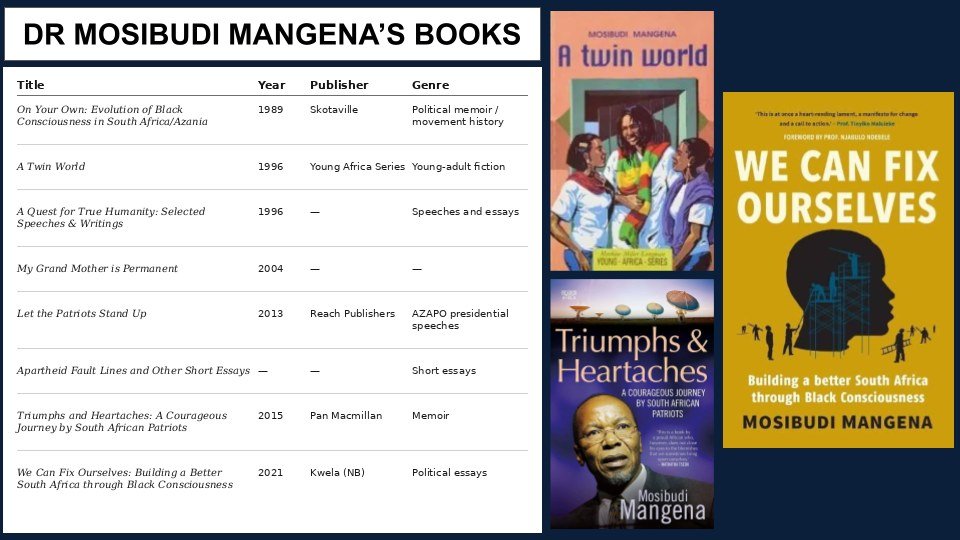
Eight books across more than three decades: movement history, memoir, speeches, short essays, and fiction for children. Three published reviews have been traced, all of the same title.Compiled 19 August 2026. Sources: Skotaville; Pan Macmillan; Kwela (NB); Reach Publishers; South African History Online.
This month, Dr Mosibudi Mangena turned seventy-nine. I want to mark it by describing a photograph that does not exist, because nobody was there to take it.
Two men lie flat on their stomachs on a prison floor, one on either side of a heavy metal door that separates B Section from A Section on Robben Island, talking to each other through the gap beneath it. One of them is Nelson Rolihlahla Mandela. The other is a mathematics student from Tzaneen, twenty-nine years his junior, who has been on the Island for barely two months.
We know the scene happened only because the younger man wrote it down, thirty-nine years later, in a newspaper.
The door
The account is Mangena's own, published in the Mail & Guardian in December 2013, in the days after President Mandela's death, when every newspaper in the country was looking for someone who could say something true about him.
"He and I lay on our bellies on either side of a massive metal door separating two sections, A and B, in the Robben Island Prison."
He goes on to describe how messages moved between the sections, not as letters but as what he calls a worm-like thing: a sheet of paper rolled so tightly and so neatly that it became a finger, small enough to pass under a door, precise enough to survive the passing.
I want to sit with that image, because it is doing more work than it appears to be doing. Two men, from different generations but united by a common burning desire for freedom, separated by steel, in a prison built to make communication impossible, have between them constructed a technology. Not a metaphor for one. An actual method — a rolling technique, a delivery mechanism, a discipline of hands. The state had taken away the post. They built a post.
That paragraph is one of the most vivid first-person accounts of communication on Robben Island that we possess. It has sat in a newspaper for over a decade. It has been quoted almost nowhere else.
The sentence that contains him
Here is how our scholarship holds Mosibudi Mangena. In Fran Buntman's Robben Island and Prisoner Resistance to Apartheid, the major academic study of that prison, published by Cambridge, he appears in one sentence:
"In 1974, Mosibudi Mangena was the first black consciousness person to arrive on the prison, though many more black consciousness adherents were later sent to the Island, especially in the wake of the 1976 uprising."
Read it again, because everything I want to say is inside it. He is not the subject of that sentence. He is its date stamp. He exists in order to mark the moment a movement reached a place, and then the sentence moves on to the people who came after him. He is the hinge on which somebody else's chapter turns.
This is not an oversight by a careless scholar. Buntman is right, and her sentence is doing exactly what she needed it to do. It is the pattern I am pointing at, because once you see it you find it everywhere. He is cited constantly and studied almost never.
What the citation contains
Mangena was born at Tzaneen on 7 August 1947, to parents who worked on a farm and later bought land of their own. He enrolled for a BSc at the University of Zululand in 1970 and was forced to discontinue at the end of 1971. In December 1972, at the Black People's Convention's inaugural congress at Hammanskraal, he was elected its National Organiser. In 1973 he was arrested and detained in Port Elizabeth under Section 6 of the Terrorism Act, and that October he was sentenced to five years. The court was the Grahamstown Supreme Court, by his own account. He was delivered to Robben Island early the following year.
What he found there was a university. The prisoners had built an education out of what the state could not quite refuse them: correspondence courses through Unisa, lectures in the yard, men with degrees teaching men who could not yet read. They called Robben Island a university of struggle, and they meant it exactly. But the name should soften nothing. The lime quarry's glare took Mandela's eyesight. Men were tortured, and some died of neglect. The university existed despite the suffering, not because of it.
And then Mangena did something I find almost unbearable to state plainly. He registered with Unisa, completed the BSc the state had interrupted, and then completed a BSc Honours on top of it — while serving the sentence. He was released in October 1978 into a banning order and house arrest. He left for Botswana in August 1981, and in exile he took a Master of Science in Applied Mathematics, and passed it cum laude.
A man who is prevented from studying, studies. A man who is confined, liberates himself through education. A man apartheid never wanted to learn mathematics, calculates. A man whom the state has defined as a security risk defines himself, instead, as a scientist. Apartheid wanted him for a hewer of wood and a drawer of water. He defied it even in prison, and asserted his humanity.
Steve Biko gave us the line that explains why this is not a charming biographical detail but a political act. In a paper delivered to a Cape Town conference in January 1971, later collected in I Write What I Like, he wrote that at the heart of black thinking is the realisation "that the most potent weapon in the hands of the oppressor is the mind of the oppressed." If that is true — and the whole of the Black Consciousness tradition rests on it being true — then a mathematics degree earned inside a maximum security prison is not an achievement adjacent to the struggle. It is the struggle, conducted on the one terrain the warders could not enter.
Mangena has put it more economically than I can. Science, he told Unisa's History and Memory Project, taught him to question everything, and to recognise that accepted reality may be wrong.
A scientist among the lawyers
There is something about this life that I think we have failed to notice because we have never held it up long enough to look at.
Our liberation movement produced lawyers in abundance. Nelson Mandela and Oliver Tambo opened a practice. Judge President Fikile Bam studied law on the Island and went on to the Land Claims Court. Dikgang Moseneke did the same and went on to the Constitutional Court. It produced doctors: Dr A.B. Xuma, who led the ANC from 1940 to 1949, took his medical degree at Northwestern University, trained further in Hungary, and sat his qualifying examinations at Edinburgh in 1927; Steve Biko was a medical student when he helped found the South African Students' Organisation; Nthato Motlana was the first doctor to open a private practice in Soweto, and served its people for forty years. This is to mention but a few; the list is endless.
Where are the natural scientists?
There was Oliver Tambo, who took his BSc at Fort Hare and taught mathematics and science at St Peter's before the law claimed him. There may be a few others. But I have looked, and I cannot readily name many figures of that generation who were front-rank political organisers, research-level mathematicians, and working authors of both political prose and fiction. Mangena is all three. He organised the Black People's Convention nationally, took a master's degree in applied mathematics, and wrote a short novel for young readers about a boy unsettled and then fascinated by the opinions of his Rastafarian friend. Ask yourself how many people in the public life of this country could sit down and do any two of those things, let alone all three.
This matters beyond the biography. A movement whose leadership is drawn overwhelmingly from law and medicine will reason about the state in a particular way: through rights, procedure, diagnosis and remedy. A mathematician reasons differently. He asks what the model assumes, whether the assumption holds, and what happens at the boundary. When Mangena says that science taught him that accepted reality may be wrong, he is not offering an inspirational line for a graduation programme. He is describing a method, and it is the same method Black Consciousness applied to the accepted reality of race.
We do not have many people who arrived at the same conclusion by both routes. We had one, and we did not ask him about it.
What the state itself has said
The man our scholarship holds in a subordinate clause is not held so lightly in the government's own records.
On 28 April 2004, President Thabo Mbeki announced a cabinet that severed science and technology from arts and culture, and the following day Mangena took office as the first Minister of Science and Technology in South Africa's history, the first holder of a standalone science portfolio. He came to it from Education, where he had served as Deputy Minister. He held it while serving as the president of an opposition party, AZAPO.
On 28 September 2006 he stood in front of a press conference and announced that South Africa had been shortlisted to host the Square Kilometre Array. The project office's own newsletter records his argument: that if the array were built here, the face of the Northern Cape would be transformed, and the province would have the opportunity to become a centre of high technology expertise. Twenty years on, that is not rhetoric. It is a description of what happened.
When he left office in May 2009, the South African Journal of Science commended him for research and development spending having risen to 0.92% of gross domestic product, while noting in the same breath that university researchers had benefited little from the increase. That 0.92% remains the high-water mark. The most recent national survey, released at the end of October 2025, puts the figure at 0.62%. The Ten-Year Innovation Plan adopted on his watch had set a target of 2% by 2018; the 2019 White Paper quietly replaced it with 1.5% by 2030.
I record that as a fact about the country and not as a charge against any of the ministers who followed him. The decline runs across fifteen years and successive administrations, and no single office holds it. But it belongs in this article, because it is the same failure in another register. A country that loses the record of what a person built will not notice when it stops building. And a country that underspends on research forfeits the compounding return that research alone produces.
The universities have said what they think of him. Five have conferred honorary doctorates: the Vaal University of Technology in 2008, Stellenbosch in 2009, the University of KwaZulu-Natal and the University of South Africa in 2013, and the University of Venda in 2016. I would draw your attention to the fourth. The institution that awarded him an honorary doctorate in 2013 is the same institution that posted study materials into a prison cell in 1974, and Unisa understood exactly what it was doing.
Glaring by its absence from that list is the University of Zululand, where he began his degree and was forced out before he could finish it.
And in April 2013 the Republic conferred on him the Order of Luthuli in Silver. The citation reads, in full:
"For his excellent contribution to the struggle against apartheid and positive contribution to democracy in South Africa through his role in improving education, especially in the critical areas of mathematics and science."
The state knows precisely who he is. It has said so, in its own honours, in its own words, at its own ceremony.
Eight books, three reviews
He is also, and this is the part almost nobody knows, one of the more productive authors in our public life.
On Your Own, his account of the evolution of Black Consciousness, came out in 1989 from Skotaville. In 1996 he published two books in the same year: A Quest for True Humanity, a collection of his speeches and writing, and A Twin World, the novel. My Grand Mother is Permanent followed in 2004. Let the Patriots Stand Up, gathering his AZAPO presidential speeches from 1994 to 2010, came out in 2013 through Reach Publishers, a South African self-publishing house. Triumphs and Heartaches, the memoir, was published by Pan Macmillan in 2015, parts of it written as a fellow at the Stellenbosch Institute for Advanced Study. We Can Fix Ourselves came from Kwela in 2021, carrying a foreword by Professor Njabulo Ndebele. And there is a further collection, Apartheid Fault Lines and Other Short Essays.
Eight books across more than three decades: movement history, memoir, speeches, short essays, and fiction for children.
I went looking for what our critics made of them, and found three published reviews of any of the eight. All three are of the same book, the 2021 one. Hein Willemse, writing in Afrikaans on a literary website, calls it a politieke selfhelpboek, a political self-help book, and finds Mangena's faith in Black Consciousness aandoenlik, touching, but at moments idealistic and naive. Masilo Lepuru, in an academic journal three years after publication, comes from the opposite direction entirely: Mangena is not radical enough, too willing to reason inside the constitutional settlement. And City Press reviewed it in March 2022.
Notice what has happened there. The one book of his that has been seriously read was attacked from both flanks at once — too idealistic for a literary scholar, too accommodating for an Africanist. That is what serious reception looks like. It is what we have managed once, in thirty-two years of his publishing.
And then there is Triumphs and Heartaches: a memoir of the Black Consciousness Movement, Robben Island and exile, published by one of the country's major houses, written by a former cabinet minister who led a party for sixteen years. I cannot find a single published review of it anywhere in the open record.
He has offered his own explanation, and characteristically it is not about himself. Speaking at a township book club in 2019, he set out what self-publishing costs a writer who cannot get through the front door: the reading of the manuscript, the typesetting, the proofreading, the printing, and hardest of all the distribution. Then he added that if he wrote his books in Sepedi, nobody would publish them and nobody would read them.
That is a man explaining, without complaint, the machinery by which a country decides which of its own it will bother to hear.
The decision nobody went back to
In January 2001, President Mbeki appointed him Deputy Minister of Education. He was at that moment the president of AZAPO, a party in opposition to the government he was joining.
The charge came immediately, and it came from comrades, not from opponents: the Pan Africanist Congress said publicly that he had been co-opted by the ruling party. AZAPO's own central committee was divided, and one of its members published a defence arguing that the post had been offered to a person and not to a party.
However, his 2001 appointment cost something real. Writing in the Helen Suzman Foundation's journal the following year, William Gumede recorded that the appointment outraged a section of the movement, who broke away in August 2002 to form a rival Black Consciousness formation.
I am not going to resolve that argument here, it is not my place, and I would not trust anyone who offered to resolve it quickly. It is one of the genuinely hard questions in our politics: what a person owes their organisation, what they owe the office, and what they owe the child in the classroom who has no interest whatsoever in which party sent the textbooks. What I will say is this. The question was asked once, in January 2001, and then our journalism stopped asking it. Nobody returned in 2004, or in 2009, or in 2010, to establish what those nine years had actually done to him, to AZAPO, or to the schools.
A serious record would have gone back. Ours did not.
Where the citation runs out
He stepped down from the AZAPO presidency in March 2010, after sixteen years. The Sowetan covered it, in a report about the contest to replace him, quoting the party's general secretary on who might succeed him. The story was the vacancy, not the man who had filled it for sixteen years.
The pattern holds in the archives. The New York Public Library's Schomburg Center keeps a Black Consciousness Movement collection; its finding aid names Biko, Sobukwe, both Mandelas, Mosala, Mkhabela and Mabasa, and does not mention Mangena once. A 2024 survey of the Black Consciousness Movement in a South African journal mentions neither him, nor AZAPO, nor AZANLA.
I want to be careful here, because carelessness would prove the opposite of my point. He is not invisible. Gregory Houston has written a chapter on him. Masilo Lepuru has engaged his thinking seriously enough to reject it. Toivo Asheeke's history of the Black Consciousness armed struggle draws on him. Ian Macqueen calls his 1989 book a valuable autobiographical source. A doctoral thesis at the University of Limpopo treats his 1978 banishment as the beginning of organised resistance in Mogalakwena, and contains what appears to be the only recorded interview with him anywhere, conducted at Polokwane in November 2006, filed inside somebody else's argument. The SADC's own liberation-history volumes carry testimony about him, including sharp criticism.
But look at the shape of it. Mabogo More's Intellectual Foundations of Black Consciousness, the standard work on the movement's thought, lists Mangena's 1989 book in the bibliography and engages its arguments nowhere in the text. Thiven Reddy gives him one sentence, as evidence in an argument about ANC–AZAPO relations. He is a source, a citation, an example, a date — material for other people's cases. In more than fifty years of public life he has been the subject of a five-page entry, one of eighty-three in an edited compendium, and of a single book review.
And the state's own record has him wrong. The Presidency's profile gives his term as Minister of Science and Technology as 2004 to 2008. That is incorrect, and the government's own archive disproves it: on 23 January 2009, the Department of Science and Technology published a speech delivered by its Minister, Mosibudi Mangena, at a mathematics breakfast. He served until 10 May 2009. A year of a man's public service has been mislaid on the state's own website, and nobody has corrected it, because nobody has been looking.
And here is the detail that has stayed with me longest. He has spent years writing a newspaper column, week after week, on crime and policing and schools and the moral condition of the country. Across the columns I have read, he does not once invoke his own ministry. Not to defend it, not to explain it, not to borrow authority from it.
He has never stopped speaking. We have very largely stopped listening. Those are not the same absence, and we should stop confusing them.
Hugh Masekela spent his last years making an argument that is widely quoted now, usually about music and language and almost never about people. Lecturing at Unisa's Annual Spring Law Conference, in a text published in Amandla! at the end of 2015, he put it flatly: "we don't know anything about ourselves." And then, harder: "We are not recognisable anywhere." In 2017, accepting an honorary doctorate at the University of the Witwatersrand, he turned it into a warning about the compound interest on that failure: how humiliating it would be, he said, if twenty years hence our children were asked who they really are and answered: "They say we used to be Africans very long ago."
Bra Hugh's own case is usually put one way: that he was revered abroad and taken for granted at home. Mangena's case is different, and worse in a way that should trouble us more. There is no foreign audience holding him in an esteem we have withheld. He is not celebrated elsewhere and overlooked here. He is cited everywhere and studied nowhere — and this country was the only place that was ever going to do it.
Closing
An archive is not a neutral thing. It looks like a record of what happened, but it is really a record of what a country decided was worth keeping — which means it carries, silently, all of that country's assumptions about whose life constitutes evidence. We inherited an archive built by a state that had strong views on that question. The work of the last three decades was supposed to include correcting it.
We have done some of that work. We have done less of it than we tell ourselves. A man is alive, at seventy-nine, who was the first of his movement onto that Island, who took a science degree while serving the sentence, who wrote eight books, who led a party for sixteen years and a ministry for five, who lay on his stomach on a prison floor talking to Nelson Mandela through the gap under a steel door, and who became AZAPO's first Member of Parliament, in a National Assembly his party had refused to contest five years earlier. He has given us the account. We have used it to date other people's chapters.
At the opening of the film Troy, Odysseus says that men are haunted by the vastness of eternity, "and so we ask ourselves: will our actions echo across the centuries? Will strangers hear our names long after we are gone, and wonder who we were, how bravely we fought, how fiercely we loved?"
I notice, having written that down, that I have reached for a screenplay to ask a question our own writers ask better. Ben Okri asks it in Mental Fight: "Will you be at the harvest, / Among the gatherers of new fruits?" That reach is the argument of this article, made against myself.
Looking back at Mangena's life, I ask both questions. My brave answer is affirmative.
There is no mystery about how this is fixed. Someone conducts the long interview that has never been conducted. Someone opens the Black Consciousness Movement papers at Fort Hare and makes a finding aid. Someone reviews the books. Someone corrects the date on the government's website, and the entry that files AZANLA under the wrong party. None of this requires permission, funding or a commission. It requires attention, which is the scarcest thing we have and the only one that costs nothing.
The men on either side of that door built a way to pass a message when the state had made messages impossible. The least we can do, in a country where nothing is stopping us, is receive the ones that were sent.
The future is not an accident.
“The future is not an accident.”
Dr Malusi Gigaba is a Scholar-Statesman, an ANC NEC Member, a former Cabinet Minister of the Republic of South Africa, a Member of Parliament, and a member of both the Joint Standing Committee on Defence and the Portfolio Committee on Trade, Industry and Competition.