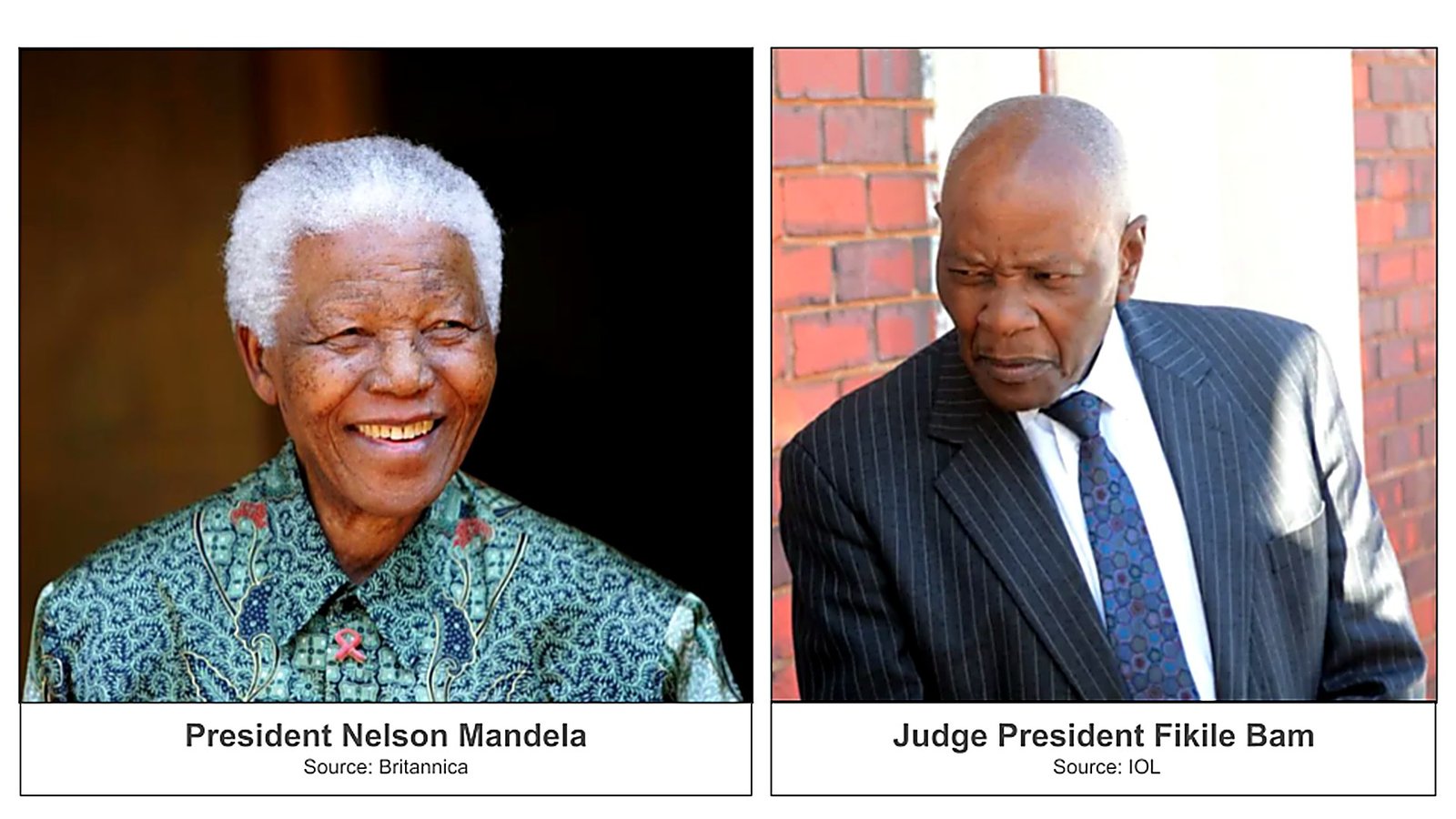
On 18 July 1918, in the village of Mvezo, Nelson Rolihlahla Mandela was born. Nineteen years later, on 18 July 1937, in the Transkei town of Tsolo, a boy named Fikile Charles Bam was born into the same century, the same region, and, though neither could have known it, the same date that history would eventually crowd with a single name. One of these men the world commemorates each year with sixty-seven minutes of service. The other, most of the country has never heard of. That asymmetry is not an accident of memory. It is a lesson about how nations decide what to remember, and it is worth interrupting. Next to what and how to remember is another equally important question, that is, why do you choose to remember what you remember the way you have chosen to remember it.
The face the nation chose, and the world abided
There is nothing wrong with Mandela Day. It is right that a democracy should hold a day for the man who gave so much of his own comfort and life, his energy, intellect and skill, to help forge a united nation and thus lead us out of conflict into a nation the Union of South Africa in 1910 had failed to accomplish. For, what 1994 represented was not the continuation of the all-white project of 1910, but a negation of that abysmal vision which had united South Africa on the basis of the total exclusion of the black majority from political participation.
Again, it is right that a democracy should hold a day for the man who walked out of prison and chose reconciliation over revenge, and it is right that the day should ask ordinary people to give something back. The observance is not informal sentiment, either: in November 2009 the United Nations General Assembly formally declared 18 July Nelson Mandela International Day, first marked the following year, and called on people everywhere to devote sixty-seven minutes to service: one minute for each of the sixty-seven years President Mandela gave to public life. No other South African has had a date on the calendar conferred by the community of nations. But a commemoration is also an act of compression. It takes a struggle that involved hundreds of thousands of people, dozens of organisations, and decades of disagreement about method and principle, and it files all of it under one face. The face is not false. It is simply insufficient.
There is a reason we reach for a single face, and it is not merely laziness. Human sympathy, psychologists have found, is calibrated to the individual rather than the multitude. The economist Thomas Schelling first noticed it; the psychologist Paul Slovic demonstrated it. We are moved by one identifiable person and grow strangely numb before large numbers, a dimming Slovic calls psychic numbing. A struggle of hundreds of thousands exceeds our emotional grasp; a single face fits inside it. To this the study of organisations adds what it calls the romance of leadership: the habit of crediting collective outcomes to one commanding figure, because a single author is a simpler story than a movement.
President Mandela understood the instinct, and resisted it. On the day of his release, 11 February 1990, he told the crowd:
I stand here before you not as a prophet but as a humble servant of you, the people.
In that same speech he saluted "our President, Comrade Oliver Tambo, for leading the ANC even under the most difficult circumstances," and insisted that "no individual leader is able to take on this enormous task on his own." The world needed a face and chose his; he spent much of his life pointing past it.
None of this unseats President Mandela. The nation chose him, and the world abided in that choice, for reasons that were real: twenty-seven years' imprisonment, a moral steadfastness that made him a symbol the world could rally to. Yet he never claimed the pedestal. He rejected it, insisting that he was “not a saint, unless you think of a saint as a sinner who keeps on trying.” It was the oppressed themselves who elevated him, for what he had done and what he had come to represent; the people saw themselves in him. That is why widening the frame costs Mandela nothing; it simply lets back into the picture the others who stood there with him all along.
For the eighteenth of July did not give the nation only one son. It gave us others, born into the same struggle and, in one case, the very same date, whose sacrifices we should equally resolve never to forget; the multitude that chose one face always had names of its own. One of them shared not only President Mandela's cause and his prison but his very birthday. One of them was a man from Tsolo.
The man from Tsolo
Judge President Bam was born in 1937 into a family with a long memory of land and dispossession in the Eastern Cape. He was clever in the way the system most feared: clever enough to move through it and out the other side. He took a BA in Law at the University of Cape Town, completing it in 1960, the year of Sharpeville, the year the state of emergency taught a generation of young Black South Africans that the law as it stood was not their protector but their jailer. His biography is the biography of a man who kept faith with the law precisely because he had seen it used as a weapon.
He did not join the African National Congress. He did not join the Pan Africanist Congress. This is the detail that the compressed history struggles to hold, and it is the detail that matters most. Bam belonged to a smaller, sharper, more heterodox current of the liberation movement, the tradition of the Non-European Unity Movement and its offshoots, which insisted on principled analysis over mass mobilisation, held to a strict opposition to collaboration with apartheid structures, and refused the easy comforts of a single vanguard party. It was a tradition rich in teachers and theorists, suspicious of personality cults. The struggle, in other words, was an argument as much as it was a war. Bam was on one of its less-travelled roads.
The Yu Chi Chan Club and the price of a different banner
In 1962, in Cape Town, Judge President Bam helped found a study group with an arresting name: the Yu Chi Chan Club, borrowed from Mao Zedong's treatise on guerrilla warfare. Its nine members — among them the philosopher and linguist Neville Alexander, and the young activist Dulcie September, who was jailed for five years in the same crackdown, driven into exile, and assassinated outside the ANC's Paris office in 1988 — were expelled adherents of the Unity Movement tradition who wanted to examine, seriously and unsentimentally, whether armed struggle was possible in South African conditions. The club soon reconstituted itself as the National Liberation Front. It was a small organisation. It was not a safe one.
The security police did not distinguish between large movements and small ones when the charge was the overthrow of the state. Bam was arrested, convicted, and sentenced to ten years' imprisonment. And so, in 1964, the very year the Rivonia Trial delivered President Mandela to Robben Island, where he arrived on 13 June to begin a life sentence: Fikile Bam was delivered to the same island by an entirely different trial, under an entirely different banner. Two trials, two organisations, one island, one year. He arrived a member of an organisation most South Africans have never heard of, to serve his sentence in the same place as the men whose names would later define the era. The point is not that Bam was Mandela's equal in fame. The point is that the prison did not care about the banner under which a man had been convicted. Apartheid was catholic in its enemies. So the struggle against it was necessarily plural, and the memory of that struggle should be plural too.
B Section, and an election across the divide
What happened next on the Island is the detail that ought to be taught in every school. Judge President Bam was placed in B Section: the isolation wing that held the political leadership, President Mandela and Walter Sisulu among them. And there, the prisoners of B Section elected Fikile Bam the first chairperson of their prisoners' committee: the body that negotiated, argued, and organised on behalf of the men in that wing.
Consider what that election meant. The men doing the electing were, in the main, ANC. The man they chose came from an entirely different political home, the small, clandestine current of the Unity Movement tradition, which had long defined itself against the ANC's Congress approach and competed with it for the intellectual leadership of the struggle. They elected him anyway. They elected him because, in the compressed world of that wing, character and competence outranked factional loyalty. It is one of the quiet miracles of Robben Island that a place designed to break men instead taught them to govern themselves across the very divisions the state was counting on to keep them weak. Bam's chairmanship is not a footnote. It is a working model of the non-racial, non-sectarian democracy the prisoners believed they were fighting for, rehearsed years before it was won.
It was in B Section, too, that Bam and President Mandela became close friends: two men who discovered they had entered the world on the same day. Bam would describe the bond, years later, in a jurist's careful phrasing: "We had what I would say [was] a very close relationship... We obviously were also made to be very close because we were both lawyers." He remembered Mandela precisely, a man who "never lost his cool, even when he was angry," who "tended to be softer in his voice when he wanted to make a point, but firmer." The Nelson Mandela Foundation records the small, human ritual that grew from that coincidence: each year, Mandela saved his meagre ration of Christmas sweets to give to Bam on the eighteenth of July, their shared birthday. In a place engineered to strip men of everything, the gift of a few hoarded sweets was an assertion that the human bond could not be confiscated. History remembers the speeches. It should also remember the sweets.
The law learned behind bars
Judge President Bam did on Robben Island what the state least intended its prisoners to do: he studied. He read law behind the walls, completing further legal qualifications through the University of South Africa, and emerged from a decade of imprisonment not broken but credentialed. He was not alone in turning a cell into a classroom: President Mandela would complete his own LLB through the same University of South Africa in 1989, in the final months of his twenty-seven years in prison. Released in 1974, at the end of the full ten-year term, he was admitted as an attorney in 1978 and joined the Johannesburg Bar in 1979, before being pushed into the Transkei. He would go on to direct the Legal Resources Centre in Port Elizabeth, serve on the Goldstone Commission that investigated political violence in the dying years of apartheid, and sit on the first democratic board of the South African Broadcasting Corporation.
This is a particular kind of biography. It belongs to the men and women who did not become presidents or premiers, but who built, brick by unglamorous brick, the institutional architecture of the constitutional state. The record of Bam's professional life is a record of that building. He was, in the words of Chief Justice Mogoeng Mogoeng, a man of "selfless and tireless service" and "unparalleled scholarly prowess." His colleagues called him "Bro Fiks." He was known for a calm that a decade of imprisonment had tempered rather than embittered.
Land — the freedom that was left unfinished
And then, in 1995, Fikile Bam was appointed the first Judge President of the Land Claims Court, the specialised court that opened its doors in 1996 to adjudicate the single most unfinished piece of business of the democratic settlement: the return of land to those from whom it was taken.
Understand the weight of this appointment. Political freedom (the vote, the constitution, the flag) was delivered in 1994. But the material dispossession on which apartheid and colonialism had been built was not undone by an election. That dispossession had a founding statute: the Natives Land Act of 1913, which confined the African majority, the overwhelming bulk of the population, to a small fraction of the country's land, and which set in legislative concrete a pattern of racial ownership that every subsequent apartheid law would deepen. Restitution, when it finally came, was an attempt to reverse eight decades of that engineering. The Commission on Restitution of Land Rights was constituted on 1 March 1995, and the Land Claims Court was created to give that restitution the force of law. Bam presided over it for some fifteen years, the longest-serving judicial officer in that role, building the jurisprudence of restitution from almost nothing, case by contested case, claimant by dispossessed claimant.
The work was neither quick nor clean. Land restitution in South Africa has been dogged by the slowness of adjudication, the difficulty of proving claims to land taken generations ago, and the sheer scale of what was stolen. Bam's court sat at the centre of that difficulty, and his patience, the same calm that his fellow prisoners had elected, was precisely the temperament the task demanded. He was not building headlines. He was building precedent, the slow accretion of reasoned judgments on which a more just distribution of land would either stand or fail. When he died in 2011, the Law Society of South Africa named the stakes with precision: as a pioneer of the Land Claims Court, it said, Bam had "contributed immensely to land reform jurisprudence," and would be missed "by the legal profession and by the still landless majority of South Africa." The phrase is a verdict on the man and on the unfinished work in a single breath.
It is difficult to imagine a more fitting destiny for a boy from Tsolo whose family carried the memory of dispossession, who had gone to prison under a banner most have forgotten, and who had learned the law inside the very institution meant to silence him. President Mandela's walk to freedom ended, symbolically, on 11 February 1990 and, constitutionally, in 1994. But Bam's work points to the longer walk, the one that does not end at the ballot box, because the wound apartheid inflicted was not only political but material, written into the ownership of the soil itself. That walk is not finished. Three decades on, land restitution remains slow, contested, and incomplete, and the debate about how to complete it is among the most consequential this democracy will have.
The lesson from next door: Kenya's heroes' day
South Africa need not invent this correction. There is a working example a few borders north. For decades Kenya observed Kenyatta Day on 20 October: a public holiday named for Jomo Kenyatta and built around the arrest of the nationalist leaders detained at Kapenguria in 1952. Even then, the day was less singular than its name implied: those leaders, the "Kapenguria Six," were six men, not one: Kenyatta among them, alongside Bildad Kaggia, Fred Kubai, Achieng' Oneko, Kung'u Karumba, and Paul Ngei. But the name fixed the memory on a single face.
Then, with the promulgation of Kenya's new Constitution in August 2010, the holiday was deliberately renamed. Kenyatta Day became Mashujaa Day, *mashujaa* is the Swahili word for "heroes", and its purpose was widened to honour all who contributed to Kenya's independence, and to its building in the decades since. The date did not move. The reverence did not diminish. What changed was the arithmetic of memory: a day that had belonged to one name was opened to the many who had earned a place in it. A nation decided, as a deliberate act of constitutional renewal, that a founder's day could become a people's day, and found that it lost nothing in the widening, and gained a great deal.
To remember Judge President Bam on 18 July is therefore to remember the part of liberation that the celebration tends to skip. It is easy to commemorate a walk that has a triumphant ending. It is harder, and more honest, to commemorate the walk that is still underway.
The single-face version of our history offers a comfortable settlement: the struggle was won, the saint prevailed, the story is complete. Fikile Bam's life refuses that comfort. It insists that the struggle was many people and many organisations, not one; that principled service was rendered by figures whose names never reached the currency; and that the freedom we mark each July is, in the dimension that touches land and livelihood, an inheritance only partly claimed.
This rejoinder on Fikile Bam is not meant to diminish the name of President Mandela. Far from it. No one can take away from our beloved doyen of our struggle his role in the struggle. It is meant to humanise Madiba, to make him a part of a people involved in a titanic struggle to restore their dignity. He was not alone. He never made any such claim. There were others. He knew that. Fikile Bam was one such. Not the only one, but one of many. The eighteenth belongs to them all, including those still engaged in a struggle to achieve social justice and restore to the black majority their unfinished claim to social justice.
So let the eighteenth of July hold two names, not one. Let it hold President Mandela, and let it hold the man to whom he gave his birthday sweets, the jurist of the unfinished freedom, who spent his life demonstrating that the law could be turned from a weapon of dispossession into an instrument of return. Let it hold all the other heroes and heroines, known and unknown (global, national and local), who gave their all for our struggle for social justice. Herein, we single out only two, but our society's rich tapestry is inundated with countless other Mandelas and Bams, male and female, whose sacrifices continue to exhort us to pay attention all the time to the less fortunate, the indigent, the children and others still yearning for the restoration of their dignity and the achievement of social justice. The country Judge President Bam served still owes the debt he spent his career adjudicating. Remembering him is not sentiment. It is a summons to finish the walk.
And let every community, each year on this day, name its own heroes and heroines (the local, the unsung) and hand them to the young to keep.
“The future is not an accident.”
Dr Malusi Gigaba is a Scholar-Statesman, an ANC NEC Member, a former Cabinet Minister of the Republic of South Africa, a Member of Parliament, and a member of both the Joint Standing Committee on Defence and the Portfolio Committee on Trade, Industry and Competition.