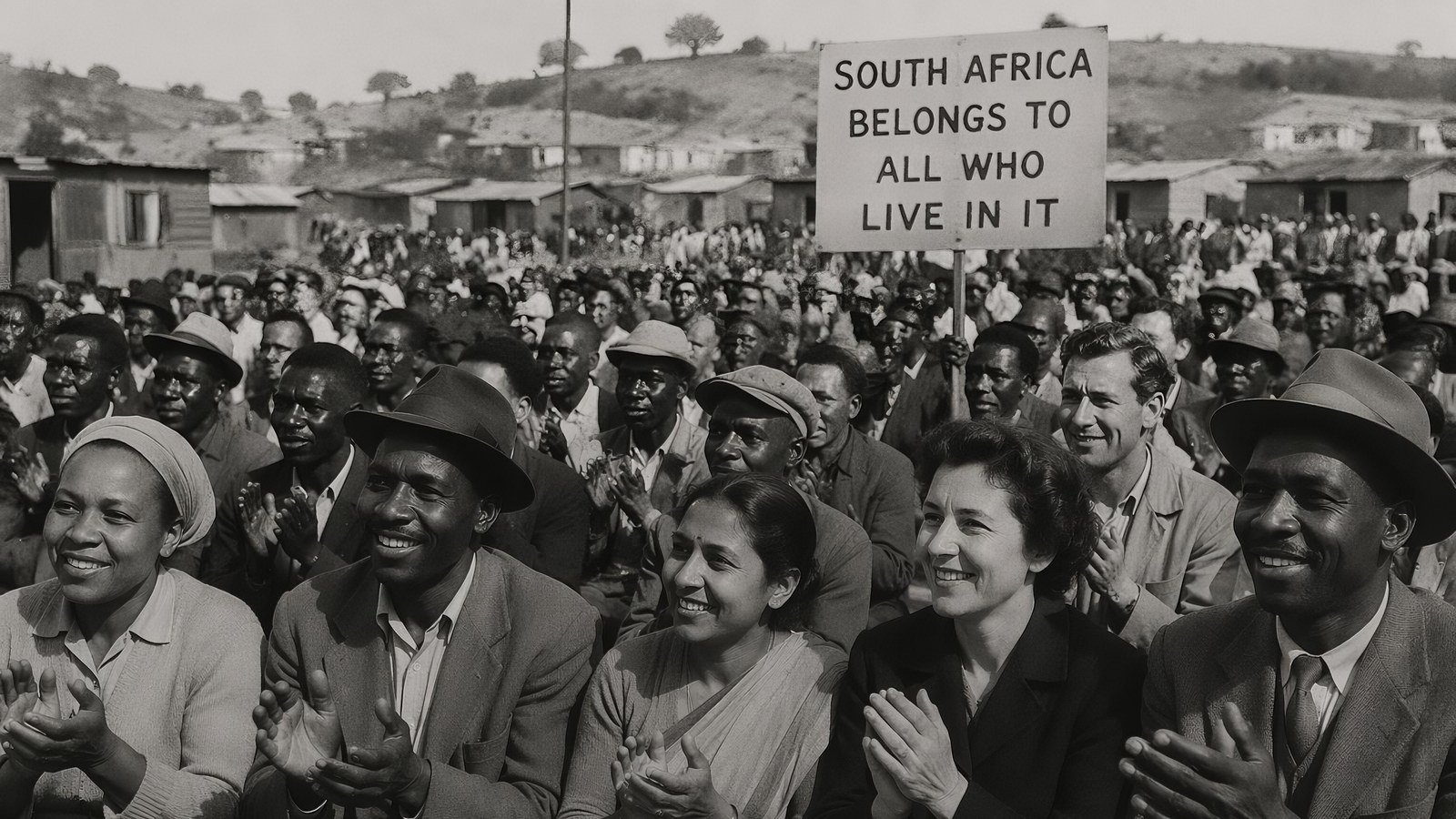
On a chicken-wire-enclosed field in Kliptown, on Sunday 26 June 1955, roughly three thousand ordinary people adopted a single page of demands and called it the Freedom Charter. Its first sentence did not speak of one race, one tribe, or one accident of birth. It declared that South Africa belongs to all who live in it, black and white. Seventy-one years later, that sentence has become the most quoted and the least obeyed line in the country’s political memory.
The idea, and the men and women who could not stand inside it
The Charter began as a proposal, not a slogan. In August 1953, at the African National Congress provincial conference in the Cape, Professor Z.K. Matthews suggested a national convention that would draw up “a Freedom Charter for the democratic South Africa of the future.” The idea was endorsed nationally that September. It drew its energy from the 1952 Defiance Campaign, the mass civil-disobedience movement that had given the liberation struggle a following far larger than it had ever held, and a question it had not yet answered: what, precisely, were these people demanding?
Allow me to borrow extensively from the ideas and words of the people behind the Congress of the People and the Freedom Charter, if only in brief to explain, using their own words, what the purpose of the Charter was. In a document entitled Congress of the People that was part of the ANC National Conference in 1954, held at Tongaat, it was said that:
“The South African people’s movement can be proud of its record of unbroken struggle for rights and liberty, but never have the mass of South African citizens been summoned together to proclaim their desire and aspirations in a single declaration – a Charter for Freedom. The drawing up and adoption of such a charter of freedom is the purpose for which the Congress of the People has been called. Never in South African history have the ordinary people of this country been enabled to take part in deciding their own fate and future. Elections have been restricted to a small minority of the population; franchise rights, particularly in recent times, have been threatened and curtailed. There is a need to hear the voice of the ordinary citizen of this land, proclaiming to the world his demands for freedom.”
— The Congress of the People, 1954
Then in 1956, Nelson Mandela said that the Charter was widely acclaimed and discussed by the democratic movement in South Africa, and constituted a serious and formidable challenge to the racial and anti-popular policies of the apartheid society. He wrote:
“The Charter is more than a mere list of demands for democratic reforms. It is a revolutionary document precisely because the changes it envisages cannot be won without breaking up the economic and political set-up of present South Africa.”
— Nelson Mandela, 1956
In a Freedom Charter commemorative article published by the ANC’s Sechaba publication in June 1976, itself a very tumultuous and history-making year, the very sentence reads:
“The time comes for every radical movement when to talk of ‘freedom’ is not enough. One has to paint a picture of it, give it substance, fill in the details. We reached that moment in South Africa in 1955… It was no longer good enough to know only what we were against: apartheid, race discrimination, poverty, oppression. This was the enemy and we had all seen its face for ourselves, and learnt to oppose it relentlessly. This was what we were against. But what were we for? Freedom in our lifetime? What was this freedom? What was its shape and colour, and what would it be like to live in? In 1954 we knew the time had come to give the ‘freedom’ shadow a South African substance. We were going to draw the picture of our future in as much detail as we could.”
— Sechaba, ANC, June 1976
The drafters of the Charter therefore viewed it as a crucial turning point, which forced the anti-apartheid movement to stop just complaining about what was wrong and start describing, in very specific terms, what the new, just society would look like. It transformed a vague dream of “freedom” into a detailed blueprint for revolution and a new nation which inspired successive generations of freedom fighters to fight relentlessly for freedom, knowing what they were fighting for. Over time, many of its clauses have remained open to interpretation by those who inherited the vision, upon whose hands now rests the inordinate task to bring the Charter to life.
There is an irony at the centre of the Kliptown story that is too often left out. The men who built the Congress of the People could not lawfully attend it. The then ANC President-General, Inkosi Albert Luthuli, was banned. He opened the Congress of the People through a Message read on his behalf. Walter Sisulu, the ANC’s Secretary-General until 1954 and one of the chief organisers of the gathering, ran the secretariat that convened it while under a banning order that made his presence illegal. Nelson Mandela, who had served as Volunteer-in-Chief of the Defiance Campaign, was banned. Ahmed Kathrada, who helped organise the event, was banned. On the day the people adopted the document these men had spent two years assembling, they were on the outskirts of the field, on the wrong side of the wire, watching a gathering they were forbidden to join.
That detail is not decoration. It is the argument. A state that must erase its own citizens from a public field, that must forbid organisers from attending the gathering they organised, has already conceded what kind of state it is. The banning order was a technology of forced non-belonging, an instrument designed to remove a person from public, associational, and political life, to make them legally absent from their own country. By 1955, some forty-two ANC leaders had been served with such orders. The leadership that authored a charter declaring that the country belonged to all who lived in it was itself standing at the margin, legally declared not to belong.
A charter built from below, under a watching state
What makes Kliptown singular is not that it produced a document. It is how the document was produced. Through 1954 and 1955, an estimated fifty thousand volunteers fanned out across townships, farms, and locations, collecting “freedom demands” from people who had never been asked what they wanted. The demands came back on pages torn from school exercise books, on scraps of paper, on the backs of leaflets, written in many languages, ranging from single lines to small essays. They were sorted by committee and drafted into a single text, its distinctive cadence usually attributed to Lionel Bernstein, one of the drafters. Neither Matthews, who proposed the idea, nor Chief Albert Luthuli, who was banned, saw the final draft before the day.
The gathering ran across two days, 25 and 26 June 1955. The Congress was attended by a total of 2 884 delegates from all over the country, 721 of whom were women. Africans made up 2 186 delegates, 320 were Indians, 230 were Coloured, and 112 Whites. Hundreds of other delegates were prevented from attending the Congress by the police.
Each clause was read aloud and adopted in turn. On the afternoon of the second day, the state answered. A detachment of police carrying Sten guns took the platform, confiscated every document they could find, announced that they suspected treason was being plotted, and recorded the name and address of every delegate before dispersing them. By then the Charter had already been read in full and adopted.
The seized papers became evidence. The following year, the state arrested 156 leaders of the Congress movement and charged them with high treason; the Charter itself was entered as proof of a revolutionary conspiracy. The 156 were not a fringe. Among them were Inkosi Albert Luthuli, the ANC president and future Nobel Peace laureate; Oliver Tambo, who would lead the movement through three decades of exile; Lilian Ngoyi and Helen Joseph, two of the women who that same year led twenty thousand marchers to the Union Buildings against the pass laws; and Professor Z.K. Matthews, the man who had first proposed a Freedom Charter, now charged with treason for it. Among the “subversive” items the police carried away from Kliptown and later produced in court were two catering signs reading “soup with meat” and “soup without meat.” The trial lasted four and a half years, until 1961, and ended in the acquittal of every accused. Included among those accused of conspiring to overthrow the state were all the people the regime had banished, who had thus been unable physically to attend the Congress of the People. The gap between a regime’s paranoia and a queue for soup is the whole measure of the thing.
Dr Malusi Gigaba on the 71st anniversary of the Freedom Charter, 28 June 2026. Source: YouTube.
The Charter was not an outlier in the process of struggle
The Freedom Charter was not an outlier in the entire process of struggle. The 1941 Atlantic Charter had raised hopes among Africans for post-war freedom. In response, the African National Congress convened a conference in December 1943, led by Dr A.B. Xuma, to interpret the Charter for Africa and draft a Bill of Rights. While it was drafted differently from the Freedom Charter, it was a product of a popular process which collected the popular demands of the people.
The African Claims sought to tailor the key principles of the Atlantic Charter to the specific context of Africans in South Africa, in order to effectively draw the attention of South Africa’s government and white population to the perspectives and status of African people. The African Claims insisted that a just and lasting peace was only possible if people of all classes, colours, and races were granted full participation in education, politics, and economic life.
The African Claims document clarified that vague terms like “peoples” must include Africans, and supported the Atlantic Charter’s principles but added key reservations: opposing territorial aggrandisement, demanding self-determination for African states, protecting the British Protectorates from South African incorporation, and calling for economic justice, labour rights, and the end of racial domination. The Bill of Rights in the African Claims demanded full citizenship for Africans in South Africa, including equal voting rights, the abolition of pass laws and segregation, land redistribution, fair labour and educational opportunities, universal healthcare, and the repeal of all discriminatory legislation.
However, the African Claims was still drafted from a point of weakness and victimhood, with the African leaders recognising that they would not be directly represented at the Peace Conference which would adopt the Atlantic Charter. They noted that only the government and white representatives would speak for the country at the Peace Conference, so they wanted both the government and the public to understand African aspirations. They called on the United Nations to recognise their interpretation of the Atlantic Charter, asserting their claim to full citizenship.
That notwithstanding, the drafters of the African Claims were very lucid as to the challenge at hand:
“As African leaders we are not so foolish as to believe that because we have made these declarations that our government will grant us our claims for the mere asking. We realise that for the African this is only a beginning of a long struggle entailing great sacrifices of time, means and even life itself. To the African people the declaration is a challenge to organise and unite themselves under the mass liberation movement, the African National Congress. The struggle is on right now and it must be persistent and insistent. In a mass liberation movement there is no room for divisions or for personal ambitions. The goal is one, namely, freedom for all. It should be the central and only aim or objective of all true African nationals. Divisions and gratification of personal ambitions under the circumstances will be a betrayal of this great cause.”
— Africans’ Claims in South Africa, 1943
The Freedom Charter therefore symbolised a radical departure from this approach. It not only made the demand for independence and national self-determination, but articulated that philosophy in practice by expressing the very clear view that all its demands are directed not at the then minority government, but at the new democratic government elected through popular will. Hence the view that none of the demands of the Charter would be realised until the political and economic structure undergirding white supremacist rule was overthrown. Only a people’s government would guarantee to the oppressed their full liberties.
The Freedom Charter remains to this day a foundational document that articulates a vision of a non-racial, democratic, and egalitarian society. Its significance today lies in its continued call for the redistribution of wealth, land, and power, demands that challenge the persistent inequalities of post-apartheid South Africa. The persistence of racialised poverty, land dispossession, and economic exclusion mean that the vision of the Charter remains unattained.
Thus, the Charter serves as a benchmark for continued mobilisation for structural transformation: inclusive growth and redistribution, equitable land reform, a decent wage, and sustainable livelihoods. The Charter remains a uniting vision for a future free of white supremacy and neo-colonialist domination, a national democratic future.
The Charter’s true meaning is not as a historical relic, but a living manifesto for ongoing struggle against racialised capitalism and elite reform, urging a decisive break with the compromises of the negotiated settlement so that we forge ahead with the pursuit of genuine emancipation. It insists that freedom cannot be achieved without economic justice, making it a rallying point for those who view South Africa’s democracy as incomplete without a radical restructuring of society. After all, this was what the ANC’s 1969 Strategy and Tactics said.
What the document actually said about Africa
The Charter is remembered as a national text. Read in full, it is a continental one. Its closing section, “There Shall be Peace and Friendship,” reaches deliberately beyond the country’s borders. It recognises “the right of all peoples of Africa to independence and self-government,” and it insists that the people of the three British protectorates then bordering South Africa, the territories that would become Lesotho, Botswana, and Eswatini, “shall be free to decide for themselves their own future.”
This was not rhetorical generosity. In June 1955, the independent African state was almost a theoretical category. Only four sovereign African countries existed: Liberia, Ethiopia, Egypt, and Libya. Sudan would follow in 1956, Ghana in 1957, and the seventeen states of 1960 had not yet been born. When the people at Kliptown recognised the freedom of other Africans as a condition of their own, they were recognising something that did not yet exist on most of the map. The Charter spoke for a continent that was still, in its overwhelming majority, colonised.
But the Charter became the basis for a statement of solidarity with fellow African countries still reeling under the yoke of colonial oppression. From it grew the movement’s rebuke of the apartheid regime’s campaign of terror against the Frontline States, and its assurance to fellow African countries and peoples of the solidarity of a free and democratic South Africa. In its name the ANC would pledge to maintain close relations with its neighbours, to abolish the veiled threats and economic pressure against neighbouring countries, to take its rightful place within the Organisation of African Unity, to strengthen Pan-African unity in all fields, and to support the national liberation movements of the peoples of the world against imperialism, colonialism and neocolonialism, forging diplomatic relations with fellow African states on the basis of mutual respect for each other’s independence, sovereignty and territorial integrity.
Of course, this demands that South Africa and its neighbours should work together to promote mutual interests of economic growth and development, cultural and sports exchanges and interaction, and collaborate in fighting cross-border and international crime and other security threats. In a world confronted by cross-border, organised syndicates, no country can face that risk alone. Whilst borders still exist, we should strive to promote regular movement between our countries by documenting our respective nationals, respecting each other’s borders and, above all else, promoting regional and continental African solidarity for economic growth and development. We should all act together to ensure the security of women, children, the poor and working-class people who remain the most vulnerable migrants, whether within or beyond national borders.
The definition of belonging the Freedom Charter chose was deliberate. The country, it said, belonged to all who lived in it, not to those born to the right blood, the right tribe, or the right ancestry. Belonging was anchored in residence and shared humanity, not in nativity. That is the precise clause that the present moment tests.
A date the whole continent turns out to share
The continental reading of Kliptown is not an interpretation imposed afterward. The people in that field understood themselves to be part of something larger, and said so. Two months earlier, in April 1955, the Asian-African Conference at Bandung had condemned racial discrimination and named apartheid South Africa directly.
Apartheid South Africa was excluded from Bandung. Its liberation movement refused to be silent. Two men, Moses Kotane of the ANC and Maulvi Cachalia of the South African Indian Congress, set out to carry the country’s message to the conference regardless. The government had refused them passports, so they left without any, slipping out of the country and reaching London with no papers to show. There the Indian High Commission, on Jawaharlal Nehru’s authority, issued them Indian travel documents, and on those they made their way to Bandung by way of Cairo and New Delhi, shadowed by police to the moment they left London. The detail is worth holding onto, because it inverts the usual picture. The apartheid state could withhold their passports; it could not withhold them from the conference. They were not the ones turned away. Bandung seated apartheid’s victims and excluded apartheid’s government, and received Kotane and Cachalia as the authentic voice of South Africa. And when it was over, Kotane did not creep home. He flew back into Jan Smuts Airport in December 1955, his banning order still in force, to four hundred people singing Nkosi Sikelel’ iAfrika on the tarmac. A man the state had tried to render paperless and invisible walked back through the front door of his own country to a hero’s welcome.
When Kliptown opened, messages of solidarity were read into it from across the world, including one from the African-American artist and activist Paul Robeson, who tied the gathering to Bandung and wrote that “Claimed by her people, liberated Africa shall soon — yes, in our day — rise to greatness in the world.”
There is a further coincidence of the calendar that the Charter’s authors could not have arranged. The 26th of June is a continental date several times over. On that day in 1913, in Martinique, Aimé Césaire was born, the poet who would help name the Négritude movement and insist on the right of colonised people to define themselves. On that day in 1960, Madagascar took its independence. The Freedom Charter, Césaire’s birth, and an African independence share a single square on the calendar. It is a useful accident, because it makes visible what the document already contained: the conviction that the right of a people to govern, the right of a self to be named, and the right of a nation to exist are versions of one principle, and that the principle does not stop at a border.
The contest over who belongs
The definition of belonging the Charter chose was contested from the first day, and it is worth being precise about how. A faction within the ANC, the Africanists, rejected the line that the country belonged to all who lived in it, “black and white.” They held instead to a vision of government of the Africans, by the Africans, for the Africans. In 1959 they broke away to form the Pan Africanist Congress under Robert Sobukwe.
That disagreement must be read honestly, because it is easy to misread. The Africanist “African” was an anti-colonial category, a claim about who should hold power in a land dispossessed by conquest. It was not a claim that fellow Africans from beyond the country’s borders were foreigners to be feared. Neither side at the founding of the liberation movement imagined belonging as a weapon to be turned against other Africans. The argument of 1955 was between two definitions of a shared liberation, not between welcome and hostility.
Which is what makes the present moment so disfiguring. The hostility that now periodically turns on African migrants, the politics that measures a Zimbabwean, a Mozambican, a Somali, or a Congolese against an idea of national belonging and finds them wanting, has no parent in the founding argument at all. It is not the Africanist position and it is certainly not the Charterist one. It is a third thing, a nativism that the men at Kliptown, banned and standing at the edge of their own gathering, would have recognised immediately, because it was the logic used against them. A state, or a society, that decides some Africans belong and others do not is not completing the work of 1955. It is reversing it.
None of this is an argument against borders, or against the right of a state to regulate who enters it and on what terms. A country is entitled to know who crosses its frontier, to set the conditions of lawful residence, to require documentation, and to administer migration in an orderly and lawful way. Belonging, in any functioning state, is still something that has to be regulated; the Charter neither abolished that responsibility nor asked the country to. To read “South Africa belongs to all who live in it” as a licence for unregulated entry, or as a promise that residence without status carries the same claims as citizenship, is to mistake a principle for a policy. The distinction that matters is between regulation and hostility. Administering a border is the ordinary, legitimate work of a state. Treating fellow Africans as enemies, making the migrant the answer to a domestic grievance, is something else, and it is that something else, not the rule of law, that betrays the founding clause.
Sophiatown, in the same year, a few kilometres away
The Charter did not arise in a year of calm. It arose in the same months that the state was demonstrating, in concrete and rubble, its own theory of who belonged where. On 9 February 1955, four months before Kliptown, the government began the forced removal of Sophiatown, a racially mixed freehold suburb of Johannesburg where black residents could own land. Some two thousand armed police moved the first families out. Over the following five years, around sixty thousand people were removed, and they were relocated to Meadowlands, in the township complex of Soweto.
Kliptown is part of Soweto. So at the very moment the state was bulldozing a multiracial community to feed the segregated grid of the new township, citizens gathered within that same township to declare that South Africa belonged to all who lived in it. One definition of belonging was written in demolition orders. The other was read aloud off a torn exercise book. They occupied the same square of the same map in the same year. The country has spent seventy-one years deciding which of the two it actually meant.
What the anniversary asks now
It is tempting, on an anniversary, to treat the Freedom Charter as a finished achievement, a relic to be honoured and set down. Its own history forbids that. The document was not handed down by leaders; it was collected from below, by volunteers, from people on farms and in locations who were never expected to have a view. It was adopted by a gathering its own architects were forbidden to enter. It was carried into a treason trial as evidence and survived. It outlasted the banning orders, the removals, and the regime itself, and its central sentence was eventually written into the preamble of the country’s Constitution.
The question it leaves is not whether the sentence is beautiful. It is whether the country still means it. A promise that the land belongs to all who live in it cannot be narrowed to all who were born here, or all who share a language, or all who can prove a lineage, without becoming a different promise altogether. The men who watched from the edge of that field in 1955 understood what it cost to be told, by the power of the state, that you do not belong in your own country. To turn that same instrument on other Africans is not to defend the Charter. It is to take the side of the wire.
The work that remains is the oldest work there is: to decide, and to keep deciding, who counts as one of us. Kliptown answered that question once, in a field, under guard, in the plain words of people who had nothing and asked for everything. Seventy-one years on, the answer is not self-enforcing. It has to be chosen again.
“The future is not an accident.”
Dr Malusi Gigaba is a Scholar-Statesman, an ANC NEC Member, a former Cabinet Minister of the Republic of South Africa, a Member of Parliament, and a member of both the Joint Standing Committee on Defence and the Portfolio Committee on Trade, Industry and Competition.