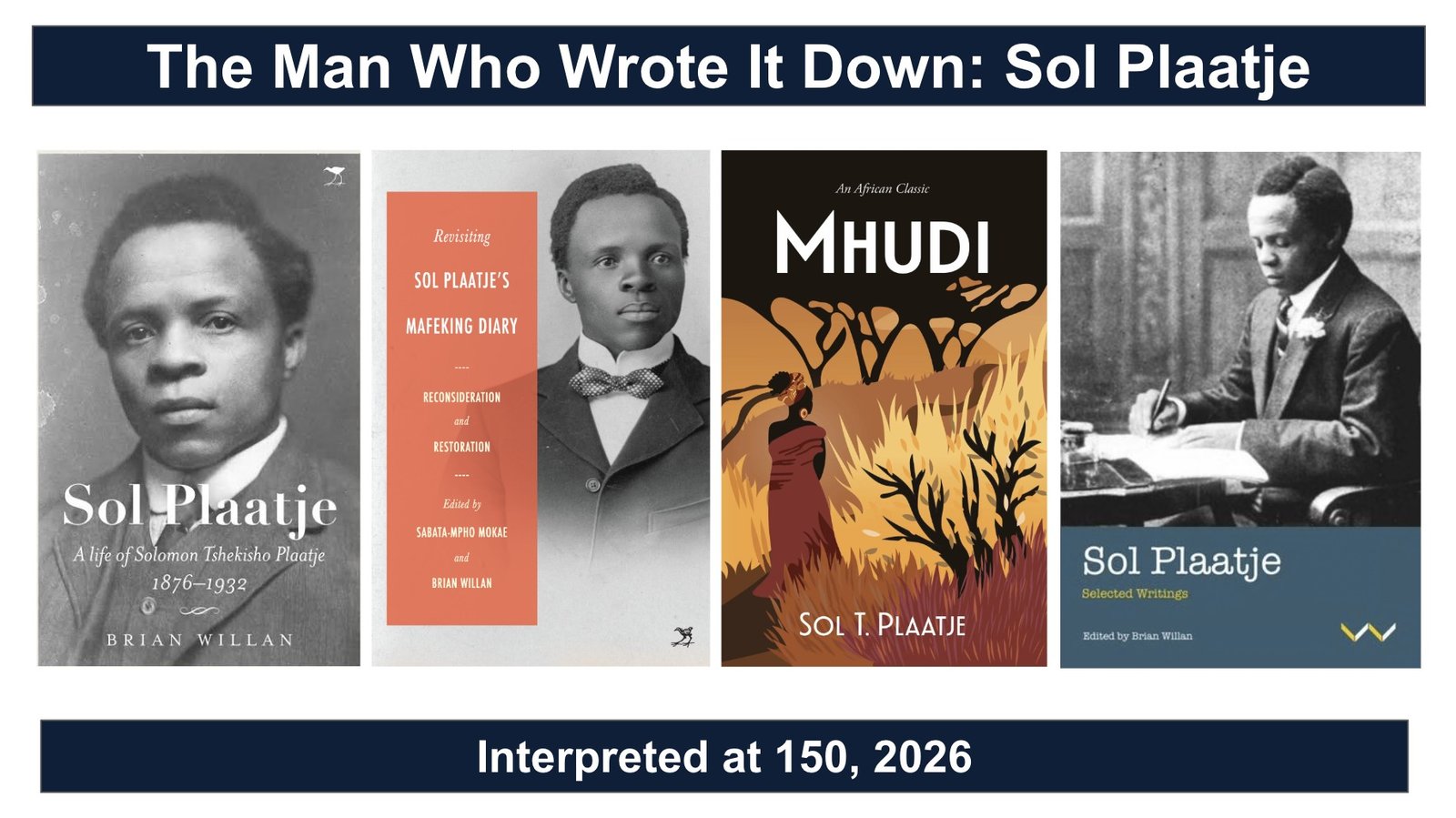
Four books by and about Sol Plaatje, from left: Brian Willan, Sol Plaatje: A Life of Solomon Tshekisho Plaatje, 1876–1932; Sabata-mpho Mokae and Brian Willan (eds), Revisiting Sol Plaatje’s Mafeking Diary; Sol T. Plaatje, Mhudi; and Brian Willan (ed.), Sol Plaatje: Selected Writings.
This month the 150th anniversary of Sol Plaatje’s birth is being kept, and Sol Plaatje University in Kimberley has set aside a week for it. The month has already brought a dedicated essay on him, Janet Remmington’s “Sol Plaatje at 150” in The Conversation Africa, and I draw on it below.
I write as a member of the National Executive Committee of the African National Congress. In 1912 Plaatje became the first general secretary of the South African Native National Congress (SANNC), the body that became the ANC. The man who took that office had already been a court interpreter, a diarist and a newspaper editor. He was a good deal more than the office he held in the SANNC.
Two weeks into the siege of Mafikeng, on Sunday 29 October 1899, a twenty-three-year-old court interpreter opened a notebook and began to write. The siege belonged to the Anglo-Boer War, fought from 1899 to 1902 between Britain and the two Boer republics, the Transvaal and the Orange Free State. Boer forces had surrounded the small border town of Mafikeng, held by a British garrison under Colonel Robert Baden-Powell, and cut it off for months. Plaatje never stated explicitly why he started the diary, as Brian Willan, whose fourth book on Sol Plaatje appeared in 2018, notes. The town was full of people keeping diaries, among them the magistrate he worked for, and Willan writes that even without their example Plaatje “would have needed little encouragement”.
That notebook is why most of us know Plaatje’s name from the siege. It is not the best clue to what he was. For more than a decade, from the year before the siege until he left for Kimberley, where he and others started a newspaper in 1910, he lived and worked in Mafikeng. He began there as an interpreter, and an interpreter is a particular kind of person: the one through whom everyone else speaks.
In August I published an article on this platform about 26 women the record must never lose. One was Krotoa, an interpreter. The First Is Never the Only tested what we mean when we call someone first. Plaatje is the other half of that story: an interpreter who kept the pen. I want to ask what that cost him, and what it left us.
A word on names. Mafikeng is Setswana for “place of rocks”, and the town is officially Mahikeng today. I use Mafikeng throughout, except where I quote or name someone else’s words. What follows rests on the record: what Plaatje wrote, what he said to a commission of inquiry in 1904, what a phonetician wrote about him, and the historians who have read his papers most closely.
What an interpreter carries
Plaatje applied on 5 August 1898 for the post of interpreter to the magistrate’s court in Mafikeng. He had spent four and a half years as a messenger and letter carrier at the Post Office in Kimberley. His formal schooling was at the Pniel mission school, where at thirteen he passed the Standard IV examination. Pniel was the only formal education he received. The rest he built himself. He later called the Post Office his “educational institution”, and in Kimberley he joined a society whose aim was to cultivate the use of English. In that application he listed six languages he could translate into and out of, among them English, Dutch, German, Sesotho and Setswana. Six languages, from a young man who had passed Standard IV at thirteen. Silas Molema had recommended him. He started on 1 October 1898 under the magistrate and civil commissioner, Charles Bell, and he went to live in Molema’s house.
Bell was himself a fine linguist and a stickler. On Plaatje’s first day, Plaatje recalled, Bell told him that interpreting in court and interpreting at the sale of a cow were two different things. In 1909 Plaatje wrote a treatise of his own on the subject and called it “The Essential Interpreter”. Willan’s thesis describes it as unpublished. It sits among the Silas Molema and Plaatje papers at Wits, and Willan describes and quotes it in his doctoral thesis.
What does it say? That a court interpreter is someone a man’s liberty can turn on. Plaatje wrote that every court needed more than a human tool for turning one sentence into another. It needed a conscience that would never allow “augmentation or garbling”, and an interpreter who added something to free an unfortunate prisoner was, in his view, as much at fault as one who added something to condemn him.
When the war came his work grew. He was appointed Dutch interpreter to the Court of Summary Jurisdiction, because the staff interpreter, a white man, could not manage Dutch. He drew up the reports of the Barolong runners and spies for Bell, and so, through Bell, for Baden-Powell’s intelligence. Bell described the reports as “a true record of what happened, from a Native point of view”. And Bell, who kept a diary of his own, asked him to type it up, and Plaatje did.
What does interpreting ask of a person? It asks him to stand between two parties, carry the words of each to the other, and be trusted by both because he is understood to add nothing. He is in the room for everything and the author of none of it. A strange schooling for a writer, and the right one.
He did not lose his sense of the absurd. Of one sitting during the siege he wrote that the plaintiff’s attorney was in military dress and the lawyer for the defence unshaven and without a collar, while he himself, in knickerbockers and no jacket, looked more like “a village cyclist than a court interpreter”.
A room in Silas Molema’s house
He shared a room in Molema’s house with a friend, David Phooko, who was clerk and interpreter to the Inspector of Native Locations. Some of the entries for December 1899 and January 1900 are in Phooko’s hand. Plaatje dictated, Phooko wrote, and Plaatje went over the pages afterwards, making corrections. So the man who kept the pen handed it, for some entries, to a friend. Willan counts those entries among the most amusing passages in the diary. Phooko’s own diary has not survived.
His wife, Elizabeth, had left for the safety of the south of the Colony some weeks before the siege began. Willan reads the diary as a record Plaatje could one day share with her and, if he did not survive, something for her to treasure. On 25 March 1900 Plaatje wrote that the “worst news I have received for months” was that Emang Marumolwa, who cooked and cleaned for him, was being called home by her mother.
Small things like these are the point. They show a man with a household and a cook to worry about, inside a besieged town.
Whose war it was
He was funny about the war, and not only about court dress. In his first entry he wrote that “no music is as thrilling” as listening to the guns on your side. The same entry has a word for the Maxim gun taken straight from the English and bent into Setswana, makasono. An interpreter’s ear had caught it on the first day.
The story the British told themselves was that this was a white man’s war. Willan puts it plainly: if one needed to disprove that notion, the diary is perhaps the single most striking piece of evidence there is, “unambiguous evidence” of the extent of black involvement in the defence of Mafikeng.
I do not want to flatten him. Plaatje was at once a loyal British subject and a Morolong at home among his own people, and he moved between the two with ease and, at times, plain enjoyment. He was also a government clerk, and the diary shows it. The Plaatje of 1899 had not yet met the disappointments that came with Union.
The notebook in the scrapbook
For seventy years the diary was unknown beyond the family. In 1969 the anthropologist John Comaroff, doing doctoral research, was handed a leather scrapbook by Plaatje’s grandson, Barolong Molema, and the diary was in it. Macmillan published it in 1973 as The Boer War Diary of Sol T. Plaatje, with later editions in 1989 and 1999 allowing a more accurate rendering of the handwritten original.
The manuscript is held at the University of the Witwatersrand: 180 pages in two notebooks. Wits describes it as containing the only known surviving written account of the siege by an African. Willan is more careful. He calls it one of the very few diaries by Black South Africans of the nineteenth and early twentieth centuries to have been written, or at least to have survived. He adds that historians have mined the diary for evidence, but few have read it as writing: nearly fifty years after the first edition he finds it neglected as a text in its own right.
What the notebook leaves out
Any diary leaves things out, and it is worth asking what this one leaves out.
On 31 December 1899, Willan writes, Baden-Powell wanted the Barolong paramount chief, Wessels Montshiwa, removed. Bell’s own diary records that the purpose of the meeting was to tell the chief that business would in future be done with his counsellors. Willan calls Plaatje’s diary “surprisingly reticent” here: it records that the Colonel and the Civil Commissioner came down to settle an issue among the chiefs, and says nothing of his own part. Modiri Molema wrote that Plaatje refused to interpret at the meeting once its purpose was made clear. Molema put it in images from Setswana: Plaatje was not a seraba, a bag of charms that his employer could use to make him translate, nor a serankure, a single-stringed instrument, to be used at will.
Whose mouth is speaking? That is Krotoa’s problem turned round. In the chief’s kgotla, on Molema’s account, Plaatje would not lend his.
Plaatje also interpreted in the Court of Summary Jurisdiction, where Africans were tried for theft or for spying for the Boers. Official records show that six or seven of them were executed. Willan notes that the diary does not mention the execution of 25 January 1900. In March, he writes, the diary says only “the horse thieves sentenced”; they were executed two days later. A second case followed a fortnight afterwards.
Plaatje’s last entry is dated 30 March 1900, nearly seven weeks before the siege was lifted. Willan suggests that Plaatje stopped because the diary had become too painful to go on with. It is a suggestion, and we can never know. To me the omissions read as the work of a man doing a job in the middle of a war, and not of a man composing a monument. The silences are not a flaw in the diary. They are where the interpreter stands.
The newspaper and the witness
The war ended in 1902. The newspaper had begun before it. The first issue of Koranta ea Becoana appeared on 27 April 1901 as a one-page Setswana insert in the Mafeking Mail, which spelt the town’s name the British way. It was not the first African-language paper. John Tengo Jabavu’s isiXhosa Imvo Zabantsundu had begun in King William’s Town in 1884, and in the 1880s the London Missionary Society’s Mahoko a Becwana offered Setswana readers a paper of their own. What the Cambridge article marks as new about Koranta is that it was the first Setswana newspaper produced weekly.
In September 1904 the South African Native Affairs Commission took evidence in Bechuanaland, and Plaatje stood in the room twice. First he translated for the Chief, Badirile Montshiwa. Then he was examined himself, as “Native Editor”, and the printed minutes of evidence keep his answers. He gave his age as twenty-seven. Asked how he came to edit a paper, he said, “I just started it as an enterprise”. Asked whether he had begun the paper, he said yes: “I began the paper, and one of the Chiefs financed it”. By then his years as a court interpreter, which Willan dates from 1898 to 1902, were over, and the money behind his work was a chief’s, not the state’s. Asked its object, he said, “Supplying information to my people”. Asked who wrote it, he said he did, in English and in Setswana, with no white writers.
I do not want a Plaatje of 1904 who already speaks in the voice of 1912. Stephen Volz, whose study of the paper was published this year, shows a paper that wanted educated Africans spared the choice between becoming “Black Englishmen” and being left as disenfranchised “Natives”. Plaatje and his readers expected British law to serve them, and Volz records that they were sadly disappointed. The weekly run ended in 1904, the paper appeared only sporadically until 1909, and by 1910 Plaatje was in Kimberley, where he and others started Tsala ea Becoana.
The interpreter who was recorded
In 1915 and 1916 Plaatje worked in London with Daniel Jones, a leading phonetician of his day. Jones’s preface to A Sechuana Reader in International Phonetic Orthography, published by the University of London Press in 1916, says they had constant meetings between May 1915 and September 1916, and credits Plaatje with “unusual linguistic ability”. The first twelve texts were written specially by Plaatje. Jones states that the pronunciation the book records is that of Mr Plaatje, and that, as far as he knows, no one had before attempted to determine the precise nature of the language’s tones.
Put plainly: the sound of Setswana as one man from Mafikeng said it in 1916 is on the page, in an alphabet any linguist can read. In his own preface Plaatje wrote that it would be a blessing if missionaries knew phonetics, for their congregations would then be spared “wrong words, some of them obscene”. He had spent years as the voice others spoke through. In this book it was his own language that others would learn to speak.
Seven years later his voice was captured again, this time on shellac, the hard, brittle material gramophone records were pressed from in those years. On 16 October 1923, for the Zonophone company in London, with Sylvia Colenso at the piano, he sang a set of songs that included the hymn Nkosi Sikelel’ iAfrika. Her voice can be heard repeating the refrain. The Flat International archive credits him with making the first recording of the hymn.
Going back for it
The diary alone did not take him far from his own moment. The books that followed did. Native Life in South Africa, which he published in 1916, has a first chapter called “A Retrospect”, which explains the Land Act of 1913 by looking back to the Union of 1910 and the old Republics’ and the Cape’s native policies. In it he wrote that on 20 June 1913 the South African Native “found himself, not actually a slave, but a pariah in the land of his birth”. Mhudi, finished in 1920, is subtitled “An Epic of South African Native Life a Hundred Years Ago”. A recent anniversary essay reads it as a corrective to official Afrikaner versions of the past and an addition to Barolong historiography. In 1899 he wrote history as it happened. Later he went back for it.
The interpretation we must always contest and never allow to be appropriated
There are many ways to write about a prominent figure such as Sol Plaatje. One is to venerate him, and simply praise him. This is a man who overcame adversity to become one of the most influential figures in history, and who left an indelible mark on his people’s memory.
Another is to write about him as a victim of colonialism, a subject person whose freedom, like that of his people, was taken away by colonial invaders. In this telling he is a victim, an object of history, and all we must do is pity him and forget his many talents, his intelligence, his leadership and his ability to turn adversity into strength.
A third is to look at him as a figure divorced from the concrete conditions in which he was born, grew up and lived. This often happens when liberal historians, mostly white, appropriate a historical black figure, disfigure him and portray him on terms acceptable only to the liberal discourse, where he does not threaten the status quo but simply becomes a “common liberal”.
This is the liberal way of portraying historical black figures, from Plaatje to Mandela and others. It is how they disfigure these revolutionary figures in their contestation of the meaning of their lives, and it leads to the erasure of the memory of these personages as revolutionary figures in their time and throughout history.
Plaatje was the Congress’s first general secretary, so the question of what kind of movement it was is partly a question about him.
In a political lecture I presented on Dr John Langalibalele Dube in 2012, the year of the ANC’s Centenary Celebrations, I said:
“A major challenge faced by Dube and his comrades was how to engage the British and the Boers after the construction of a new political order, the Union of South Africa, which consolidated white domination and formalised the exclusion of Africans from the public affairs of their motherland. According to the ANC under Dube, the formation of the Union was an opportunity lost – an opportunity to create a political order where blacks and whites could exist and live side by side as equals and/or in harmony.
“Of course, the Boers and the British saw it differently: for them this was an opportunity to consolidate their control over the productive capacity of our emerging economy, which was undergoing rapid industrialisation following the discovery of gold and diamonds in the late 1800s, and to resolve the native question on the basis that the native would relate to the new Union from his position as cheap and super-exploited labour, without any political or other basic human rights.
“Having due regard to the fact that the formation of the Union was still in its infancy in 1912, it is not inconceivable that the fight for a place in the ordering of our public affairs, as compared to a confrontational fight for freedom, was seen as a better alternative. Bearing this in mind, one can understand why the ANC elected to petition rather than to protest.
“White rulers found the idea of African subjects questioning their legislative programmes and administrative arrangements indeed their God-given political authority, distasteful. Even more objectionable to them was the practice of Africans approaching the Governor or appealing to the British parliament. It can therefore be said that the methods employed at the time, the objects of such methods, the level of development and sophistication of our economy, the methods used by the ANC were not just an alternative to war but considered lawful and effective means to engage the white rulers.
“It was accepted that in civilised nations where reason and rationality prevailed, deputations and petitions had to yield results. Of course, in South Africa, the passage of time was to prove that rationality and reason were foreign to the Boers and British rulers.
“The ANC of 1912 fashioned itself an active role in the institutional politics of the Union. It required a leadership that had the wisdom and the discipline to engage the white rulers on equal footing. At its meeting in Mangaung, the inaugural conference had to sift through highly gifted and educated leaders of our people, the teachers, the lawyers, the clergy and the princelings of the scattered African royalty.”
We now tend to think of that kind of petitioning as polite and largely ineffectual. It was not seen that way at the time.
The men who built the Congress came from the educated elite. C. C. Saunders traces the origins of African nationalism in the Eastern Cape to a new African elite, the product of mission education, whose politics he characterises as essentially accommodationist and defensive. Among the Congress’s own stated aims, South African History Online records, was loyalty to the British Crown and all lawful authorities. A reader can fairly call that heritage liberal.
Whilst understanding the limitations imposed on them by the material conditions of their existence and by the education they had imbibed from colonial governments, the fact that they were already developing a semblance of African nationalism defines them as far from being “common liberals”. There were already offshoots of radicalisation, which would find their full expression in the 1940s, in the midst of the Second World War and the radicalisation of workers and youth in universities and black townships.
Plaatje the leader: a man who served
Plaatje stands as one of South Africa’s most remarkable yet understated champions of justice, a man whose insight into the dispossession of his people was matched by his commitment to their cause. Through his writings he chronicled the devastation wrought by colonial legislation with a clarity that still cuts to the bone.
He deserves that praise, and he should not be reduced to it.
His analysis went beyond observation to indictment. Native Life in South Africa is his protest against the Land Act of 1913, which barred Africans from buying or hiring land across most of the country, and what he knew he put on the record in his own name.
Leadership, for him, was a matter of service before it was a matter of office. Lucien van der Walt records in his biographical entry that Plaatje wrote for Umteteli wa Bantu and was offered its editorship, and that he was offered the presidency of the South African Native National Congress and declined it, partly because of family pressures.
A man of letters, politics and principle, Sol Plaatje embodied a leadership defined not by position but by service. In an age that demanded silence, he spoke. In a system designed to erase, he documented. And in a struggle that continues, his words remain a testament to one man’s refusal to be anything less than fully human, and to his determination that his people should be seen as nothing less.
What “first” records
In August I held the word “first” to a few tests: state the claim in the narrowest terms the record will bear, show the collision where two claims meet, and print the disagreement where a date cannot be settled. Plaatje’s firsts are a fair test.
Mhudi is described by its editors, Sabata-mpho Mokae and Willan, as the first full-length novel in English written by a Black South African. The words that carry the claim are “full-length” and “written”. Plaatje finished it in 1920, and it was printed in 1930. R. R. R. Dhlomo, a journalist and novelist, published a much shorter book, An African Tragedy, in 1928. So the word “full-length” is doing work. Dhlomo’s book was printed first, and Plaatje’s is the longer one.
His Shakespeare raises the same question. Plaatje translated several of the plays into Setswana, but only two were published: Diphosho-phosho in 1930, and Dintshontsho tsa bo-Juliuse Kesara, from Julius Caesar, in 1937, five years after his death. Willan writes that the rest have been lost. Nor were his the first Shakespeare in an African language. In a conference paper Willan reports scenes from King John acted in English and Setswana at a school in Bloemfontein in late 1876, and calls it “the first record we have of Shakespeare being translated into any African language by a native-speaker”. Translation of Shakespeare into an African language goes back to 1876, more than three decades before Plaatje began, and he was still among the early translators. The work says something about the man. You cannot translate what you have not read, and choosing which plays to put into Setswana took reading well beyond two titles. It was a reader’s work, from a man whose formal schooling ended at a mission school.
None of this makes him smaller. A man called first at so many things is easy to turn into a statue. The record shows a man whose novel waited ten years for a printer, and whose hymn went out on a disc in 1923. Firsts are what other people count. What he did was the work.
What he is owed
The building in Pretoria that housed the Department of Education has carried his name since 15 June 2000. A university in Kimberley, which opened in 2014, is named after him, and its anniversary week included a panel and a lecture from Willan.
What do we owe a man who carried everyone else’s words? Readers. The diary is a fair warning about the rest: used as evidence, honoured in name, less often read as writing. Remmington reminds us in that essay that Plaatje was called a “walking library”, and a walking library is a poor thing to leave unopened.
The 1904 evidence is the easiest place to start, because it is free. The Commission’s fourth volume is online on the Five Hundred Year Archive’s EMANDULO site, and Plaatje’s examination runs from page 264 to page 270. Read the Chairman’s question at 37,622, which asks whether, having translated the Chief’s replies, he agrees with them. In 1909 Plaatje wrote that a court needs an interpreter who adds nothing. The man who had made that his trade answers: “I would not say that I do.”
For his years in the state’s service he had been the voice other people spoke through. In that room an official body asked him, on the record, what he himself thought. That is the cost the opening asked about. An interpreter is safe so long as he adds nothing, and Plaatje left the state’s service, wrote for his own people, and when asked, said what he thought.
He interpreted the court, kept the record and edited the paper. An interpreter’s work is finished when the other person has understood. Plaatje carried a great deal across for a great many people, and the work of understanding him, of reading what he wrote down, is still ours to finish. Wits has said that the Plaatje papers returned from London in 2024 will be digitised. When they are, let them be opened by more than the scholars.
“The future is not an accident.”
Dr Malusi Gigaba is a Scholar-Statesman, an ANC NEC Member, a former Cabinet Minister of the Republic of South Africa, a Member of Parliament, and a member of both the Portfolio Committee on Trade, Industry and Competition and the Portfolio Committee on Justice and Constitutional Development.