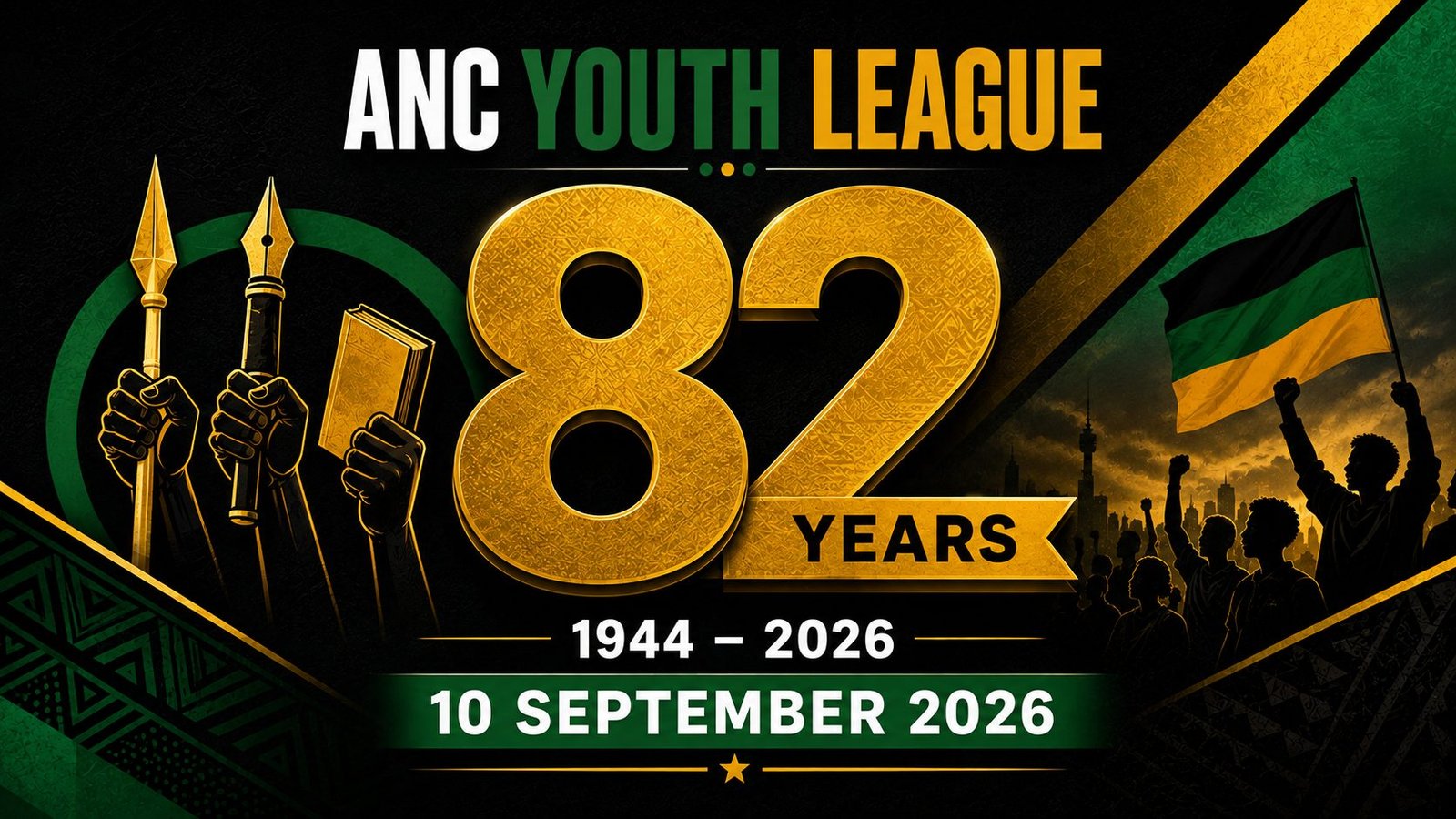
Eighty-two years of the ANC Youth League, 1944–2026. Image: Office of Dr Malusi Gigaba
10 September 1944.
That is the day the African National Congress Youth League was launched, at its founding congress at the Bantu Men's Social Centre in Johannesburg.
A founding gets remembered as a ceremony. It is almost always a piece of drafting. Someone sits down and writes the rules that will bind the person writing them, and the useful question to put to any founding document is not what it declared, but what it cost the people who put their names to it.
Eighty-two years ago today, a group of young men in Johannesburg finished doing something that is almost never remarked upon in the retelling of their story. They had already issued a manifesto in April that same year, announcing the intention to launch the League of the Youth of the African National Congress.
In April, they issued A Clarion Call, making their intentions known, and described both what they intended doing and what its founding principles were. What they did in September 1944 was submit themselves to the principles they had already proclaimed, and rules.
The permission that came before the excitement
The Congress Youth League did not begin with young people seizing space from their elders. It began with a resolution.
At the annual conference of the African National Congress in December 1943, a resolution moved by Manasseh Moerane and seconded by A.P. Mda authorised the founding of a Youth League. Its terms were procedural and unglamorous: that it should henceforth be competent for the African youth to organise and establish provincial conferences of the Youth League, with a view to forming a national congress of the Youth League immediately.
Read that again, because the sequence matters. The League was authorised before it existed. It did not take its existence; it was granted it, by decision of the body it would later go on to confront. Everything the young men subsequently did to the ANC, they did from inside a mandate the ANC itself had voted them.
This is important, because henceforth the ANCYL has understood and described itself an organised body of opinion within the ANC, which derives its existence from the Constitution and hence mandate of the ANC. This means that even if its own members were to vote, even by unanimous decision to dissolve the ANCYL, only an ANC Conference is so empowered with the authority to effect that decision. Not the ANC NEC, but the ANC National Conference, as its highest decision-making body, in order to provide a safe-guard against arbitrary action.
There is an argument, popular in every generation including my own, that institutions are obstacles and that the impatient must go around them. The founders of the Youth League had every reason to believe it. They went through the institution instead, and the record of what followed is the strongest evidence we have that they were right.
The manifesto: a rebuke, and a promise
In April 1944 the League issued its manifesto, drafted by Anton Lembede, A.P. Mda, Jordan Ngubane and Nelson Mandela and published in the name of a provisional committee. Walter Sisulu, William Nkomo, Lionel Mxolisi Majombozi and Oliver Tambo served as the “editorial board” for this document before it was finally adopted. It is a fierce document, and it was fiercest about the organisation that had authorised it. Congress, it said, had:
“declined and became an organisation of the privileged few – some Professionals, Small Traders, a sprinkling of Intellectuals and Conservatives of all grades.”
— Congress Youth League Manifesto, 1944
That is not a mild criticism. It is a charge of capture, laid by young members against their own leadership, in public, in writing, under their own names.
The manifesto articulates the spirit of the moment. In 1937, the All-African Convention had been formed, with accusations that the ANC leadership had become elitist, weak, passive and distant from the masses and struggles of the oppressed. The AAC threatened the very existence of the ANC, such that the ANC leadership had constituted a delegation to meet with the AAC to find a compromise. This delegation, comprising of some of the most prominent leaders of the ANC, even proposed consideration of a merger between the ANC and AAC. However, given the turn of fortunes in the late 1940s and 1950s in favour of the ANC, this would not materialise.
The intervention of the youth in a way saved the ANC from an impending demise, and they would do so again and again, as history would repeatedly summon them to.
In brief, and hopefully one day we would dedicate an article to its deep analysis, the manifesto,
- Outlined fundamental contracts between the visions of white supremacy and the black nation,
- Boldly confronted the internal political and organisational weaknesses of the ANC, without denying them, sweeping them under the carpet or choosing sides with any faction within the ANC. The youth of the ANC chose the ANC! They pledged their loyalty both to the cause of the struggle as well as the ANC itself, as a vehicle for the genuine liberation of the oppressed people,
- Cast the eyes of the youth on the broader struggle for national liberation and decolonisation and unity across the African Continent. The youth took on a progressive Pan-Africanist approach from the outset, something the ANC had not yet done prior,
- Outlined the creed of African Nationalism, which they sought to implant in the ANC. Prior to this, not even the ANC itself had attempted to explain why it was an African, National, Congress, other than describing itself in broad terms as the Parliament of the People of South Africa back in 1912 when it was founded, and
- Asserted the right of the oppressed to fight for freedom themselves, by their own chosen methods.
But the manifesto did something else that is almost always passed over. It set out a programme of work for the League's first three years, and the first item on that list was "Drafting and framing of the Constitution".
Consider what that admission concedes. These were men who had just written the most quotable political document of their generation, and their own assessment of it was that it was not yet enough. A manifesto declares what you believe. Anyone may issue one, and nothing in it can be used against you. A constitution is different in kind. It is a set of rules you agree to be governed by on the day they go against you, drafted at the one moment you cannot know which side of them you will be standing on.
They wrote the manifesto first because it was urgent. They wrote the constitution because they were serious.
The manifesto would be followed by The Basic Policy Document of 1948, a year after Lembede’s death, in which the ANCYL refined its philosophy of African Nationalism and spelt out its programme of action around issues such as land, education and others.
From appointed to elected
The League's first leaders were not chosen by anyone who could remove them.
When the provisional committee was formed, Nkomo took the interim chair and Lionel Majombozi the secretaryship. Both were medical students at Wits. That is appointment, and it is how almost every organisation begins. At the beginning there is nobody to hold an election among.
The inaugural meeting was held at Easter 1944 at the Bantu Men's Social Centre, with Lembede and Mda among the speakers and Dr A.B. Xuma, the ANC's President-General, present. It was not the launch. It was the ground being laid for one. The publication of a manifesto is not the founding of an organisation, any more than Pixley ka Isaka Seme's call in 1911 was the founding of the ANC. We mark the ANC's birthday on 8 January 1912, the day it was constituted, not the day it was proposed.
On 10 September 1944 the League held the congress that made it permanent. Nkomo stood aside to complete his medical degree, a constitution was adopted, and Anton Lembede was elected the Youth League's first president, Oliver Tambo, National Secretary and Walter Sisulu, National Treasurer.
The confusion in the record has a long life, and the League itself is the evidence for how it was settled. For years after the movement was unbanned, the ANCYL marked its birthday on 27 October, in honour of Oliver Tambo, its first National Secretary and its Honorary Life President. Had April been known as the founding, there would have been nothing to settle and no need for a stand-in. The date was fixed at 10 September during my own presidency, on the League's own research and on the accounts of the men who were in the room. We went to Walter Sisulu and Nelson Mandela. They agreed with us.
What matters is the nature of the act. An appointed chairman gave way and an elected president took office. The distinction between those two words is the entire distance between a committee and an organisation.
The rules they wrote against themselves
The constitution that resulted is a short document and an unsentimental one. Its provisions repay reading slowly.
Membership was open to African men and women between the ages of twelve and forty, on payment of a registration fee. Every member above the age of seventeen became automatically a member of the African National Congress. Conference, and not the executive, elected the president and his committee. Provincial conferences were to meet twice a year and the national conference annually. Amendment of the constitution required a two-thirds majority in a special session of national conference. And where the document was silent, it deferred: "If any matter arises for which this Constitution makes no provision, the constitution of the African National Congress shall be used to provide for the necessary information."
Look at what those clauses do to the people who wrote them.
The membership clause fuses the League's adult members into the very organisation the manifesto had just accused of capture. The clause on conference removes from the executive the power to choose the executive. The amendment clause makes the rules harder to change than to obey, which is the whole purpose of an amendment clause and the reason it is always the first one a body in difficulty wants to suspend. And the deference clause settles, in advance and in writing, that the League is a part of Congress and not a rival to it.
Not one of those provisions had to be written that way. Men who believed their elders had failed the nation could have built a body that answered to nobody, or that answered only to itself. They chose the harder architecture, and they chose it while they were young enough and angry enough to have chosen otherwise. A movement is tested by what it does when it has power. An organisation is tested by what it writes down before it has any.
What the rules made possible
Everything the Youth League is remembered for came afterwards, and came through those rules.
Lembede died in 1947, at thirty-three. The League did not collapse, because it had a procedure: A.P. Mda acted, and was then elected in his own right in 1948. That is what a succession clause is for, and its value is only ever visible in the year it is needed.
The founders built an institution, and bequeathed future generations such an institution with a firm foundation that did not depend on the founders, or on personages, no matter how popular or influential they might be.
In August 1948 the League issued its basic policy document, setting out African nationalism as, in its words, the dynamic national liberatory creed of the oppressed African people. In June 1949, in the pages of Inkundla ya Bantu, Mda made the charge against the parent body directly, calling its leadership "dilly-dallying, opportunist and half-hearted".
“We have arrived at the parting of the ways. We demand discipline in Congress ranks. Down with opportunism and double-dealing.”
— A.P. Mda, Inkundla ya Bantu, June 1949
And then, on 17 December 1949, at the ANC's 38th National Conference, the League got what it wanted. The Programme of Action was adopted, committing Congress to "immediate and active boycott, strike, civil disobedience, non-co-operation and such other means as may bring about the accomplishment and realisation of our aspirations". Dr Xuma lost the presidency to Dr J.S. Moroka. Walter Sisulu became Secretary-General. The generation that had been a provisional committee five years earlier now held the machinery of the movement.
Notice how it was done. The League did not split. It did not form a rival organisation. It did not seize a building or disrupt a conference. It contested a decision at the body constitutionally empowered to take it, and it won the vote. Dr Xuma, defeated, was re-elected to the executive and resigned from it with a line that ought to be taught to every person who has ever lost an internal election: "I do not want to be a stumbling block to the new executive."
Two points must be made, and they are less comfortable to common sense. First, the ANCYL did not seek to change ANC leadership as the first call of duty after its formation in 1944. It took a whole 4 years for it to reach that conclusion, when Dr Xuma turned down his support for the ANCYL-sponsored radical programme of action. He then disappeared at the 1948 conference, leaving the conference in a dilemma and unable to conclude its business. The YL took this as an opportunity to go back to basics to mobilise ANC branch support for its POA and advocate for a new leadership, when all other then-leaders turned their proposal down for the election of a new President. Only in 1949 did the League gain groundswell support for their proposals.
Second, the ANCYL read the room. They did not put themselves as such leaders to replace Dr Xuma and his cohort. They understood African society then and the type of leadership required to lead them, and did not think anyone among them would be suitable. Hence they searched, found and fetched Dr JS Moroka, who wasn't even an ANC member then. Then they proposed Sisulu as Secretary General, in order to give effect to the implementation of their POA.
Three years later the same generation ran the Defiance Campaign. Forty-five years later one of them was President of the Republic. All of it downstream of a decision to hold conferences whose outcomes were binding.
What the founding asks of its heirs
I write this as someone who held that office, and who has had to live inside the League's rules rather than only admire them. That is not a credential. It is the reason I cannot write about this founding as though it were somebody else's inheritance.
The founders left four things, and each of them arrives as a question rather than a compliment.
On leadership, they left the principle that authority in the League is conferred by conference – by popular decision – and by nothing else. The League's own recent history has tested that principle hard. The ANC's National Executive Committee disbanded the League's national leadership in 2013 and again on 30 July 2019, the structure itself remaining. What followed was a period of nearly four years in which the League had no elected national leadership at all, functioning instead under an appointed national task team, until a national congress was finally convened in July 2023, with a further congress held in December 2025. In 1944 the League moved from appointment to election in a matter of months. It is worth asking plainly how a body founded on that movement came to spend four years travelling in the opposite direction.
On discipline, they left rules with teeth, including the power to remove an official from office. That is an easy provision to admire and a hard one to write about yourself, and they wrote it while they were the officials it would fall on. Rules that bind only other people are not rules. They are instruments. The founders drew that distinction before they had any power worth protecting, which is the only time it is cheap to draw.
On structure, they left a body deliberately fused to its parent and deliberately answerable to it. That settlement has always contained a tension, because a youth league that cannot criticise its elders is decoration, and one that recognises no authority beyond itself is a faction. Mda's June 1949 attack shows where the line sits. He accused the leadership of opportunism in print, under his name, while remaining inside the organisation and pursuing the argument to a vote at conference. He was disciplined and disobedient at the same time, and there is no contradiction in that sentence.
On ideas, they left the hardest inheritance of all. The manifesto and the basic policy document were arguments, developed over years, tested in print, and written down where opponents could examine them. The founders were in their twenties and thirties and they published theory. Any generation may inherit an office. Not every generation troubles to inherit the intellectual labour that made the office worth holding.
That inheritance is being argued away in our own time, and I have said so in public. In July I took part in a conversation staged under the title "South Africa Needs Doers, Not Corrupt Thinkers. Here's Why", and my objection was to the title. The dichotomy is artificial. What I argued there was this:
“Intellectuals must be grounded, contextual and relevant. They are not the enemy.”
The founders of 1944 are the strongest evidence for that position, and also the strangest, because the charge against intellectuals is partly theirs. Read the manifesto's list again and notice who is on it: professionals, small traders, a sprinkling of intellectuals. Then notice who wrote it. Lembede was a law graduate serving articles under Pixley ka Isaka Seme, and was at that moment writing a master's thesis in philosophy. Mda was a teacher. Ngubane edited a newspaper. Nkomo and Majombozi were medical students. The most educated group in the room put their own class on the list.
They were not against learning. They were against learning held at a distance from the people it was meant to serve. Their answer was not to think less. It was to draft a constitution, build branches, and carry an argument to conference until it became a decision. Grounded, contextual and relevant, in 1944, is what that looked like.
The temptation, when a founding is this distinguished, is to read it as an accusation against those who came after. That is not what it is, and I would not be entitled to write it if it were. Every generation of this organisation, mine included, has fallen short of 1944 in some respect, because 1944 was a moment when a small group of people got something exactly right and the rest of us have been working with the consequences ever since.
But there is one lesson in it that does not age, and it is not a lesson about youth. The men who founded the Youth League were at the height of their impatience when they sat down to write a constitution that would restrict them. They had just told the nation, in public, that their own leadership had failed it. They had the moral standing to answer to nobody. And what they did with that standing was to write down how they could be removed, how they could be outvoted, and whose rules would govern them when their own ran out.
That is what discipline means, and it has nothing to do with obedience. Discipline is the willingness to be bound by a decision you might lose. An organisation that will not write that willingness down has not yet been founded, whatever it has launched.
From the foregoing, we learn that discipline is most effective when infused with militancy, and vice versa. Discipline and militancy are two sides of the same coin. We cannot effectively solve the problems bequeathed by apartheid-colonialism without being militant, but then militancy without discipline is plain dangerous and adventurist. A fighting organisation with militancy but no discipline, or discipline without militancy, will surely end up defeated by the very same forces it is sworn to fight against.
The founders of the ANCYL also left us a legacy of a “thinking”, rational, political and independent organisation. Whilst bound by the ANC’s policies and political directive, they were never bound to any individual leader and were always fearless in being critical and making radical political and organisational proposals to the ANC.
The League's founders did not know that the rules they wrote in 1944 would put their generation at the head of the movement within five years, and in government within fifty. They could not have known. What they could do was ensure that whatever they built would still be standing when they were no longer the ones standing in it. Our task is not to admire that decision. It is to keep making it.
In times to come, we must begin to fully account, not in snippets, but in toto, for the entirety of the 82 years of the existence of the ANCYL. Going back to 1944 has served its purpose, the time has come that we should dedicate ourselves to giving a full and objective account of the 82 years of the existence of this glorious youth organisation. Not as an act of sentimentality, but as a fundamental act of drawing full lessons and giving directives to future generations.
The generation of 1944 lived to dominate South African politics for the next six decades, directing the course of the struggle in its every facet, handing over when they had fulfilled their mission of “Freedom in our Lifetime”.
What shall the current and future generations bequeath the ages? That is the question still to be answered, by none other than that generation itself.
“The future is not an accident.”
Dr Malusi Gigaba is a Scholar-Statesman, an ANC NEC Member, a former Cabinet Minister of the Republic of South Africa, a Member of Parliament, and a member of both the Joint Standing Committee on Defence and the Portfolio Committee on Trade, Industry and Competition. He served as President of the ANC Youth League from 1996 to 2004, the first to hold that office for three consecutive terms.