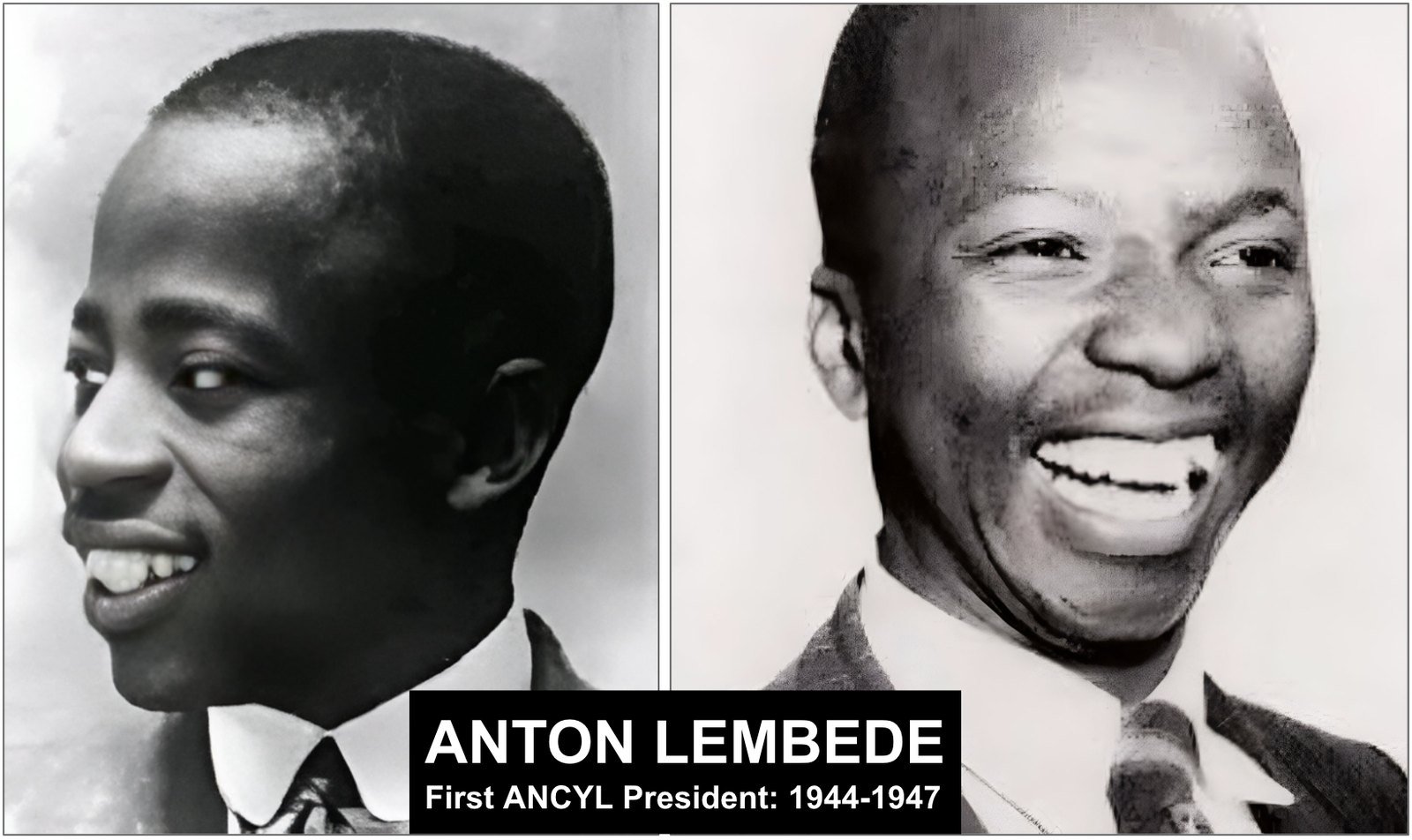
When Anton Muziwakhe Lembede, or Lembs, as his contemporaries fondly called him, The Lion That Led from the Front, as he was known: died, at half past five on the morning of Wednesday, 30 July 1947, he was in the middle of everything.
He had built a four-room house for himself at the Lembede homestead at Umbumbulu, and had instructed his family to begin laying a road to it. He was engaged to be married to Cherry Mndaweni, a nurse trained at McCord Hospital in Durban. He had bought a Buick. He had qualified as an attorney seventeen months earlier and had been made a partner in a Johannesburg firm. He had submitted a Master's thesis in philosophy and begun reading for a doctorate in law. He had been elected to the National Executive Committee of the African National Congress at the annual conference in December 1946, and died a serving member of it. And he had been, for a little under three years, the first President of the ANC Youth League.
He was thirty-three years old.
Four days later, on Sunday 3 August 1947, he was buried in Johannesburg, at Croesus Cemetery: some six hundred kilometres from the house he had just finished and never slept in. It took fifty-five years to bring him home.
This is the piece I want to write about him, and I should say at the outset that it is not the usual one. We are good at commemorating founders. We are much less good at the harder thing, which is reckoning with a person who was interrupted rather than completed. What do you owe a life that was cut off mid-sentence?
The boy in the patched trousers
He was born in 1914 on a white man's farm in the Georgedale district of Natal, near Eston: identified by his editors as the farm of Frank Fell. He was the eldest of seven children. His father, Mbazwana Martin Lembede, was a farm labourer. His mother, Martha Nora MaLuthuli Lembede, had trained and worked as a teacher, at Vredeville, Darlington and Umlazi Bridge, before the family settled on the land.
That is not a colourful detail. It is the whole foundation of the man, and he never once pretended otherwise. He is remembered as having said of himself, "I am proud of my peasant origin," and, "I am one with Africa. Look at my face; it is black like the soil of Africa." Those are not the words of somebody performing humility. They are the words of somebody who had understood that the thing his country most despised in him was the thing he was going to build a politics out of.
After starting formal school at 13 years of age, he progressed quickly through school, passing his Standard VI with a first class pass. He progressed to and trained as a teacher at Adams College between 1933 and 1935, and his contemporaries there remembered his poverty before they remembered anything else. Jordan Ngubane, who would later become one of his closest political collaborators, called him the "living symbol of African misery," and wrote that "his abject poverty was apparent to everyone because of his shabby dress: his patched pants and worn-out jackets." And, yet, in spite of all that poverty, Lembede excelled in his studies.
Hold that image, because everything that follows happened to that boy, in those trousers, and within about a decade.
Five in the morning
There was no campus available to him, no library, no supervisor, no funding and no colleagues. So he did it by post.
His roommate at Heilbron, B.M. Khaketla, left a record of the daily timetable, and I have never read it without a certain shame. He rose at five in the morning and read until six. He taught from eight until one. He studied from two until seven. He ate, and then he studied again until eleven at night. Khaketla's remark is the one that lands: "He followed this timetable religiously on weekdays." Thus from the outset, he distinguished himself with his discipline and singular determination in everything he did, resolute to break the chains of the cycle of poverty which had characterised his upbringing, so that his family could ultimately live free of this malaise.
On that timetable, teaching in rural schools, he took a Bachelor of Arts in 1940, a Bachelor of Laws in 1942, and submitted a Master's thesis in philosophy in 1945: the subject being the conception of God as it emerges in the philosophers from Descartes onward. He was reading for a doctorate in law when he died.
He worked in seven languages: Zulu, English, Afrikaans, Sesotho, Xhosa, German and Latin. Ellen Kuzwayo remembered him switching between English and Afrikaans in the middle of a debate. There is a story, and I pass it on as a story rather than as a fact, that he once began conducting a matter in a magistrate's court in Latin, until the magistrate interrupted him: "Please, Mr Lembede, this is not Rome, but South Africa."
This is not an inspirational anecdote about hard work. The method and the doctrine were the same thing. The argument Lembede would go on to make — that African people would be liberated by their own organised effort and their self-confidence, and by nothing and nobody else, was not one he found in a book. He put it plainly in "Policy of the Congress Youth League" in May 1946: "The Leader of the Africans will come out of their own loins." It was the argument his own life had already made, at five o'clock in the morning, in a rented room, with no institution behind him.
He did not have to be persuaded that African self-reliance was possible. He had a Master's degree that proved it.
The idea he argued his way toward
Now the part his admirers leave out, and that we should not, because leaving it out makes him smaller. Lembede did not arrive at his politics fully formed. He arrived by getting things wrong first and being argued out of them. He learned by doing.
In the early 1940s, wanting to improve his Afrikaans, he began reading Hendrik Verwoerd's column in Die Transvaler, the ultranationalist Afrikaans paper Verwoerd then edited, and, in his editors' careful phrase, "imbibing his ideas." For a period he was drawn to the authoritarian nationalisms then ascendant in Europe. He was studying, in the crudest laboratory available to him, how a defeated and humiliated people can be mobilised into a nation.
What stopped him was a friend. Ashby Peter Solomzi Mda, a schoolteacher from the Herschel district whom he had met at a Catholic teachers' meeting in Newcastle in 1938, and with whom he shared a house in Orlando from 1943: put Hitler's racial doctrine in front of him and made him look at where that road ended for people who looked like them. By the end of the war Lembede was rejecting fascism and Nazism without qualification.
I would rather set that down plainly than have someone else set it down unkindly, because the shape of it is to his enormous credit. He was a man who tested an idea, lost the argument to his friend, and changed.
And their nationalisms were never identical. Mda's views, his editors record, were "not as 'angular' as Lembede's"; he was uncomfortable with some of Lembede's more extreme stances. What Mda wanted was a broad nationalism "imbued with the spirit of Christ's philosophy of life and recognising the universal brotherhood of men", and he drew the line himself, in his own words: "We as African Nationalists do not hate the European — we have no racial hatred: we only hate white oppression and white domination, and not the white people themselves!" Ours, he insisted, "has nothing to do with Fascism and National Socialism." It was the nationalism of an oppressed people seeking freedom from foreign domination, and nothing narrower than that.
Mda is described by Mandela as being more mature in his own thinking than Lembede. It took his leadership to advance Lembede’s cause. Sisulu describes Mda as having had big shoes to fill in succeeding Lembede, an outstanding scholar and philosopher. However, Sisulu points out, more than any of their generation, Mda adequately filled the vacancy left by Lembede.
The friendship itself is what I most want to preserve from his story. The two argued deliberately, as a method. Mda later described his own assigned function: Lembede, he said, "used me as a tool," and "learned a lot from controversies because sometimes I attacked his positions just to give him an exercise in refuting his arguments." One was constructing the political philosophy that would reorganise African nationalism in this country. The other's job was to attack it. Not to affirm it. Not to caucus around it. To attack it, so that it would either break or come out harder.
You can see the two men in the documents themselves. Lembede's vision shaped the Youth League's 1944 Manifesto. Mda, after his death, led the drafting of the League's Basic Policy document, adopted on 2 August 1948 and issued by the League's National Executive Committee — in which, his editors write, he "took the occasion to incorporate these views as well as distance the Youth League from some of Lembede's radical positions." Both men were central to defining African nationalism in the 1940s, and to the League's broader work of instilling it in the ANC.
I would make bold to argue that it was only after the Youth League was formed that the ANC came to understand why it was an African, National, Congress. The League created that identity, not seamlessly, and not perfectly from the outset, but through a rigorous process of ideological debate and practical action. These two men stood as intellectual giants throughout it.
We have lost that. We have replaced argument with warfare, which is not the same thing and is in fact its opposite. Argument sharpens a position. Warfare protects a faction.
Three years
The Youth League was not a spontaneous eruption. It was resolved on at the ANC's annual conference in Bloemfontein in December 1943, in a resolution seconded by Mda. Its manifesto followed in March 1944, drafted by Lembede, Mda and Mandela. We must highlight that Walter Sisulu, William Nkomo, Lionel Mxolisi Majombozi and Oliver Tambo served as the “editorial board” for this document before it was finally adopted. The inaugural meeting was held on Easter Sunday 1944 at the Bantu Men's Social Centre at 1 Eloff Street, at the edge of the city among the car dealerships and the cheap food stores. A hall with a gymnasium, a stage, gramophones members could practise on, and a library that had grown to a couple of hundred books. In September 1944 the League adopted a constitution and elected its officers.
Read that manifesto now and what strikes you is not its idealism but its rudeness. It describes the leadership of the day as "the privileged few — some Professionals, Small Traders, a sprinkling of Intellectuals and Conservatives of all grades," people "out of actual touch with the needs of the rank and file," who had become "unconscious police to check the assertion of the popular will." That is not a youth wing asking for a seat. Its motto was blunter still: "Africa's cause must, and will, triumph."
And here is the circumstance in which he helped write it. From January 1944 to January 1946 Lembede was an articled clerk in the Johannesburg office of Dr Pixley ka Isaka Seme: the man who had convened the founding of the African National Congress itself in 1912. By day he was learning his trade from the movement's founder. By night he was helping draft the case against what the movement had become.
The ANC's President-General in 1944 was Dr A.B. Xuma, who had held the office since December 1940 and who, after some misgivings about their militancy, had given the young men his blessing to form the League at all. Dr Seme, by contrast, held no ANC office by then. He had been President-General from 1930 to 1937 and had been voted out, and the assessment of those seven years is not divided: his biographer calls the presidency "a disaster which the ANC narrowly survived," and another historian records that the organisation "sunk to its lowest fortunes" under him and became "virtually moribund." He was, by 1944, the living emblem of precisely the leadership the manifesto condemned, not its target by name, but unmistakably its type.
As a brief aside, Dr Xuma's own position would prove no safer at the hands of the Youth League. Five years after its formation, and two years after Lembede's death, at the 38th National Conference on 17 December 1949, Dr Xuma declined to endorse the Programme of Action the League had been pressing on him. It was adopted anyway, and the young men transferred their backing to Dr James Moroka, who narrowly took the presidency from him. The men who had asked Dr Xuma's permission to organise in 1943 removed him in 1949.
Nobody wrote down what Dr Seme made of the stinging Youth League manifesto. What we know is what he did. He kept the young man, Lembede, on, saw him qualify as an attorney in February 1946 and as a conveyancer that December, took him into partnership, and looked to him to carry on the practice. A leader publicly indicted by a generation does not usually hand that generation his own firm. Dr Seme did, which suggests he could see, as clearly as anybody, that this particular clerk was exceptional.
Two things about how Lembede came to lead the League are routinely got wrong.
The first is that it had a provisional chairman before it had a president. William Nkomo, a medical student at Wits, held the chair from early 1944 until the September elections, with Lionel Majombozi as provisional secretary, and Nkomo stepped aside then to finish his medical degree. There is something in that I find quietly admirable, and entirely absent from our own politics: a man who gave up the leadership of a national organisation because he had a qualification to complete.
The second is more delicate, and I record it because tidying it would not serve him. We do not actually know why Lembede was chosen. No source says whether the election was by ballot, by show of hands or by acclamation, whether it was contested, or whether anyone else was nominated. We know only that they picked him, and that Oliver Tambo became the League's secretary and Walter Sisulu its treasurer.
He held the office for less than three years.
What he was in the middle of
He had been ill for years. He had undergone abdominal surgery twice, in 1940 and again in 1941 while teaching at Heilbron, and his digestive system never fully recovered. The condition that killed him in 1947 was of the same family as the one that had put him on an operating table seven years earlier. He was not, whatever has since been said, struck down mysteriously. He was a chronically ill man working a schedule that would have taxed a healthy one.
On the morning of 29 July 1947 he collapsed at his office in town. He was taken to Coronation Hospital and died the following morning.
What he left behind was not a legacy in the tidy sense. It was a set of things in progress. A fiancée. A thesis passed and a doctorate begun. A practice not yet eighteen months old. A political argument three years into being made. And at Umbumbulu, a finished house with a road being laid to it that he would never travel.
"My heart yearns for the glory of an Africa that is gone. But I shall labour for the birth of a new Africa."
Those are his words, quoted at the graveside in 2002 by a President of the Republic. Read the tense of them. I shall labour. Everything about the man points forward, and he was not given the time to arrive anywhere.
His funeral was held at the Church of Christ the King in Orlando. Among those who carried him or spoke for him were Dr Seme, Dr A.B. Xuma, Dr Yusuf Dadoo, Oliver Tambo, Jordan Ngubane, William Nkomo, James "Sofasonke" Mpanza, and his own brother Nicholas. Ngubane recorded what it took to move the mourners: over fifty private cars, twenty-five lorries and six municipal double-decker buses, carrying hundreds of people to the memorial meeting at the Orlando Community Hall.
A thirty-three-year-old attorney barely eighteen months qualified, who had held one unpaid office in one wing of one organisation, was carried out of Orlando by a convoy.
His last words, in the version his brother and his nurse both recall, were about going home: "I am taking the same path which my forefathers took."
Then they buried him in Johannesburg.
The six hundred kilometres
Why was a man from Georgedale, who had just finished building a house at Umbumbulu and was having a road laid to it, buried in a Johannesburg municipal cemetery?
I have looked, and I want to be honest with you: I cannot tell you, because nobody wrote it down.
Not the scholars who edited his collected writings. Not the eight men who published tributes to him within weeks of his death (Mda, Ngubane, J.B. Marks, Govan Mbeki, William Nkomo among them), every one of whom knew exactly what had happened and none of whom thought the burial place worth a sentence. Not the reporting in 2002. There is no record of who organised the funeral or who paid for it, and no record of whether his family were consulted about where he would lie.
That silence is not a small thing. A generation capable of the most meticulous political argument, one that produced manifestos, constitutions, resolutions and a Bill of Rights inside four years, did not consider it necessary to record why its most brilliant young mind was buried six hundred kilometres from his mother. We know exactly what they thought of him; every tribute says it. About the arrangements we know nothing, because in 1947 the burial of an African man in Johannesburg was simply not the kind of event about which a record was kept.
In 2002 his family approached the ANC Youth League and asked for help bringing him home. On Sunday 27 October 2002 he was reinterred at Madundube, at Umbumbulu, among his own people: on the ground where, fifty-five years earlier, he had built the four-room house he never slept in. So solemn was the occasion that President Mbeki, accompanied by his entire National Executive Committee (NEC) and President Mandela, were present among the crowds, finally fulfilling the wishes of Lembede, to come home. The ANCYL itself was present in all its different generations to fulfil the unfinished task of their predecessors, allowing the future to honour the past in real time. In 2005 the Republic conferred on him the Order of Luthuli in Gold.
What you owe an unfinished life
One thing did continue after him, and it continued for a reason that matters.
Mda, who passed away on 7 August 1993, led the Youth League as acting president within weeks of Lembede's funeral, and was elected to it in his own right in 1948. He assembled the working committee of Nelson Rolihlahla Mandela, Walter Sisulu and Oliver Tambo. And in December 1949, twenty-eight months after Lembede was buried, the Programme of Action went to the ANC's national conference and passed. Boycott. Strike. Civil disobedience. Non-cooperation. The era of the deputation and the respectful letter was over.
That is as close as this story comes to a completed sentence, and it is worth being exact about what it proves. It does not mean Lembede's leadership ended when he died. It means that the man whose assigned job was to attack his positions for three years already knew the argument well enough to carry it without him. The thing he built that outlived him was not a doctrine. It was a partner.
Everything else was left standing open, and we prefer our founders finished. A completed life can be summarised, put on a plaque and a street sign, and set down. It makes no further demands. Lembede offers no such convenience. He completed almost nothing: not the marriage, not the doctorate, not the practice, not the presidency, and above all not the argument.
He did finish the house. He never slept in it.
That is precisely why the men who buried him kept writing about him for the rest of their lives. A finished argument can be honoured. An unfinished one has to be taken up. The first is a ceremony. The second is work.
So the question his life puts to us is not whether we admire him. Admiration is free. It is whether we are prepared to do what he actually did — to build the instrument ourselves rather than wait for one to be provided; to submit our convictions to a friend whose job is to attack them; to change our minds in public when we lose that argument; and to stand aside, as William Nkomo did, when someone else should hold the position.
But he did more than that. He did not only write a case against everything his own organisation had become. His enduring legacy is that he wrote the case for what it had to become. He led the process for the injection of the struggle with the spirit of African Nationalism, giving it a purpose and mission. He envisioned the future and helped define it, before he could bow out. As Sisulu writes of him, he “fought the struggle not only politically, but with all the impressive skills at his disposal”.
A farm labourer's son studied philosophy by correspondence because no other road was open to him, argued his way out of an idea that would have destroyed him, helped write the case against everything his own organisation had become, and died at thirty-three with a house he never entered and a sentence half-said.
Seventy-nine years on, he lies at the homestead where he built that house. His friend finished one clause of the sentence, in December 1949. The rest of it is lying exactly where he left it.
And before we leave him in that ground, go back through what you have just read and count the honorific. Dr Seme. Dr Xuma. Dr Dadoo. Dr Moroka. Four doctors, in a piece that is not about any of them. The League's provisional chairman and its provisional secretary, William Nkomo and Lionel Majombozi, were both medical students at Wits, and one of them gave up the chairmanship to finish the degree. The man they elected in his place held three university degrees, taken by correspondence from a rented room, and was reading for a fourth when he died.
That was the movement, and not incidentally: an organisation whose founder had read law at Oxford, whose president was a physician trained in the United States, and whose youth wing was run by medical students and a philosopher: every one of them operating in a country whose entire legal order rested on the proposition that they were incapable of exactly this. They did not merely think their way out of that proposition. They out-qualified it.
It is worth asking, seventy-nine years on, what we have done with the institutions they left us, and whether the young person now reading philosophy at five in the morning, in a rented room, finds the door any easier to open.
Further reading
Edgar, R.R. & ka Msumza, L. (eds), 1996. Freedom in Our Lifetime: The Collected Writings of Anton Muziwakhe Lembede. Athens, OH: Ohio University Press; Johannesburg: Skotaville Publishers; Cape Town: Mayibuye Books.
Edgar, R. & ka Msumza, L. (eds), 2018. Africa's Cause Must Triumph: The Collected Writings of A.P. Mda. Cape Town: BestRed, an imprint of HSRC Press.
Mandela, N., 1994. Long Walk to Freedom: The Autobiography of Nelson Mandela. Little, Brown & Co.
Sisulu, E., 2002. Walter & Albertina Sisulu: In Our Lifetime. Cape Town: David Philip Publishers.
“The future is not an accident.”
Dr Malusi Gigaba is a Scholar-Statesman, an ANC NEC Member, a former Cabinet Minister of the Republic of South Africa, a Member of Parliament, and a member of both the Joint Standing Committee on Defence and the Portfolio Committee on Trade, Industry and Competition.