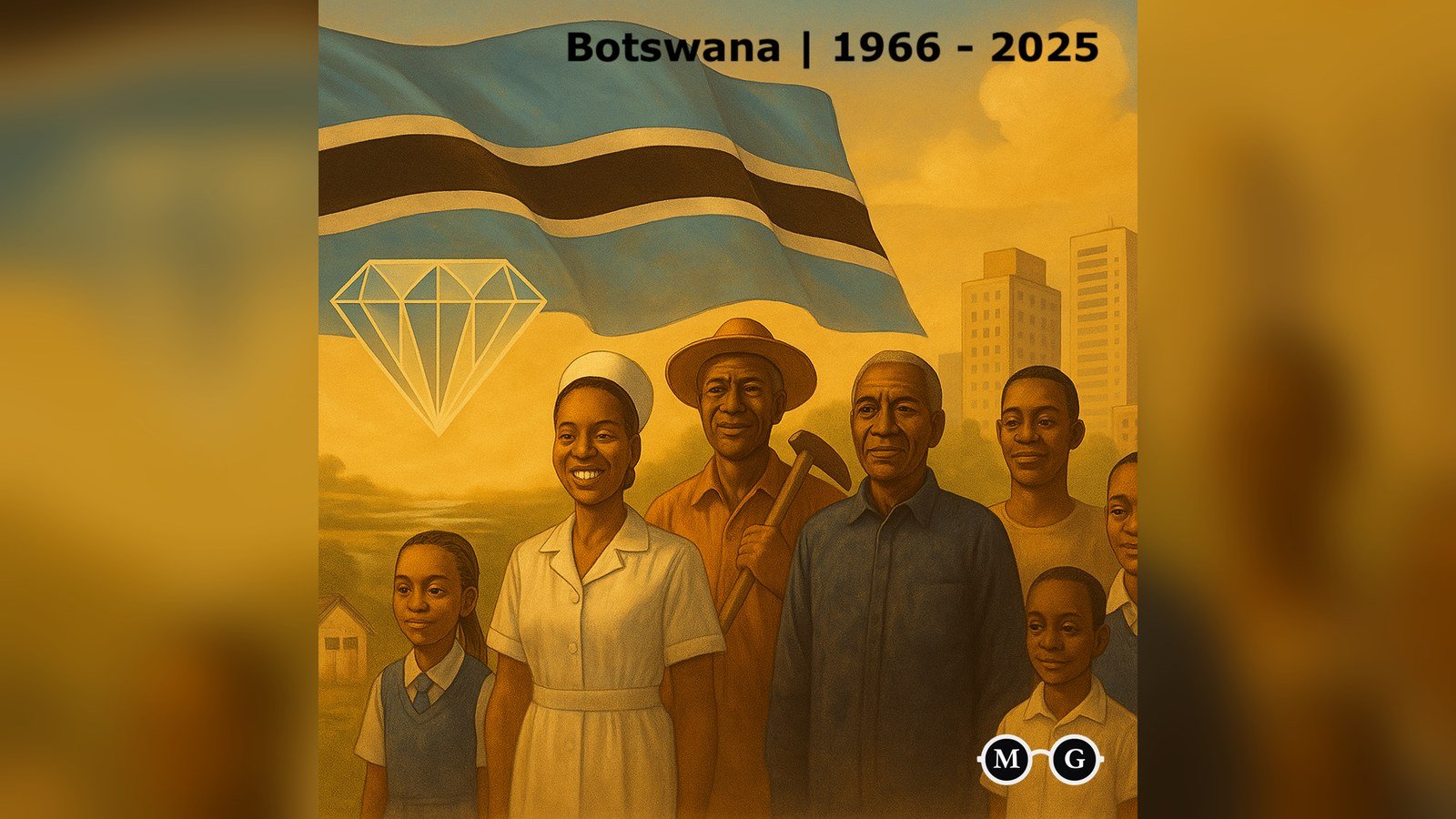
On 30 September, Botswana marks its Independence Day. Few countries on the continent embody the promise of self-rule as well as regional and international solidarity as powerfully as this landlocked nation. Emerging in 1966 as one of the poorest states in the world, with only 12 kilometres of paved road and just 22 citizens holding university degrees, Botswana has become of one of Africa's beacons of hope. Today it stands as an upper-middle-income country, a respected democracy, and an African example of how natural resources can be turned into national wealth rather than national strife.
This piece, the last of the Heritage Series 2025, reflects on Botswana's journey. It is a story of how diamonds, often a curse elsewhere, became instruments of development. It is a story of institutions, accountability, and visionary leadership – elements that make Botswana's success a continental lesson worth celebrating. It is also a story about how a then economically vulnerable nation took a principled stance for independence beyond its borders.
Democracy and Accountability from Day One
At independence, Botswana's leaders, led by President Sir Seretse Khama, set the tone for governance. Unlike many states that succumbed to graft, coups or authoritarianism, Botswana invested in rule-based institutions and a culture of consultation. Multi-party elections have been held without interruption since 1966. Parliament and the judiciary have remained active checks on executive power, ensuring that political dominance did not translate into impunity.
Clean governance became a hallmark. Botswana's leaders embedded mineral revenues into the national budget and development plans, avoiding the opaque off-budget accounts that fuel corruption elsewhere. Transparency, reinforced by an independent press and judiciary, won public trust. The results are visible: today Botswana is ranked as Africa's least corrupt country, outscoring even some European states.
This culture of accountability translated into real benefits. Free education and universal healthcare were rolled out across the country, financed by mineral revenues. The state promoted national unity, discouraging tribalism through inclusive policies, and fostered a peaceful political culture. Botswana has never experienced a coup or civil war, a rarity in post-colonial Africa.
Contribution to the Fight Against Apartheid
Botswana's Independence Day is significant for Southern Africa because of the country's crucial, yet perilous, support for the anti-apartheid struggle. Despite being an economically vulnerable neighbour to South Africa, Botswana under President Seretse Khama, adopted a principled stance against apartheid.
Both the OAU as well as the Frontline States took the view that the apartheid regime constituted a major threat to Africa's survival and pursuit of total decolonisation. The apartheid regime, which served as both a bulwark of colonialism and outpost of imperialism, pursued a multi-pronged strategy in Africa which sought to,
- Co-opt some regimes willing to collaborate with it,
- Conduct a campaign of political destabilisation against most Southern African countries through military raids (Maseru in Lesotho, Matola in Mozambique, Gaborone in Botswana, and Cuito Cuanavale in Angola) in an effort to isolate the South African liberation movement and chase them as far from South Africa's borders as possible; and
- Working with imperialist countries, conduct a campaign of economic strangulation through ensuring that neighbouring countries were unstable and could not pursue sustainable development programmes, including through sponsoring terrorist organisations that conducted internecine civil wars such as UNITA in Angola and Frelimo in Mozambique.
Botswana's official policy was rooted in its moral and political opposition to apartheid and colonialism, but this country of less than 3 million Batswana could not afford direct military confrontation given its economic vulnerability. Therefore, its contribution was strategic, focusing on,
- diplomatic endeavours to condemn apartheid on international platforms and grant recognition to liberation movements like the ANC;
- providing humanitarian aid to political refugees and serving as a critical transit route for freedom fighters; and
- providing principled defiance exercised with caution to avoid giving South Africa a direct reason for invasion, a delicate balancing act born of necessity.
This solidarity came at a high price. Botswana suffered military raids from the apartheid regime, most infamously the 1985 attack on Gaborone, and risked severe economic retaliation due to its dependence on South Africa. Ultimately, Botswana's contribution is seen as one of immense courage under extreme constraint, providing the essential "soft" infrastructure for liberation without being destabilised.
Diamonds into Development
Botswana's discovery of diamonds in 1967 could have spelled disaster. Many countries with an abundance of natural resources have suffered what has often been referred to in economic circles as "the resources curse", or "the Dutch disease", which describes how a resource boom can harm other sectors. The influx of foreign currency from resource exports causes the nation's currency to appreciate, making its other exports (like agriculture and manufactured goods) more expensive and less competitive on the global market. This leads to a decline, or "de-industrialisation," of these sectors, making the economy dangerously dependent on a single volatile commodity. South Africa, with the dominance of its economy by the "minerals-energy complex" (MEC) is a case in point.
The "resource curse" is a paradoxical phenomenon where countries with an abundance of non-renewable natural resources (such as oil, gas, diamonds, and minerals) tend to have less economic growth, less democracy, and worse development outcomes than countries with fewer natural resources. Instead of being a blessing that fuels prosperity, the wealth from these resources often leads to negative economic, political, and social consequences. However, countries such as Botswana and Norway have tended to admirably defy this trend.
In 1969, the government negotiated an unprecedented 50-50 joint venture with De Beers, creating Debswana. This arrangement meant that profits from mining were equally shared between the company and the state, on behalf of the people. The revenues were not captured by elites; they were channelled into roads, schools, hospitals, and water systems. Over time, Botswana pushed for even greater benefits such that by 2006, diamonds were being sorted and valued locally. By 2013, De Beers relocated its global sales headquarters from London to Gaborone, turning the capital into one of the world's diamond trading centres. Botswana also secured a 15% ownership stake in De Beers.
Diamonds became the backbone of the economy – accounting for 80% of exports, one-third of government revenue, and a quarter of GDP – but were managed prudently. Successive National Development Plans directed spending into long-term priorities rather than short-term populism. The country built one of Africa's most extensive paved road networks, achieved near-universal school enrolment, and invested in public health, including pioneering free antiretroviral treatment during the HIV/AIDS crisis. One of the hallmarks of this programme has been the Development Fund, with De Beers committing significant capital to diversification, skills training, and local industry
In its latest agreement with De Beers, signed in February 2025, Botswana extracted even more favourable terms for Batswana. Why this matters is because Botswana has refused to let multinationals, many headquartered abroad, reap disproportionate benefits from its resources. By pushing for progressively higher state shares and embedding beneficiation clauses, the government ensures that the wealth of diamonds translates into jobs, infrastructure, and social services for citizens, not just shareholder dividends overseas. This evolution reflects a consistent principle since independence: diamonds must leave a legacy for Batswana, not impoverishment in the shadow of extraction.
"The days of parceling out vast concession areas to foreign interests for exploitation must come to an end. We'll continue to welcome foreign investment but we must negotiate better for a bigger share of the natural resources that belong to us and we must insist on value addition to these resources." - Hon. John Dramani Mahama, President of the Republic of Ghana, at the 80th session of the UN Assembly, September 2025
A Tale of Two Paths: Botswana and the Resource Curse
Botswana's trajectory is even clearer when contrasted with other diamond-rich states where contestations for national natural resources have fuelled brutal civil wars, and even regional conflicts involving international actors such as in Sierra Leone, Angola, DRC and others. In some of these countries, the vast mineral wealth continues to enrich a few while millions live in poverty, as weak institutions and conflict undermine development.
Why did Botswana succeed where others faltered? Several principles stand out:
- Institutions before windfalls – rules and oversight were in place before revenues began to flow.
- Public benefit over elite benefit – revenues were channelled into education, health, and infrastructure, not palaces or slush funds.
- Transparency – revenues were managed through the national budget, subject to scrutiny.
- Planning for the future – leaders understood "diamonds are not forever" and promoted diversification, savings, and long-term development plans.
Governance, not geology, determined the outcome.
Beyond Diamonds: Broader Successes
While diamonds powered Botswana's rise, its development achievements extend well beyond mining:
- Tourism and Conservation: By safeguarding the Okavango Delta and Chobe National Park, Botswana became a premier safari destination. Its high-value, low-impact model generates jobs while protecting biodiversity.
- Education and Skills: From a handful of graduates in 1966, Botswana now boasts a skilled workforce and a university system producing professionals for government, business, and science.
- Health Gains: Life expectancy, once devastated by HIV/AIDS, has rebounded thanks to government-funded treatment programmes. Child mortality has declined, and health services reach even rural areas.
- Fiscal Prudence: Budget surpluses in boom years and a sovereign wealth fund cushioned shocks like the global financial crisis. Infrastructure – roads, electricity, ICT – is among the best in Sub-Saharan Africa.
- Rising Prosperity: Botswana's GDP per capita reached about US$7,700 in 2024, nearly five times the Sub-Saharan African average. This places it consistently among the top five countries in the region, alongside Seychelles, Mauritius, Gabon, and Equatorial Guinea. Such income levels highlight the tangible gains of prudent governance and resource management.
- Mobility and Empowerment: Botswana has also made striking progress in vehicle ownership, a proxy for middle-class empowerment and access. As of 2019, it had about 254 registered vehicles per 1,000 people – among the highest rates in Sub-Saharan Africa, surpassed only by Mauritius and Seychelles. By comparison, South Africa registered ~208 per 1,000 and Namibia ~161. When adjusted for adults (age 15+), Botswana's rate climbs to nearly 374 per 1,000, indicating that more than one in three adults owns a vehicle. This achievement, remarkable for a sparsely populated and landlocked country, highlights how resource revenues and prudent governance have expanded opportunities for personal mobility and economic inclusion.
- Regional Leadership: Botswana has provided moral authority in SADC and beyond, advocating for democracy, mediation, and rule-based governance.
Missed Lessons Next Door
Over the past decade, South African government delegations have travelled widely across the continent, and beyond, in search of developmental lessons. Missions to Rwanda studied governance and urban cleanliness; to Ghana they examined parliamentary oversight; to Kenya they benchmarked local governance reforms; and to Benin they explored agrarian policy. Further afield, study tours to Singapore, China, the United Kingdom, Germany and the United States have often dwarfed intra-African missions in frequency and visibility. These visits have shaped debates on service delivery, industrial policy and fiscal reform.
Yet, strikingly, Botswana has featured only rarely in this knowledge diplomacy. Two notable exceptions stand out: a 2020 benchmarking tour on land administration, and an education study tour that highlighted Botswana's literacy achievements and curriculum policies. Both yielded practical, transferable insights. But in critical areas such as mineral beneficiation, fiscal prudence, anti-corruption institutions and civil service ethics, South African policymakers have largely looked thousands of kilometres east or north, rather than across the Limpopo.
This imbalance speaks to a persistent bias: the assumption that solutions must come from Asia's "tigers" or Europe's institutional giants. In reality, Botswana (a fellow SADC state, democratic peer, and resource-driven economy) offers lessons that are not only successful but also regionally relevant and contextually closer. Its diamond beneficiation model, which secured local cutting, jobs, and the relocation of De Beers' sales headquarters to Gaborone, directly addresses South Africa's own beneficiation challenges. Its Pula Fund and debt discipline could have informed Treasury debates on sovereign wealth management. Its civil service model demonstrates how meritocratic recruitment and anti-graft bodies can anchor public trust.
Recommendation: Look Closer, Learn Deeper As South Africa confronts persistent fiscal pressures, weak beneficiation outcomes, and service delivery backlogs, it should expand its benchmarking lens to include Botswana more systematically. Three practical steps stand out:
- Structured peer exchanges between the South African Treasury and Botswana's Ministry of Finance on debt management, savings frameworks, and sovereign wealth principles.
- Technical visits by South Africa's Department of Mineral Resources and Energy to Botswana's Diamond Hub, to study contractual arrangements and downstream industry development.
- Civil service and anti-corruption exchanges, where South Africa's Public Service Commission engages Botswana's Directorate on Corruption and Economic Crime for practical strategies on transparency.
Such engagements would not replace global study tours (South Africa can still learn from Singapore or Germany), but they would balance them with regionally grounded lessons, ensuring that African solutions are not undervalued.
Conclusion
As Botswana celebrates its Independence Day, its story resonates far beyond its borders. It is the story of a country that chose discipline over disorder, prudence over plunder, and nation-building over narrow gain. By transforming diamonds into schools, hospitals, opportunities — and even vehicles on the roads of ordinary Batswana — Botswana has secured a legacy for its people.
In an Africa still grappling with the paradox of plenty, Botswana reminds us that the real wealth of a nation lies not beneath its soil, but in the vision of its leaders and the trust of its citizens. It also reminds South Africa of a simple truth: sometimes, the most powerful lessons are waiting just across the border.
Indeed, Africa's future is not an accident.
“The future is not an accident.”
Dr Malusi Gigaba is a Scholar-Statesman, an ANC NEC Member, a former Cabinet Minister of the Republic of South Africa, a Member of Parliament, and a member of both the Joint Standing Committee on Defence and the Portfolio Committee on Trade, Industry and Competition.