International Day of the Girl Child, 11 October 2026.
On Sunday 11 October 2026 the world marks the International Day of the Girl Child. Six days earlier, on Monday 5 October, the world marked World Teachers’ Day, sixty years after the 1966 Recommendation on the status of teachers was adopted.
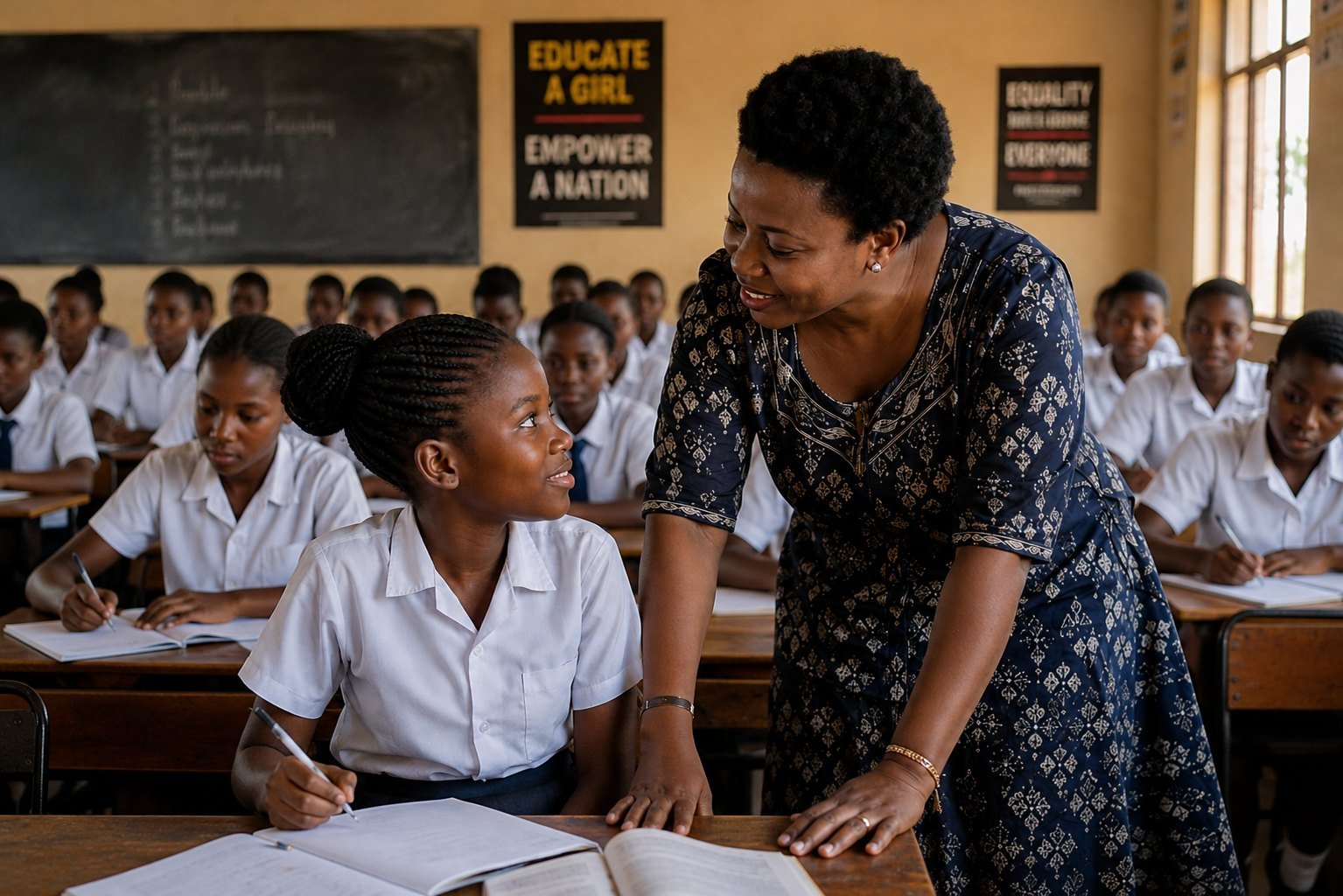
On any school morning, a girl somewhere will walk into a classroom. The person waiting for her in that room will not be a delegate to the United Nations, or a minister of state. It will be a teacher. The two days belong together, and that is why the teacher is part of this conversation. The conventions promise a girl an education, but a promise on paper reaches her only through the person at the front of the room, and the 1966 text on teachers says that advance in education “depends largely on the qualifications and ability of the teaching staff.” Who, then, is standing in that room when the world’s promise arrives? I want to ask what the world has written down about that girl, about the person waiting for her, and about the work that should follow, and to set those words beside what our own figures show.
What the resolution says, and what it leaves to others
The Day has a founding text. On 19 December 2011 the General Assembly adopted resolution 66/170, and decided that 11 October would be observed every year beginning in 2012. It is short, and it is honest about what it is. It does not list what a girl is owed. It recalls the instruments that do: the Convention on the Rights of the Child, the Convention on the Elimination of All Forms of Discrimination against Women, and the Convention on the Rights of Persons with Disabilities. It recognises that empowerment of and investment in girls, and their meaningful participation in the decisions that affect them, are key in breaking the cycle of discrimination and violence and in promoting and protecting the full and effective enjoyment of their human rights. It recognises also that empowering girls requires their active participation in decision-making and the active support and engagement of their parents, legal guardians, families and care providers, “as well as boys and men and the wider community.” And it invites all Member States, the United Nations system, other international organizations and civil society to observe the Day “and to raise awareness of the situation of girls around the world.”
This year the United Nations has given the Day the theme of ending child marriage and investing in girls’ rights. Each country brings its own emphasis to the Day. South Africa’s calendar carries its own national campaign, the 16 Days of Activism for No Violence Against Women and Children, which runs from 25 November to 10 December. Child marriage and violence against girls each deserve more than a passing line, and I have not tried to give them one here.
Go back to the resolution’s sentence about empowering girls, and notice who else it names. The 2011 text does not ask only for the support of a girl’s own family. It names boys and men, and the wider community. That is not a new thought in the United Nations’ vocabulary. The 1979 Convention, in its preamble, is “aware that a change in the traditional role of men as well as the role of women in society and in the family is needed,” to achieve full equality between men and women. Its Article 5 asks States to modify “the social and cultural patterns of conduct of men and women,” and its Article 10 names coeducation among the means of ending stereotyped roles in education. Read together, these texts do not describe the empowerment of girls as something done by girls, or for girls, apart from everyone else. They describe work that includes the boy and the man, and it returns us to the classroom, where the person waiting at the front stands before both.
The resolution’s words do not mention a school, a classroom or a teacher. That is not a failing. A resolution that sets a date is a doorway, not a house. Its authors told us where to look, and they told us in the preamble.
What the older documents say a girl is owed
Go to where the resolution points. The Convention on the Rights of the Child, adopted on 20 November 1989, says in Article 28 that States “recognize the right of the child to education,” to be achieved “on the basis of equal opportunity.” Article 29 says that education shall be directed to preparing the child for a responsible life in a free society, in a spirit that includes “equality of sexes.”
The Convention on the Elimination of All Forms of Discrimination against Women, adopted on 18 December 1979, is more exact, and its Article 10 repays slow reading. It commits States to ensure women “equal rights with men in the field of education.” Its first sub-paragraph reaches back to pre-school. It asks for access to the same curricula and the same examinations. And in the same breath it asks for something that is neither a curriculum nor an examination: “teaching staff with qualifications of the same standard.” It goes on to ask that any stereotyped concept of the roles of men and women be eliminated at every level of education, in part through “the adaptation of teaching methods.”
The right is written in the language of the State: recognise, ensure, take all appropriate measures. But look at what the State is asked to put in front of the girl. Among the things on the list is a person.
The same Convention does not stop at the school gate. Its Article 11 turns to work. It asks States to eliminate discrimination against women in the field of employment, and it names first among the rights “the right to work as an inalienable right of all human beings,” and then “the right to the same employment opportunities.” A girl is not educated for the sake of the classroom. She is educated for what the classroom opens. The Convention sets the school and the job in neighbouring articles.
Who stands in the room
If part of the right to education is the right to be taught, the next question is plain. What is owed to the person who teaches?
The world answered that too, forty-five years before the General Assembly named the Day. On 5 October 1966 a special intergovernmental conference in Paris adopted the Recommendation concerning the Status of Teachers. Sixty years have passed this month. A Recommendation is not a treaty: it sets a standard and asks States to meet it. World Teachers’ Day, held each 5 October and celebrated since 1994, commemorates its adoption. UNESCO describes the text as being revised, so the words I quote below are the 1966 words.
The Recommendation is candid about why it exists. Its fourth paragraph says that “advance in education depends largely on the qualifications and ability of the teaching staff in general,” and on the human, pedagogical and technical qualities of each teacher. Its fifth says that the proper status of teachers, and “due public regard for the profession of teaching,” are of major importance for the full realisation of the aims of education. It is not asking for sympathy for a profession. It is saying that progress in education depends, largely, on the person in the room.
And it does not forget the girl. Paragraph 10(b) asks that all facilities be made available equally so that every person may enjoy the right to education “without discrimination on grounds of sex,” among other grounds. Paragraph 7 says that “all aspects of the preparation and employment of teachers” should be free from any form of discrimination, sex among them. The authors of 1966 could see two people in that room, and for each of them they wrote down that sex must not decide what that person is owed.
What the words meet at home
The documents say what a girl is owed, who must give it to her, and what should follow when she has it. They cannot say whether it has reached her. For that we must turn to our own figures, and we are fortunate that Statistics South Africa, the national departments and our universities publish them. I want to read a few of them slowly, and I draw no conclusion from them that they do not bear.
Girls are the majority of those who sit the last school examination. Of the 746,110 candidates who wrote the National Senior Certificate in 2025, 418,121 were girls, which is 56%.
They go on. In 2024, women were 63.6% of enrolments at South Africa’s public universities, and 66.5% of their graduates: almost two thirds.
The Department also publishes those 2024 graduates in four broad groups. Women were the majority in every one, including the group it labels science, engineering and technology:
| Group | Women’s share of 2024 public-university graduates |
|---|---|
| Science, engineering and technology (a broad group) | 56.2% |
| Business and management | 65.3% |
| Education | 77.0% |
| Other humanities | 72.0% |
The first row hides as much as it shows. A 2026 working paper from the University of Cape Town reports, citing earlier work by its authors, that engineering enrolment has been over 70% men since 2012, dropping only into the high 60s in 2022, that computer science was about 60% men in 2022, and that health sciences strongly favour women. So women and men are not spread evenly across what they study. And what they study matters: a 2024 master’s assignment, which the Department of Higher Education and Training published, found that in the first quarter of 2023 the broad unemployment rate among graduates was 8.7% for those in education, 7.0% for health, and 17.6% for arts and social sciences. I have not found a measure of how much of the gap between women and men this explains, and I do not claim that it explains any of it. That study offers several possible reasons why graduate unemployment has risen, among them a shift in labour demand, a stagnating labour market, and racial and gender discrimination by employers. I do not choose between them here.
The table also counts one year’s graduates, not the people who are unemployed today, who graduated in many different years.
Then they meet the labour market. In the second quarter of 2026, Statistics South Africa put the official unemployment rate for women at 37.5% and for men at 30.3%. The qualification is not the failing: the rate for graduates of both sexes was 12.4%, against 39.2% for those without matric. But women graduates stood at 14.0%, above that 12.4%, and a year earlier the same office recorded 15.0% for women graduates against 8.9% for men. I could not find the matching figure for men in 2026, so I set the earlier year beside it and make no claim about the change between them. The rates for women and men overall are for ages 15 to 64.
In addition to what we know about women in education and the labour market, let us look at women and the economy. It is the economy the girl will enter.
At the top of our largest listed companies, the picture is uneven. Just Share’s review of the JSE Top 40, published in November 2025, found that women held 38% of board seats and 27.4% of executive roles, up three and 3.4 percentage points on 2024 for the current set of Top 40 companies. Women are 46% of the economically active population, a figure the review takes from the Commission for Employment Equity. The review counted nine boards at or near parity, six boards chaired by women, and three women among the forty chief executives.
Further down, women are fewer among those who employ others. In the second quarter of 2026, Statistics South Africa counted 795,000 employers, of whom 159,000 were women. One in five. Women were 39% of own-account workers. These are counts of status in employment, not of who owns a business. On pay, the latest Statistics South Africa figures I could find, for 2024, put the median monthly earnings of women employees at R5,300 against R6,500 for men, about 82% of the men’s figure. And Statistics South Africa’s most recent poverty report that I could find puts the incidence of household poverty in 2023 at 29.8% for households headed by women and 17.6% for those headed by men, on the lower-bound poverty line. Poverty has fallen for both since 2006, when the figures were 56.0% and 33.3%. Households headed by women are about 1.7 times as likely to be poor. Differences in hours worked, sector, age and household make-up may explain part of each gap; I have not tested them.
These numbers do not tell me why. They do not say that a girl’s schooling is the problem; the graduate figures say the opposite. They say that the promise on the page and the outcome on the street are not yet the same. What I can point to is older than any of these tables. Until 1993 a husband in a marriage in community of property could still hold marital power over his wife’s person and property, and colonial and apartheid-era law treated African women as perpetual minors, with no equal right to inherit or to hold property. These figures do not prove a link between that history and today’s numbers, and I do not rest the argument on one.
This does not settle the wider argument about how attention to girls sits beside attention to boys; that argument has its own evidence, and I do not make it here.
The line I am drawing
I should be plain about what I am doing here. The 2011 resolution does not mention the 1966 Recommendation, and the Recommendation, written forty-five years earlier, could not have mentioned the Day. The two documents do not refer to one another. I am the one setting them side by side, and the line between them is my argument, not theirs.
It is an argument I think the texts bear. The resolution points to the conventions. The conventions say what the girl is owed, and two articles of the second say what she must find when she gets there and what must be open to her when she leaves. The Recommendation says what the person in the room is owed, so that he or she can give it. What does a girl actually receive from the world’s best-drafted promises? She receives, on a given morning, what the person at the front has been prepared, supported and respected enough to give her. A right is not delivered by a resolution. It is delivered by a person. And it does not end at the school gate: the Convention that promises her the classroom promises her work, and in our own figures women’s unemployment runs higher than men’s.
That is why I distrust, in myself as much as anyone, the habit of honouring the document and forgetting the hands. We mark the Day of the Girl Child on the eleventh, and the day of the teacher on the fifth, and we treat them as two occasions. They are one question asked twice.
Sixty years ago the world wrote down what a teacher is owed. The Day of the Girl Child asks the plainer question: what is the girl owed, and who is standing in the room when she asks?
Finally, allow me, once more, to turn to two thinkers I have drawn on before: Carter G. Woodson (The Mis-Education of the Negro, 1933) and Paulo Freire (Pedagogy of the Oppressed, published in English in 1970), both of whom were ardent critics of an education that reinforced the status quo of oppression rather than liberating people from it. Woodson tells us what must be taught: the truth about the oppressed and their history. Freire tells us how it must be taught: not by depositing facts in the learner, but by posing together the problems of human beings in their relations with the world. As I read them, both would have the teacher’s ultimate task be not to produce and reproduce obedient subjects, but to help people become agents of their own liberation.
As we celebrate our teachers and note what we owe the girl-child, we should ask: what is each of us doing to give our teachers what the 1966 text said they must have, so that they can raise learners in whose hands we can place the future of our country? This question demands our honest collective answer.
The work that remains is not to draft another page. The pages exist, and they are good. The work is to see that on an ordinary morning the words and the person meet, and that the person has been given what the page said they must have. And when the girl leaves that room, the door to work should be as open to her as the door to school was. That is a task for every country that put its name to these texts, and for every one of us who has ever been taught.
“The future is not an accident.”
Dr Malusi Gigaba is a Scholar-Statesman, an ANC NEC Member, a former Cabinet Minister of the Republic of South Africa, a Member of Parliament, and a member of both the Portfolio Committee on Trade, Industry and Competition and the Portfolio Committee on Justice and Constitutional Development.