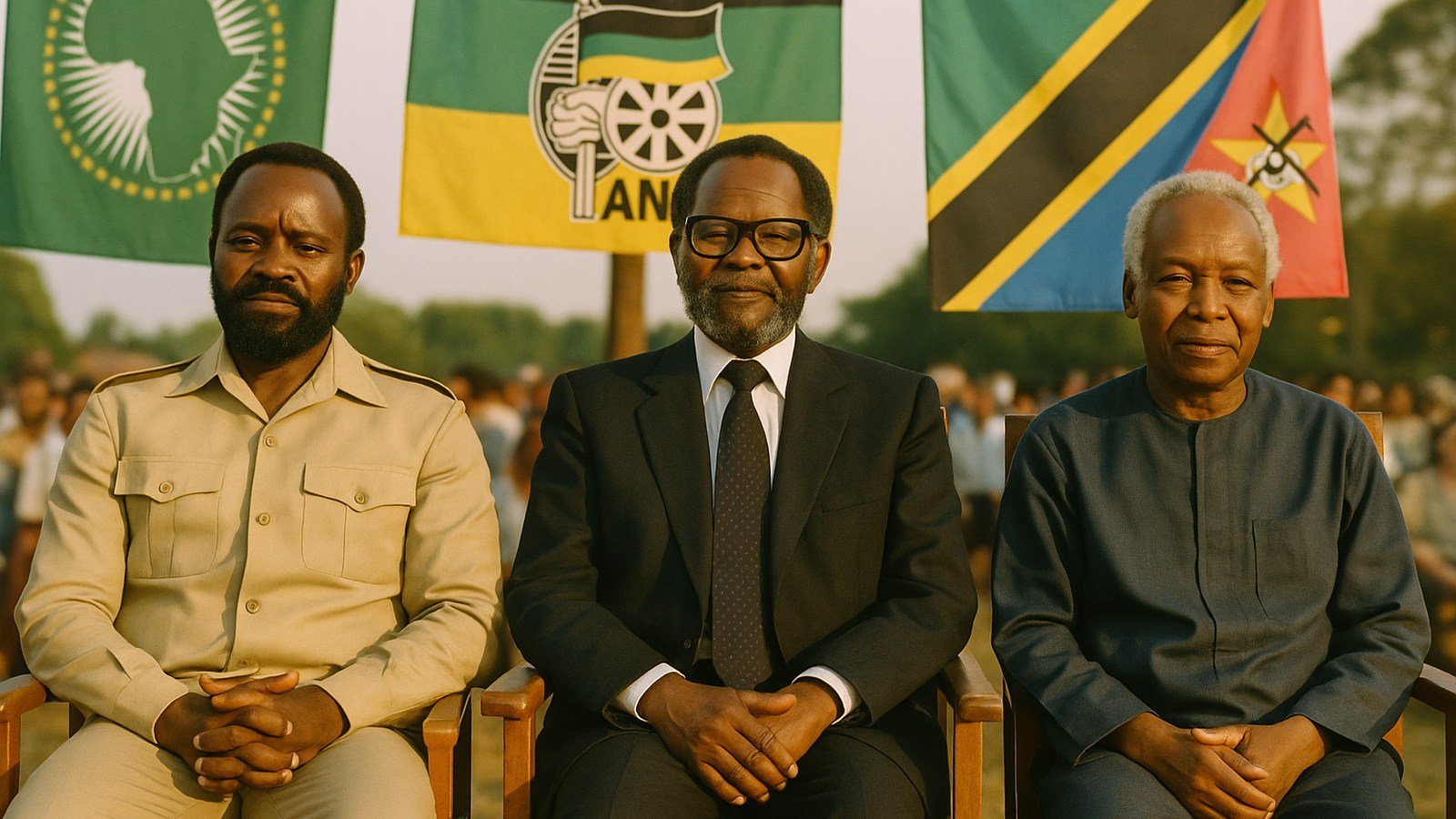
History must repeat itself: by design.
Dear Africa's Future Leaders
There comes a time in every generation when the continent asks again: Who will love her enough to serve her, and who will serve her enough to free her?
In this season, our memory drifts northward to Dar es Salaam, east to Maputo, and south to the exiled corridors of Lusaka and London: the moral geography of our liberation.
Here, three names stand like sentinels over Africa's conscience: Julius Kambarage Nyerere, Samora Moisés Machel, and Oliver Reginald Tambo.
This month binds their stories together. On 27 October 1917, Oliver Reginald Kaizana Tambo, The Diplomat, was born. On 19 October 1986, Samora Moisés Machel, The Commander, lost his life in the Mbuzini air crash while returning from a summit on Southern Africa's peace and unity. And, on 14 October 1999, Julius Kambarage Nyerere (Mwalimu, the Teacher) passed away.
Though separated by years, their dates converge in October: a month that calls us to remember Africa's moral architects and to renew their shared vision of people-centred, cross-border leadership. Their names will forever be associated with Africa's struggle for total emancipation against colonialism, for social justice and new human, and dare we say, humane, values.
They will be remembered for forging a worldwide and continent-wide solidarity movement for independence decolonisation. All born in colonised societies, among an oppressed and humiliated people, they strode the globe like colossi and affirmed the great nobility and supremacy of our course, as well as the immense pride and humanity of our peoples who, though oppressed and despised, were however free and noble in spirit, and gallant in their actions.
Beyond their friendship, Nyerere, Machel, and Tambo stood among a progressive generation of African leaders who transformed solidarity into structure. Nyerere and Tambo helped steer the formation of the Organisation of African Unity (OAU) in 1963, grounding Africa's political independence in continental unity. Later, together with Machel and other leaders of the Frontline States, they forged a regional alliance that sheltered liberation movements and turned moral conviction into coordinated action.
The prize that both Tanzania and Mozambique, and that Samora Machel personally, paid for their steadfast support for our struggle in South Africa remains etched in our collective memories as a people. We know that we owe our freedom, in part, to their principled solidarity with our struggle and the moral stand they took in a hostile world to associate with and provide political, moral and material support to our struggle.
Under Machel's leadership, Mozambique helped anchor a wider regional alliance that, through shared purpose and mutual sacrifice, produced the 1980 Lusaka Declaration: the foundation of today's Southern African Development Community (SADC).
Their leadership gave continental unity an institutional backbone: ideas became alliances, and solidarity became strategy.
The three African leaders' nations lay apart, yet their destinies converged. Even today, the bonds of friendships forged during those dark days between our leaders, movements and peoples remain a permanent firm, a monumental legacy celebrating Africa's greatest doyens.
They did not speak the same mother tongue; they spoke the same moral language: duty, humility, and love for the people.
Today, as you inherit the unfinished work of Africa's freedom (the task of total economic independence, digital sovereignty, and ethical governance), their footsteps remain a map.
Mwalimu (Nyerere) — The Teacher
Before he governed a nation, Julius Nyerere taught mathematics and English at St Francis' College (Pugu). His students called him Mwalimu, "teacher" in Kiswahili, a name that followed him into history.
He believed that a leader's first classroom is the conscience.
When colonial education celebrated Europe, he quietly translated Shakespeare's Julius Caesar (Juliasi Kaizari) and The Merchant of Venice (Mabepari wa Venisi) into Kiswahili, proving that African languages could carry the world's classics. Translation, for him, was liberation and consciousness began with national pride.
Yet Nyerere's truest lesson was taught not in a classroom but in how he turned his country into a sanctuary. From the early 1960s, Tanzania became the de facto home and headquarters of the ANC and all of Africa's national liberation movements in exile. Dar es Salaam hosted the OAU Liberation Committee and welcomed thousands of South African exiles, students, and fighters.
It was from Tanzanian soil that Oliver Tambo coordinated the ANC's diplomacy, that Umkhonto we Sizwe trained its earliest recruits, and that the movement regained its voice after being banned at home.
It was also on Tanzanian soil, in the town of Morogoro in 1969, that the ANC in exile held its historic Consultative Conference. There, under Tambo's steady leadership and with Nyerere's blessing, the movement redefined its strategy, broadened its membership, and reaffirmed the Freedom Charter as its moral compass. The Morogoro Conference became the moment the ANC turned reflection into renewal: proof that exile had not silenced its purpose, but sharpened it.
Tanzania bore the economic cost of that hospitality because, to Nyerere, liberation anywhere on the continent was liberation for all.
The two men, Nyerere and Tambo, shared not just strategy, but spirit.
Nyerere often said of Tambo: "He is a man of quiet strength and deep integrity, the conscience of his movement."
For his part, Tambo called Nyerere "the moral north of our struggle, the man who gave the exiled ANC a home and Africa a voice of reason."
Nyerere's ujamaa ("familyhood") philosophy built villages on cooperation, not competition. He taught that freedom without self-reliance is dependency with a flag. He sacrificed personal comfort, retiring voluntarily in 1985 to model humility in power: a rare curriculum in leadership.
"Leadership is not about power; it is about responsibility."
From Mwalimu we learn that knowledge in the people's language is the first freedom, and that leadership without moral instruction soon collapses under its own cleverness.
The Commander (Machel) — Courage and Solidarity
Samora Machel trained as a nurse before taking up arms. Healing and fighting were never opposites to him; both were acts of protection.
When he joined FRELIMO in 1962 to free Mozambique from Portuguese rule, he rose to become Commander-in-Chief of the Forças Populares de Libertação de Moçambique (FPLM).
In 1972 he issued the Montepuez Directive, a moral code for guerrilla fighters forbidding theft, cruelty, or arrogance: "A gun without ideology is a stick."
After independence in 1975, he opened Mozambique's borders to the ANC's armed wing, Umkhonto we Sizwe. Mozambique became the frontline of South Africa's struggle, providing camps, routes, and intelligence for operations launched from its soil.
Pretoria retaliated with sabotage and raids that devastated Mozambican towns and railways. One of the deadliest was the Matola raid of 1981, in which South African commandos killed twelve ANC cadres near Maputo.
The next day, Machel stood beside O.R. Tambo at the memorial and declared: "Their blood is ours."
In those dark hours, Machel and Tambo stood not just as allies but as brothers-in-arms: united by a conviction that the freedom of one African nation could never be separated from the freedom of another. For both men, the defeat of the apartheid regime in South Africa was an urgent task, in the interests of all of the African Continent.
Machel told Tambo: "Tell your people that Mozambique's heart beats with South Africa's struggle." To prove the truth of his words, Mozambique also embraced in its soil the remains of South Africa's beloved children, the most prominent of whom was Uncle Moses Mabhida, the General Secretary of the South Africa Communist Party, described by OR as, "a colossus that was supremely human!"
Still, despite relentless assault, Machel refused to abandon the ANC. To him, solidarity was a covenant, not convenience.
On 19 October 1986, returning from a regional summit aimed at peace in Southern Africa, his aircraft crashed near Mbuzini on the South Africa–Mozambique border.
To this day, many believe that apartheid security forces engineered the disaster.
At his passing, Tambo's tribute echoed across Africa: "Samora Machel was a soldier for humanity who knew that our struggles were one."
The blood they shared with South Africans consecrated the very idea of Pan-African unity, not as an institution, but as a lived covenant of sacrifice.
He understood that the cost of solidarity is high, but the cost of indifference is fatal.
In him, command meant discipline under fire, not dominance over others.
For Africa's future leaders, Machel's life teaches that courage is not loudness; it is the quiet decision to stand firm when expediency whispers "compromise."
The Diplomat (Tambo) — Patience and Purpose
Oliver Tambo left South Africa in 1960 to build the ANC's external mission. The decision was taken that he and Josiah Matlou must secretly leave the country to begin building the ANC's rear-bases in exile in anticipation that the movement would soon be banned.
It had become apparent after the historic victory of the National Party in 1948 that white supremacy was entering a new phase of intense aggression and enforcement. Just after they left, in 1961, the Sharpeville Massacre occurred on 21 March 1961, prompting the ANC's launch of armed struggle and Umkhonto WeSizwe (MK) on December 16th. Thus, dramatically, South Africa entered its period of the most intense repression characterised by sustained violence for a whole three decades, ending with the 1994 general elections.
The task which faced these young leaders of our people when they left the country on this ostensibly insurmountable mission was arduous and unenviable. The ANC had no armed soldier, no training base, no office, no gun, no residential area or camp for its refugees and no fighting experience. There were few independent states that would host its refugees and provide training to its soldiers. They had to establish all of that.
For thirty years OR carried a nation's hopes in a suitcase, creating a government-in-waiting without territory, leading what was regarded by all in all the capitals of the world as the genuine government and leader of the people of South Africa.
He established ANC offices in more than twenty-five countries, from Dar es Salaam and Lusaka to London and Stockholm, turning exile into an international frontline. By 1990, when the ANC was unbanned, the ANC had more international footprint and acceptance than the white minority regime, establishing as the de facto legitimate government of the Republic of South Africa.
Through his steady diplomacy, he persuaded the world to see apartheid not as a South African anomaly but as a crime against humanity. His integrity and dignity pervaded his every calculated word and actions. He was a household name in all the international conferences about world peace, human rights and liberty. He evinced moral charisma even in his pictures.
It was not only on international platforms that OR was a moral leader, but he inspired generations of freedom fighters in South Africa and abroad to be relentless and fearless in pursuit of freedom.
The mere mention of his name sent shivers down the spines of the racist tyrants while it ignited death-defying acts of unimaginable courage among the youth in the townships and rural areas of our countries who have never even seen him. They took his every word as an order and command of the day, even when he instructed them to return to schools during the period of school and class boycotts in the eighties and turn their schools into assembly points at which to receive the orders of the day.
A moral compass of our struggle, he condemned arrogance, brutal violence and acts of vigilantism, but understood and defended his cadres when caught in difficult moments when they could not but commit acts of violence in pursuit of our noble cause.
Tambo's partnership with Sweden's Olof Palme secured scholarships and humanitarian aid for South African exiles. Inside the movement, he maintained unity among ideological factions, insisting that moral discipline was itself a diplomatic act.
He was, as Nyerere once said, "the embodiment of the ANC's conscience."
His calm voice out-lasted the roar of the oppressor.
From Tambo we learn that persuasion is power, that integrity builds longer bridges than ambition, and that Africa's standing in the world will depend on the steadiness of her negotiators as much as the bravery of her soldiers.
Key Lessons for Africa's Future Leaders
From these three giants (the Teacher, the Commander, and the Diplomat), emerge principles that must guide Africa's next generation of leadership.
Their stories are not monuments; they are design manuals for the continent's renewal.
Mwalimu (Nyerere): Leadership must begin with moral instruction. Knowledge in the people's language, humility in power, and service before ambition are the cornerstones of credible governance. The next liberation will depend on systems where learning leads, and politics follows. We do not do politics for its own sake, but to change and improve lives.
The Commander (Machel): Courage is not the absence of fear, but discipline in the face of it. Africa must design conviction into governance: the kind that builds nations, not empires; that fights corruption with the same moral clarity that once confronted colonialism. Our Commander teaches us to stand firm in the face of adversity.
The Diplomat (Tambo): Integrity is Africa's quiet strength. Persuasion rooted in principle must again become the continent's most powerful weapon. The future will belong to those who negotiate with conscience as steadfastly as others once fought with arms.
Together, these lessons remind us that Africa's renewal will not be improvised. It must be designed.
The Frontlines of the Future
Dear future leaders, the freedom you inherit was born of immense sacrifice, solidarity and cross-border faith.
Tanzania gave sanctuary to the ANC when South Africa had no home; Mozambique gave its ground to Umkhonto we Sizwe even when its own army was barely formed; and Tambo criss-crossed the world and gave it a reason to care.
Their alliance proves that Africa's strength has never lain in its size but in its solidarity.
Today, our frontlines have shifted. They are not drawn by trenches and rifles but by code, climate, and conscience. The battlefields are boardrooms, data centres, classrooms, and parliaments.
To win them, you must:
- Build economies of self-reliance, not dependency.
- Invest in ethical governance where public office is service, not spoils.
- Protect African sovereignty in digital and financial spaces.
- Collaborate regionally, for no nation can be prosperous alone.
- Remember: love for the people is the most radical policy of all.
Conviction without compassion becomes tyranny; compassion without conviction becomes drift.
Let history repeat itself — but this time, by design: through minds that teach (Mwalimu), hands that build (The Commander), and hearts that unite (The Diplomat).
Yours in Africa's Second Liberation,
Dr Malusi Gigaba
“The future is not an accident.”
Dr Malusi Gigaba is a Scholar-Statesman, an ANC NEC Member, a former Cabinet Minister of the Republic of South Africa, a Member of Parliament, and a member of both the Joint Standing Committee on Defence and the Portfolio Committee on Trade, Industry and Competition.