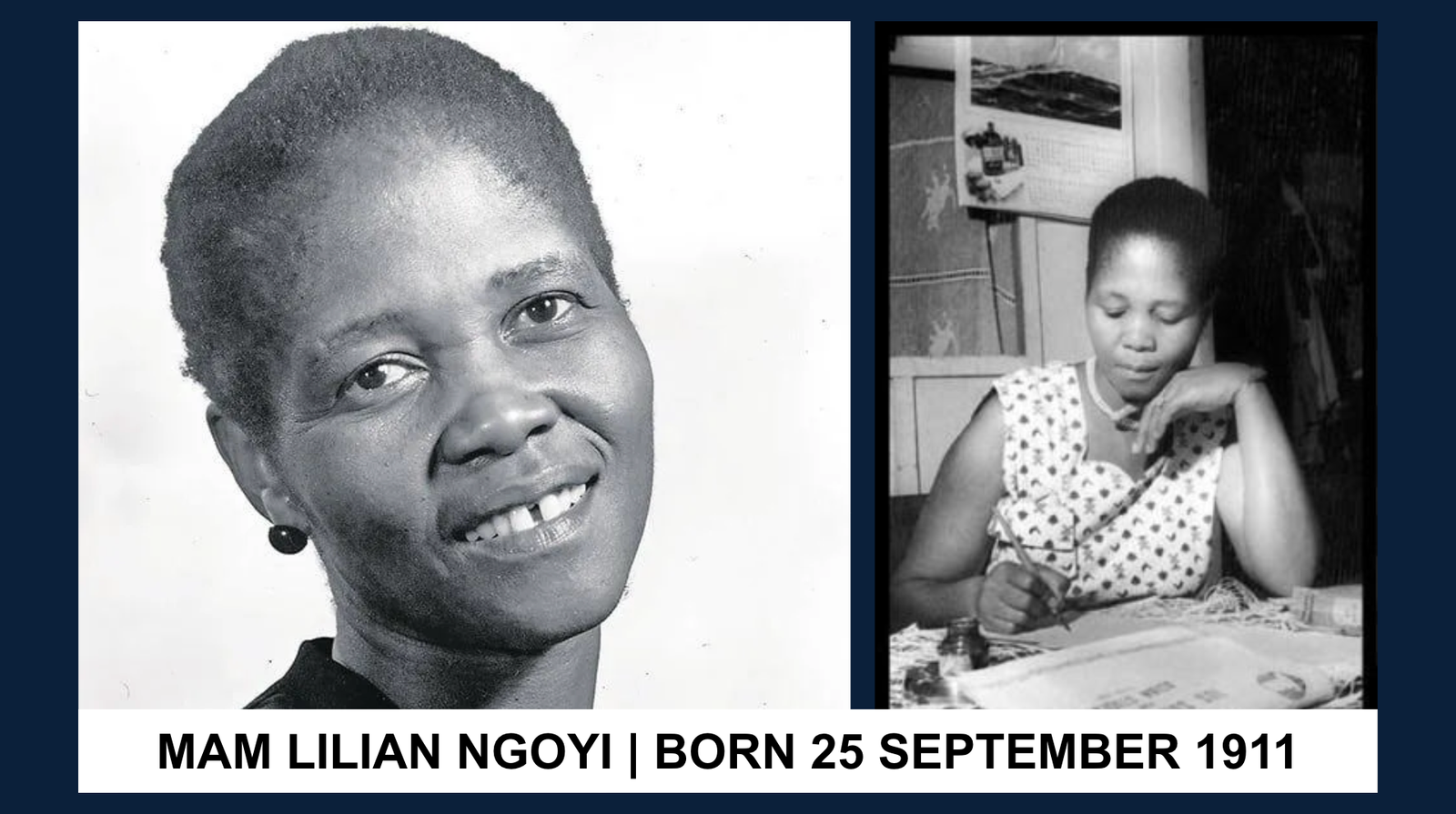
Lilian Ngoyi, 1911–1980.
On 25 September 1911, in Pretoria, a girl named Masediba was born to Annie and Isaac Matabane. In Sesotho, sediba is a fountain, a wellspring. The prefix Ma- marked a woman’s name: the expanded meaning is the woman who brings life. Her grandfather had served in the royal Mphahlele household before turning to the Methodist ministry, a man who crossed between worlds. His granddaughter would have crossed them too, though on terms the state had not authorised and in directions it would spend the rest of her life trying to reverse.
Her name was Lilian Masediba Ngoyi. Two days ago, she turned 115. And the question that has occupied me as I prepared this piece is not the obvious one. Not what did she do? The record, when you take the trouble to read it, answers that comprehensively. The question is this: how does a woman who held the highest offices the liberation movement could give, who was banned three times for what she believed, who travelled under a false name to address a world congress because her own government refused her a passport, become, more than four decades after her death, a name we recognise but a life we do not know?
That question is not rhetorical. I went looking for the answer.
The seamstress from Pretoria
Ngoyi’s early life is the story of an ordinary black woman in early-twentieth-century South Africa, which is to say, a story shaped entirely by what the state and the economy would and would not allow.
Her father was a miner who died of lung disease. Her mother worked as a washerwoman. She attended Kilnerton Primary School, a Methodist mission school in Pretoria, until Standard Two. In 1928, at sixteen, she moved to Johannesburg and trained in general nursing at the City Deep Mine Hospital. But nursing did not hold her. In 1934, she married John Gerard Ngoyi. Three years later, John was killed in a motor car accident. She was twenty-six, a widow, and a mother of three, Edith, Memory and Eggart, raising them while caring for orphaned cousins and elderly parents. The family lived in the Shelters, the tin shanties of James Mpanza’s Orlando land invasion.
She became a seamstress. She worked in the garment factories of Johannesburg and from home, stitching clothes for a living. It was in the garment factories, through the Garment Workers’ Union under Solly Sachs, one of the few non-racial unions of its era, that she encountered trade unionism, and through trade unionism, politics. The factory floor was, for Lilian Ngoyi, the lecture hall.
I make this point because it matters for what follows. She did not come to politics through the academy or the professions. She came through the needle and the machine, through solidarity with other working women, through the lived experience of what it meant to be black, female and poor in a country that regarded her labour as a resource and her personhood as an inconvenience. That provenance gave her something that formal political education cannot always give: the authority of experience. When she spoke to a crowd, she was not interpreting a condition she had studied. She was testifying to one she had lived.
She was, it can confidently be argued, an embodiment of the dialectical interface between class, race and gender, of the inordinate historical burden borne by black women, in particular, and all black oppressed, to fight against class, race and gender oppression. The nature of oppression in our country was such that black women bore the brunt of class exploitation at work, as workers, of national oppression all over, as black people, and of gender discrimination at work, across the nation and at the home-front, as black working women. Theirs has been the most difficult burden of all, one which continues to this day to bedevil our nation and be at the epicentre of all the unresolved questions of our time.
From the factory floor to the front line
By 1952, Ngoyi had joined the ANC Women’s League. She was forty-one. That year, she volunteered in the Campaign of Defiance Against Unjust Laws, the ANC-led action in which thousands deliberately broke apartheid laws to court arrest. She walked into a whites-only post office to telegram Prime Minister Malan. Not youth radicalism. A middle-aged woman who had buried a husband and raised children alone deciding she had had enough. It was the moment that carried her from the factory floor to the front line. Her rise was swift because her capacity was large. She became Treasurer of the South African Non-European Council of Trade Unions. In 1954, she helped establish the Federation of South African Women, FEDSAW, the organisation that would, two years later, give structural form to the largest single act of women’s political defiance in South African history. She became president of the ANC Women’s League, the position she held when she led twenty thousand women to the Union Buildings in August 1956. In December of that year, she became the first woman elected to the National Executive Committee of the African National Congress, a body that had existed, at that point, for forty-four years without a woman at its table.
Read that again. Forty-four years.
These are not minor offices. The NEC of the ANC was, and remains, the highest decision-making body of the organisation between national conferences. To be the first woman elected to it was not a gesture of inclusion, or an act of benevolence on the side of men. This was an acknowledgement, earned and not given, that Lilian Ngoyi belonged at the table where the liberation of this country was being directed. Not because no woman before her had deserved a seat, but because the movement itself, like the country it sought to change, had not yet made room. She was not done a favour; she had earned her right to sit at the high table, as a midwife and pioneer, and usher for all other women who would later occupy those seats.
Her weapon was her voice. Es’kia Mphahlele, profiling her in Drum magazine in 1956, wrote that she could “toss an audience on her little finger, get men grunting with shame.” Winnie Madikizela-Mandela would later recall: “She spoke the language of the worker, and she was herself an ordinary factory worker.” She was not a theorist. She was a speaker who could move a room, and a room she had moved could move a country. Almost nothing of her oratory survives on tape or in transcript. A woman whose voice moved thousands, and the record kept almost none of it. That silence is itself a data point about what was considered worth preserving. The same applies to the other three women with whom she appears on the images of the march. We know their pictures, but not the speeches they made on the day. They have been silenced.
The passport she was never meant to have
In 1955, the Women’s International Democratic Federation convened its World Congress of Mothers in Lausanne, Switzerland. The congress brought together women from across the world to address questions of peace, disarmament and the rights of mothers and children. South Africa’s liberation movement selected Lilian Ngoyi and Dora Tamana, another doyen of the struggle, to represent it.
There was a problem. The apartheid state did not issue travel documents to black South Africans who wished to attend political gatherings abroad, least of all a congress convened by an international body the state regarded with suspicion. Ngoyi and Tamana had no passports and no prospect of obtaining them through any official channel.
They went anyway.
The details of how they travelled deserve to be stated plainly, because they tell us something about what political commitment looked like when it could not be performed from a podium. Ngoyi and Tamana travelled under assumed names. They entered Britain under the pretext of attending Bible studies. They sat in segregated seating. And when they arrived in Lausanne, they represented a country that had done everything in its administrative power to prevent them from being there.
I note this without performance. The department that carries the name Home Affairs, in which I once served, was in 1955 the instrument that denied Lilian Ngoyi the right to leave her own country. The institution whose mandate is to affirm citizenship, to say, on paper, you belong and you may move freely, was the institution that told a leader of the ANC Women’s League that she could not. That she went regardless, under a name that was not hers, past officials who did not see her, tells you something about the kind of woman she was. It tells you something else about the kind of state she lived under.
From Lausanne, Ngoyi travelled on to England, Germany, Romania, China and Russia. A seamstress from Pretoria, moving across continents on borrowed papers, carrying a mandate from a movement her government had declared illegitimate. She returned to South Africa with a wider view of the world, a deeper conviction, and the attention of a state that now regarded her as dangerous.
Twenty thousand women
The march did not organise itself, and it was not welcomed by everyone in the movement. Walter Sisulu and other male ANC leaders initially believed the women would “just mess things up.” They questioned whether women understood the risks of confronting the state directly. Ngoyi’s response was characteristic: the women “would know what to do,” she said, and “other women would step forward” if leaders were arrested. Her conviction persuaded the male leadership to endorse the march, though they provided minimal practical support.
On 9 August 1956, Lilian Ngoyi, together with Rahima Moosa, Helen Joseph and Sophie Williams-De Bruyn, led approximately twenty thousand women to the Union Buildings in Pretoria. They came to protest the extension of pass laws to women. They came in silence, and their silence was louder than anything they could have said.
That march is the event for which Ngoyi is most widely remembered. It is commemorated every year on Women’s Day. It is invoked in speeches, printed on posters, referenced in curricula. And yet there is a peculiar narrowness to how we remember it. We remember the march. We do not always remember the woman who organised it. We know the image, the crowd, the steps of the Union Buildings, the petitions laid at the door of a Prime Minister who refused to receive them, but not the life that brought her to those steps, or the life the state would take from her afterward.
The 1956 march was not the beginning of Lilian Ngoyi’s political life. It was not its conclusion. It was one chapter, a magnificent one, in a life that had chapters before it and chapters after it that we have not yet troubled to read.
The long silence
The state did not punish Lilian Ngoyi for what she had done. It punished her for what she could still do. The treatment of Ngoyi after 1956 tells us that the apartheid regime understood something precise: that a woman who could move twenty thousand people to march in silence could move them to do a great deal more. It acted accordingly. In a way, hers was no different from those that were incarcerated for long periods in detention on Robben Island, except for the fact that it was claimed she was “free”.
In 1962, Ngoyi was served with her first five-year banning order. She was prohibited from attending gatherings, from entering educational institutions, from leaving the magisterial district of Johannesburg. She was, in the language of the law, restricted, which meant, in practice, that she was being removed from the public life she had claimed as her own.
The first order was renewed in 1967. When it lapsed in 1972, there was a brief reprieve, the only period in her final two decades when she could move and speak and gather without the state’s permission. In August 1973, she used that reprieve to visit Nelson Mandela on Robben Island. She was one of the only former comrades, Evans would later note, ever to secure approval, though it remains unclear why the state granted it. Mandela greeted her: “Ohh! Lily, my dearest.” She told the Rand Daily Mail afterward: “On Robben Island there is no despair and no self-pity… There is no time for tears there.” In 1975, a third banning order was imposed. It would run until 1980.
The banning orders did not merely silence her. They impoverished her. Security police raided her home regularly, driving away the customers who had once come for her sewing. She could not travel into town to buy fabrics. Unlike other political families, she received no support from the exiled ANC leadership or from the International Defence and Aid Fund. She survived on sporadic charitable donations and on what she could still make with her needle. “We feel small to say thanks all the time,” she wrote. Friends overseas sent her seeds, and she grew vegetables in her small yard. It was, perhaps, the only form of sustenance the state had not found a way to take from her.
On 13 March 1980, two months before her third banning order would have lapsed, Lilian Ngoyi died at her home in Orlando, Soweto, in poverty. She was sixty-eight years old. She had spent fifteen of the last eighteen years of her life under banning orders: the state’s sustained instruction that she be silent.
Archbishop Desmond Tutu, speaking at her funeral, predicted that her name would one day be written “in letters of gold.” It was a generous and prophetic thing to say. In 1982, two years after her death, the ANC awarded her the Isitwalandwe, the movement’s highest honour. She was not alive to receive it. But prophecy, like naming a street, requires someone to do the work of fulfilment. The letters of gold have yet to be written in full.
Named but not known
Let me return to the question with which I began: how does a woman of Lilian Ngoyi’s standing become a name we recognise but a life we do not know?
The evidence of the gap is not a matter of impression. It is measurable. On her 115th birthday, I searched the major social media platforms, the ANC’s own information channels, and the websites of the national and provincial governments for birthday tributes in her honour. The result was sobering.
On X, formerly Twitter, every post bearing her name in the days around 25 September 2026 concerned a street: road closures, a running race, traffic advisories for the R192-million Lilian Ngoyi Street rehabilitation in the Johannesburg inner city. Not one was a birthday tribute from a South African voice.
On Facebook, the pattern repeated: a hair salon advertising its location on Lilian Ngoyi Road; the JMPD posting a traffic update; a funeral home using the street as an address. The only birthday tribute I could find came from the Great Plains Black History Museum in Omaha, Nebraska, an institution on another continent, doing what none of ours appeared to be doing on the day.
The ANC Women’s League issued no birthday statement that I could find. The government’s Heritage Month 2026 programme, themed “Reimagine our heritage institutions,” made no mention of her. The Heritage Day celebrations in Gauteng centred on a race that started on the street bearing her name without, so far as the public record shows, pausing to say whose name it was.
Her name, in September 2026, is doing heavy work: as a geographic coordinate.
Deputy President Paul Mashatile, in a Lilian Ngoyi Memorial Lecture in August 2025, called her “the matriarch of Black Resistance,” “a tiger who could electrify a crowd and the lamb who nurtured those she loved.” Those are fine and true words. But memorial lectures held intermittently are not the same as institutional memory. They are events, and the record of this particular lecture series has not been one of consistency.
And then there is the biography. In August 2026, Martha Evans published what the Cape Times described as “the first full-length biography of one of South Africa’s most influential yet underrepresented liberation figures.” The book runs to 368 pages. It took sixty-four years from Ngoyi’s first banning order, and forty-six from her death, for the country to produce a comprehensive scholarly account of her life.
That delay is not an accident. It is the long shadow of the banning order: not the crude silencing of death, which makes martyrs whose stories cannot be suppressed, but the quieter erasure of invisibility, which ensures that the story is simply never told in full. And the reasons for the delay tell us something structural about whose stories get preserved. She was not the wife of a high-profile ANC man. Winnie was Mandela’s wife. Albertina was Sisulu’s. Lilian Ngoyi was widowed at twenty-six and rose on her own. She lived most of her public life under banning orders, effectively erased from the public record for fifteen years. And she died in poverty in 1980, before liberation, before there was a democratic government to honour her in life.
The South African Heritage Resources Agency declared her Orlando West home a National Heritage Site in 2010, thirty years after her death. Strijdom Square in Pretoria was renamed Lilian Ngoyi Square in 2006. A sewing machine sculpture, made from car parts by the artist Stephen Maqashela, stands outside her Orlando West home; her adopted daughter recalled she spent her confinement sewing ANC Women’s League blouses. Streets in three cities bear her name. The Lilian Ngoyi Street rehabilitation in Johannesburg, at R192 million, is expected to reopen in October 2026. But there is no Lilian Ngoyi Foundation. No Lilian Ngoyi Trust. No NGO, no scholarship fund, no research institute, no school, no university bearing her name.
She is not forgotten. She is reduced, compressed into a single morning at the Union Buildings and a name on a street sign. And that is a different, harder problem, because the reduction creates the illusion that she has been honoured. We are investing public money in the infrastructure of her name. The question is whether we are investing anything commensurate in the substance of her memory.
The question still remains lingering in post-apartheid South Africa about how we remember, or how we should remember, those that lit the firmament on our horizon, who gave us hope when our country was still enveloped in the dark cloud of racial tyranny, who gave us courage by occupying the frontline when comfort was either to stand idly or occupy the positions of silence to protect their own lives? Should we build them monuments? Name streets and government buildings after them?
It would seem to me that we ought to complete the struggle that was the passion of their lives. In the case of Mama Lilian, this would be to end socio-economic exploitation and exclusion based on class; inequality, discrimination and disunity based on race; as well as patriarchy, violence and inequality based on gender! Mama Lilian’s life was of struggle for the restoration of the dignity of the most common among our people, and her struggle for the most total emancipation of the most oppressed and discriminated against. Every day must register progress in that struggle.
I said at the outset that the question is not whether we have forgotten Lilian Ngoyi. We have not. We have named a street after her. We have declared her home a heritage site. We have, from time to time, gathered to speak of her. But naming is not knowing, and knowing is not honouring: not the single march we recall, but the whole life, the seamstress and the trade unionist, the mother and the president of the Women’s League, the woman who travelled under a borrowed name to speak to a world that her own government had tried to keep her from reaching.
The Evans biography is a beginning, not a conclusion. It is the first sustained attempt to do what should have been done decades ago: to tell the full story of a woman who led from the front, who was silenced for it, and whose silence we inherited without ever fully interrogating what we lost.
Lilian Masediba Ngoyi was not a footnote in someone else’s liberation. She was not an addendum to a march. She was not defined by marriage to a famous man; she was widowed at twenty-six and built her authority from nothing, against the resistance of her own movement and the full weight of the state. She was a leader, in her own right, and that phrase is not a title. It is literally what she had to prove. It is time we treated her story with the seriousness her rank demands.
“The future is not an accident.”
Dr Malusi Gigaba is a Scholar-Statesman, an ANC NEC Member, a former Cabinet Minister of the Republic of South Africa, a Member of Parliament, and a member of both the Joint Standing Committee on Defence and the Portfolio Committee on Trade, Industry and Competition.