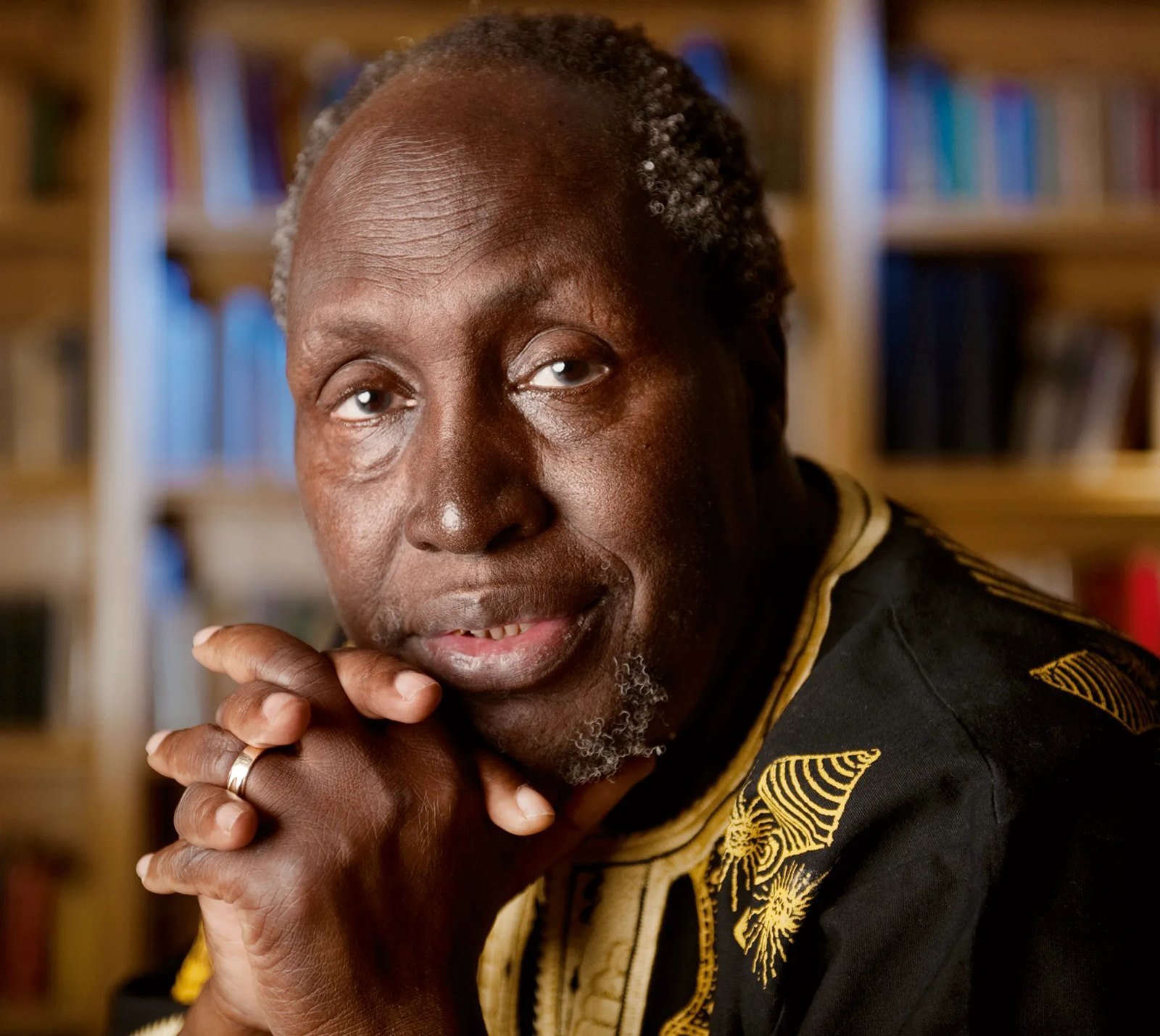
Ngũgĩ wa Thiong'o died one year ago this week, 28 May 2025, in Buford, Georgia, aged eighty-seven. He had been outside his own country, for the most part, for forty-three years. The first twenty-two of those years were imposed; the next twenty-one were chosen. The institutional reason both phases ran as long as they did is the question this article is about. It is not a literary question. It is a governance question, and it is unanswered: in Kenya, in South Africa, and in most of the post-colonial states he wrote about for half a century.
A writer who would not stop telling the truth
Ngũgĩ was born in Kamiriithu, in central Kenya, on 5 January 1938. He published his first novel, Weep Not, Child, in 1964, then writing in English under the name James Ngũgĩ. Over the next decade he produced the early novels (The River Between, A Grain of Wheat, Petals of Blood) that established him internationally as a major voice of post-independence African fiction. By the mid-1970s he was a professor in the literature department at the University of Nairobi and had become the most internationally legible Kenyan literary voice of his generation.
The institutional origin of his early career, and of the argument he would spend the rest of his life prosecuting, can be located precisely. In June 1962, while he was a student at Makerere University College in Kampala, the Department of Extra-Mural Studies hosted what was billed as the "Conference of African Writers of English Expression." Achebe was there. Soyinka was there. Mphahlele, Nkosi, Brutus, Okara, Okigbo, almost every writer of consequence then publishing in English from the continent, was there. The young James Ngugi, as he was still calling himself, was there too, as a student rather than as a featured guest; his play The Black Hermit premiered at Kampala's National Theatre as part of the conference week. At some point during the proceedings, he buttonholed Achebe and asked him to read manuscripts of The River Between and Weep Not, Child. Achebe read them; recommended them to Heinemann; and the two novels became part of the early run of the Heinemann African Writers Series, of which Achebe was the founding advisory editor. The career was made at Makerere.
Several writers of consequence were not at Makerere, and the reasons they were not are part of the institutional record the conference produced. Chief D.O. Fagunwa, the Yoruba novelist whose Ogboju Ode Ninu Igbo Irunmale (1938) had been one of the first novels published in any African language, was not invited: he wrote only in Yoruba, and the conference's title excluded him by definition. Shaaban Robert, the most prolific living East African poet writing in Kiswahili, was excluded on the same ground. Amos Tutuola, the Nigerian author of The Palm-Wine Drinkard (1952), whose international reputation predated Achebe's, was excluded on a subtler ground: he wrote in English, but in a deliberately non-standard, Africanised English that the Makerere generation — educated at the best mission and public schools the colonies offered, and proud of their mastery of "Standard English": regarded as an embarrassment. The gatekeeping at the conference had two faces. If you wrote in your own language, you were not a writer of African literature. If you wrote in English, but not in the English the conference had been trained to recognise as serious, you were a writer the conference would rather not seat at its table. Both exclusions were the institutional architecture the conference's title made possible. Ngũgĩ would later cite both, in Decolonising the Mind and in his 1985 essay "The Language of African Literature," as the evidence that the language question was never only about language. It was about who got to count, and who was permitted to set the terms of the counting.
So was the question that would end it, twice. The conference's own title, "African Writers of English Expression", was the position the conference assumed without arguing for: that to be an African writer was to write in English. The Nigerian critic Obi Wali published a response in Transition the following year titled "The Dead End of African Literature?", arguing that any African literature so defined led nowhere. Mphahlele defended the English-medium position; Achebe defended it across the four decades of his subsequent career; for fifteen years most of the conference's participants continued, in practice, to write in English. The young man who would, in 1977, decide otherwise, and who had by then already chosen the name he would carry through that decision, was at that 1962 conference, on the side of the line he would later cross. The arc from the student handing Achebe an English manuscript in Kampala to the prisoner writing in Gikuyu on toilet paper in Kamiti is the biographical sketch of Decolonising the Mind.
In 1976, he was approached by villagers from his home district of Kamiriithu, who had built, with their own hands and their own money, a community education and cultural centre and wanted to mount a play in Gikuyu: the language they actually spoke. Ngũgĩ agreed. He co-wrote Ngaahika Ndeenda (I Will Marry When I Want) with Ngũgĩ wa Mirii, a co-author whose name is almost always dropped in the international accounts, but who was a serious writer and educator in his own right. Mirii was arrested and detained alongside Ngũgĩ when the state moved on the play; he was forced into exile in 1982 after a second collaboration, settled in Zimbabwe where he became a citizen, taught and wrote on the Pan-African cause, and died in a car accident in Harare on 3 May 2008. The state's instruments worked on the collaborators too.
The play was rehearsed and performed by ordinary villagers (farm workers, teachers, traders) in the open-air theatre at the Kamiriithu Community Education and Cultural Centre in 1977. It was the first major piece of contemporary Kenyan theatre performed in Gikuyu, by Gikuyu speakers, for Gikuyu audiences. It ran for six weeks before the state withdrew the performance permit.
The political complication of what happened next is sharper than the conventional read of it. Jomo Kenyatta, Kenya's founding president, was himself Gikuyu (the endonym; commonly anglicised as Kikuyu): the same ethnic group as Ngũgĩ. Gikuyu was his first language. The Kamiriithu Community Education and Cultural Centre sat in central Kenya, in the Gikuyu heartland: his own political base. Kenya's population at the time was approximately 14.5 million (interpolating between the 1969 census figure of 10.9 million and the 1979 census figure of 15.3 million), of whom roughly one in five were Gikuyu first-language speakers, alongside Luhya, Kalenjin, Luo, and Kamba populations of comparable size. The play was performed by Ngũgĩ's own people, in his own language, in the president's own heartland, for the president's own ethnic group. What made it dangerous to the Kenyatta government was not that it had been written in Gikuyu rather than English. It was that it had been written in Gikuyu in a way the post-independence Gikuyu elite could not control: a play that mobilised the peasants and workers of central Kenya against the new African "bourgeoisie" that had emerged in their name. The language was the medium; the offence was political. This is part of why the Decolonising the Mind argument has stayed contested for forty years: language sovereignty is necessary, but it is not sufficient. A state will speak a population's own language back to it while still refusing what the population says when it speaks for itself.
On 31 December 1977, Ngũgĩ was arrested by the Kenyatta government and detained, without charge and without trial, in Kamiti Maximum Security Prison. He was held for approximately a year. He was released in December 1978, after Kenyatta's death.
What happened to him in Kamiti changed the trajectory of African literature. The decision had been prepared, in his own life, by an earlier one. By 1970, he had dropped 'James' from his masthead and begun publishing as Ngũgĩ wa Thiong'o, restoring the patronymic form his mission-school education had erased. The name change was the first move of the argument the language change would complete: the colonial inheritance was not only a language regime but an identity regime, and both required the writer to act on his own life before he could ask others to act on theirs. In prison, after the play, he decided he would no longer write his fiction in English either. The language in which he had been educated, in which he had been published, in which he had built an international career, was the language of the colonial state. To continue writing in it, after what the post-colonial state had just done to him for writing in Gikuyu, was a position he could not hold. He began, in prison, to write Caitaani Mutharaba-Ini (Devil on the Cross), the first modern novel composed in Gikuyu. He wrote it, in the absence of any other writing surface he could secure, on toilet paper.
It was typical of the oppressive colonial regime to destroy everything that the indigenous people had built as monuments to their heritage and protest: language, culture, theatres, education institutions, even parks (as was the case in black townships in South Africa in the mid-eighties). However, for a post-colonial government to do it took the pain of oppression to a new level, re-ignited the imagery of humiliation and fossilised the memory of the old dark days.
What the Kenyan state did to the theatre while Ngũgĩ was being prepared for exile is part of the same record. In March 1982, the Kamiriithu open-air theatre, the community-built venue at the centre of the original offence — was demolished by the Kenyan state on the order of the Central Provincial Commissioner; armed regular and administration police took the structure down in approximately thirty minutes. On the same ground today stands a state-built Youth Polytechnic. The institutional message was unambiguous: the state was not only punishing the writer; it was destroying the infrastructure that had made the writing possible. The conditions of intellectual production were themselves the target. A building was easier to take down than the argument the building had hosted, but a state that takes down the building is making the argument that the argument should not have been hosted.
Ngũgĩ left Kenya in 1982 and did not return for twenty-two years. He taught at Yale, at New York University, and at the University of California, Irvine, where he held a Distinguished Professorship until his late eighties. He wrote, taught, and argued continuously across four decades. The argument that would become his most cited book, Decolonising the Mind: The Politics of Language in African Literature, was first delivered as the Robb Lectures at the University of Auckland in 1984, and published in book form by James Currey and Heinemann in 1986. He returned to Kenya for the first time in August 2004: a visit, not a relocation. The return was not safe: on the night of 11 August, four armed men broke into his Norfolk Towers residence in Nairobi and attacked him, in what was widely understood as a politically motivated assault. He completed the visit and returned to the United States, where he continued to live and teach at UC Irvine. He visited Kenya several times in subsequent years, but he did not return to live. He was, for the last two decades of his life, the most frequently discussed African candidate for the Nobel Prize in Literature of his generation. He died in his own bed, surrounded by family, four governments past the one that had detained him.
The question remains why. What were the post-colonial governments afraid of in the ideas of a man who had fought on their side against colonialism? Why were they afraid of a man venerated across the world as an eminent African thinker? The government could destroy the theatre, the Kamiriithu Community Education and Cultural Centre, but it could never succeed in destroying the ideas of the people whose vision had created that monument.
The life is, on the surface, a triumph: a writer the state could not silence. The institutional record underneath the life is colder. The work the next fifty years of African intellectual culture should have built on the argument Ngũgĩ made in 1977: at the level of state language policy, of curriculum, of publishing infrastructure, of indigenous-language broadcasting — has not been built. The state that detained him is past; the argument it tried to suppress is past; the institutional answer to that argument is not yet built, anywhere on the continent.
What this argument did, when I first encountered it
The first of Ngũgĩ's books I read was A Grain of Wheat. Set in the days leading up to Kenya's independence celebrations in December 1963, the story revolves around a small village called Thabai, moving back and forth in time, revealing the painful secrets and betrayals that connect four main characters: Mugo, Gikonyo, Mumbi and Karanja.
The book grapples with the meaning of freedom and the painful experience of the betrayal of the heroes of the independence struggle by fellow comrades who, for one reason or another, find themselves compelled to be collaborators. How does a community reckon with a man like Mugo — venerated as a hero, chosen to give the independence-day address, while he carries the secret that it was he who betrayed the freedom fighter Kihika to the colonial authorities? True heroism, the novel suggests, might lie in the painful act of confession and self-awareness. The characters' private wounds (jealousy, betrayal, love) are inseparable from the political struggle. Is this easy? People's heroes such as Portia Ndwandwe chose to pay the ultimate sacrifice rather than turn into Askaris and collaborate with the enemy. Should we forgive those who collaborated with the enemy when they turn back, after freedom is achieved, to confess and apologise? These are not easy questions, because torture itself is an individual affliction, the consequences of which (physically, psychologically, and emotionally) live on in the victims.
The fight for Kenya's land and freedom is tied directly to the fight for personal integrity and healing. This novel suggests that for a new Kenya to be born, the old selves (with their lies, hatred, and guilt) must "die". Mugo's social "death" through his confession is one such sacrifice, allowing the possibility of a more honest future. The sacrifice was borne by some not through heroic feats in the struggle, but through shameful acts such as turning into the regime's informants as a result of brutal torture, which they later confessed and for which they atoned. But the shame, the pain, the trauma lives on in them forever.
In essence, A Grain of Wheat is a powerful story about how a nation's struggle for independence is deeply intertwined with the individual struggles for truth, forgiveness, and personal redemption. It moves beyond simple heroes and villains to show the painful, complex humanity of a people in transition. I came to Decolonising the Mind late, around the mid-2000s, grappling with the role of culture and language in the anti-colonial struggle. At the time, I was busy immersing myself in the writing and philosophical thoughts of various African and black anti-colonial revolutionaries such as Anton Lembede, Frantz Fanon, Paulo Freire, Steve Biko, AP Mda, Chinua Achebe and others.
The argument I took from it then was the one I have not been able to set down since: that the question of which language a state pays for, standardises, and teaches at scale is not a cultural question with a budget. It is the budget itself. It is the curriculum itself. It is the language regime of the civil service. It is the medium in which the highest-stakes decisions of a state are made. To leave that regime as the colonial state set it is not a residual condition. It is a continuous institutional choice the post-colonial state is making, year after year, by what it funds and what it does not.
This book argues that colonialism did not just take land and resources; it took control of the mind. Steve Biko reminded us that the most potent weapon in the hands of the oppressor is the mind of the oppressed. Once the oppressed believe they are a burden to the white man, they lose the power to truly threaten him. This, together with what Anton Lembede described as the capture, distortion and destruction of the colonised people's culture (the denial of their role in history, from the origins of civilisation onward) was vital to the inculcation of a sense of inevitable white superiority.
Ngũgĩ, in Decolonising the Mind, reminds us therefore that the most damaging weapon of colonialism was the forced use of the coloniser's language: English, or French. By making colonised people write and think in a foreign language, colonialism severed their connection to their own culture, history, and way of seeing the world. Biko, years later, would elaborate on this point, quoting Frantz Fanon: "Colonialism is not satisfied merely with holding a people in its grip and emptying the native's brain of all form and content; by a kind of perverted logic, it turns to the past of the oppressed people and distorts, disfigures, and destroys it."
Decolonising the mind is thus an act of mentally freeing yourself from the belief that the coloniser's culture and language are superior to your own. It means consciously choosing to value, create, and think in your own mother tongue. Ngũgĩ describes the imposition of a foreign language as a "cultural bomb." It makes a people see their own past as a wasteland of nothingness and their present as a pale imitation of the coloniser's world. It creates self-hatred and disconnection.
In this sense, language is not just words; it is the memory of a community that carries proverbs, stories, songs, and values. When you learn in a foreign language, you are not just learning new words; you are learning the world through the coloniser's eyes. Accordingly, Ngũgĩ argues that African writers who write in English or French are, even when their content is anti-colonial, still working within the colonial system. To truly decolonise, he believed writers must create literature in their own mother tongues, like Gikuyu, to speak directly to the people and rebuild their culture from within.
Ngũgĩ's final message is a call to action, especially for artists, teachers, and writers. True liberation, he says, begins when we reclaim our languages. We must stop treating our mother tongues as "vernacular" or "lesser" and instead use them as the primary tools for education, literature, and daily life. Only by speaking, writing, and thinking in our own languages can we truly free our minds and rebuild a future rooted in our own identity. He concludes the book by asserting that it is, finally, about "national, democratic and human liberation".
Of course, humanity has always been at the centre of the black struggle against colonialism. This was asserted by Ngũgĩ, as it was by Anton Lembede, Frantz Fanon, Steve Biko, and the Brazilian educator Paulo Freire.
What language did, what language costs
The decision Ngũgĩ took in Kamiti was not aesthetic, and it was not personal. It was political, and it was institutional, and it is the argument that made Decolonising the Mind the single most cited work of African intellectual argument about language, power, and the colonial inheritance.
The argument, briefly, is this. The colonial state did not merely take territory and labour. It took the language in which thinking happened. By making English (or French, or Portuguese) the medium of education, of administration, of public reasoning, the colonial state ensured that the most fully developed intellectual lives of the colonised would be conducted in the coloniser's tongue. Ngũgĩ's formulation, in the book itself, is direct:
"Language carries culture, and culture carries, particularly through orature and literature, the entire body of values by which we come to perceive ourselves and our place in the world."
He put the same argument more plainly near the end of his life. In a 2015 interview, he reduced it to a single test:
"If you know all the languages of the world but not your mother tongue, that is enslavement. But if you know your mother tongue and add all the languages of the world to it, that is empowerment."
Ngũgĩ wa Thiong'o in conversation with Larry Madowo, 2015. Source: YouTube.
The political consequence was not that the colonised could not think, they could and did, but that the most rigorous, the most institutionally rewarded, the most internationally legible thought happened in a language most of the colonised population could not access. The intellectual life of the colonised nation was conducted, in effect, in a parallel chamber from which the majority of the nation was excluded by the very condition that gave entry to the chamber its prestige.
Independence, on Ngũgĩ's reading, had not reversed that condition. The post-colonial African state inherited the colonial language regime in education, in administration, in the press, in the courts, in the universities. The condition that had made the colonised population a foreigner in its own intellectual life was preserved, by African governments, into the post-independence period. Decolonising the Mind argued that this was not a residual problem of the early independence era; it was an active, institutional choice the post-colonial state was making, year after year, by what it funded, what it standardised, and what it chose to make optional.
The argument is contested. It always has been. It has been contested by African writers who chose to keep writing in English (Chinua Achebe, most influentially, on the ground that the African writer can take English and bend it to African use), by linguists who argue the policy practicalities are harder than the rhetorical position admits, and by post-colonial governments whose actual choices revealed how high the cost of decolonising the language regime would be. The argument is also unfinished. There is no African state (including South Africa, including Kenya) that has institutionally answered the position Ngũgĩ took in Kamiti. The question of which language the state pays for, which language it standardises in print, which language it teaches at scale, which language it requires of its civil service, remains the unanswered question of decolonising the mind. The phrase is not a metaphor. It names a budget line, a language-policy decision, a curriculum choice, a publishing-subsidy regime. It is institutional or it is nothing.
What states owe the writers who will not lie
The temptation, at this point in the argument, is to ask what writers like Ngũgĩ owe their states. It is the wrong question. The writers paid in full. Ngũgĩ paid with a year in Kamiti and two decades of exile. The question, at the institutional level, runs the other way. What does the state owe the writer who tells the public the truth about it?
The answer is not patronage. States that fund writers to flatter them have not built intellectual cultures; they have built courts. The answer is not protection from criticism: the writer who needs the state to defend her work from contestation is not a free writer. The answer is something narrower and more difficult. The state owes the writer the conditions under which the work can happen. Not the work itself. That is the writer's. The conditions. A press environment that does not require the writer to leave the country to keep telling the truth. A judicial system that does not permit detention without trial, on any pretext, of anyone. A language policy that does not make the writer's own language the second-best option for serious thought. A built infrastructure (theatres, journals, university departments, publishing imprints) that does not get demolished when a state takes offence at what is being said inside it.
These are not literary policies. They are governance policies. They are produced by treasuries, by ministries of justice, by departments of arts and culture, by language boards, by passport offices. They are made, every year, by states acting institutionally. Where they are made well, intellectual cultures grow. Where they are made badly, writers leave, or are made to leave. The choice is one a state takes deliberately, by what it funds and what it tolerates.
This is the same argument the institutional record on African continental security has long made about peace and political agency: institutions cannot deliver the substantive work (the writing, the thinking, the negotiating, the building) in lieu of the people who must do it. But institutions can, and routinely do, choose whether to protect or destroy the conditions in which that work is possible. The intellectual life of the African continent is not a separate question from the political life. It is the same question, conducted in a different register.
What we owe him, here, now
Ngũgĩ has been honoured in South Africa, where he has been honoured, primarily by university departments: those institutions on the continent most internationally legible to the language-sovereignty argument he made for forty years. The argument itself, at the level of state language policy, of curriculum, of publishing subsidy, of the language in which serious public reasoning is conducted, has not yet been answered institutionally by the state that benefited most from his arguments being made.
Of South Africa's twelve official languages, the eleven established by the 1996 Constitution and South African Sign Language, added by the Constitution Eighteenth Amendment Act on 19 July 2023: nine are indigenous African languages. The Pan South African Language Board (PanSALB) was set up under the Constitution to give those languages institutional protection and promotion. Three decades into democracy, PanSALB remains, by wide assessment, under-resourced relative to the mandate the Constitution gave it. The Department of Basic Education's Curriculum and Assessment Policy Statement supports mother-tongue instruction in the foundation phase; the operational reality from Grade 4 onward is English-medium dominance in most public schools, regardless of the home language of the learners.
The asymmetry beneath the constitutional position is starker than the policy admits, and it is not unique to South Africa. In Kenya, English at independence in 1963 was the first language of a small settler and professional class; six decades later it remains the operational language of Kenyan government, courts, and higher education, in a country where Gikuyu, Luhya, Kalenjin, Luo, and Kamba between them are the home languages of well over half the population. The same pattern holds, and is sharper, in South Africa. According to the 2022 Census, English is the home language of 8.7% of South Africans: 5.2 million people. Fewer than one in ten. The other ninety-one percent speak, at home, one of the eleven other languages the Constitution names. Yet English is the operational working language of Parliament, of Cabinet, of the courts, of the civil service at senior level, of virtually every formal institution that governs South African public life. The Constitution's Section 6(2) commitment — that "recognising the historically diminished use and status of the indigenous languages of our people, the state must take practical and positive measures to elevate the status and advance the use of these languages" — sits alongside three decades of state practice that has done the opposite: by what the state has standardised, by what it has required of its civil servants, by what languages it has treated as the medium for serious public reasoning. The 2021 Progress in International Reading Literacy Study found that 81% of South African Grade 4 learners cannot read for meaning in any language; the country ranked last of the forty-three countries assessed. The language gap between home and school is not the sole cause of that finding. It is, however, part of the institutional record Ngũgĩ's argument has been asking us to read for forty years.
Indigenous-language publishing in South Africa is not, at the level of state policy, an industry. It is a handful of small imprints carried by individual editors, with no funded institutional infrastructure at the scale required to produce a generation of serious fiction, criticism, and reportage in any of the nine African languages the Constitution names. Indigenous-language graduate programmes exist at several South African universities (among them Wits, UCT, UKZN, Rhodes and North-West) but the cumulative funded infrastructure is not at the scale Ngũgĩ's argument, taken seriously, would imply. To take Decolonising the Mind seriously, three decades into a democratic dispensation that names the languages and assigns them constitutional standing, would require a state budget line, an institutional architecture, and a publishing infrastructure that does not yet exist.
The honest measure of what the post-1994 South African state has done with the inheritance the liberation generation handed it has been, on the public record of this series, somewhere between incomplete and poor. The question of what that state has done with the intellectual inheritance — with the languages it could have invested in earlier, the publishing infrastructure it could have built, the conditions for African intellectual production it could have funded and has not yet funded, is part of the same accounting. Ngũgĩ made the argument for forty years. The argument was never institutional in Kenya. It is not yet institutional in South Africa. That is not a literary failing of the African continent. It is a governance failing of the African state.
Decolonising the mind is not a metaphor. It is an institutional question that African states, including this one, have not yet answered. The cost of telling the truth in public, in this generation as in Ngũgĩ's, will continue to be borne by the writers: until the institutions that produce that cost are remade by the people who can remake them.
"The future is not an accident."
Dr Malusi Gigaba is a Scholar-Statesman, an ANC NEC Member, a former Cabinet Minister of the Republic of South Africa, a Member of Parliament, and a member of both the Joint Standing Committee on Defence and the Portfolio Committee on Trade, Industry and Competition.