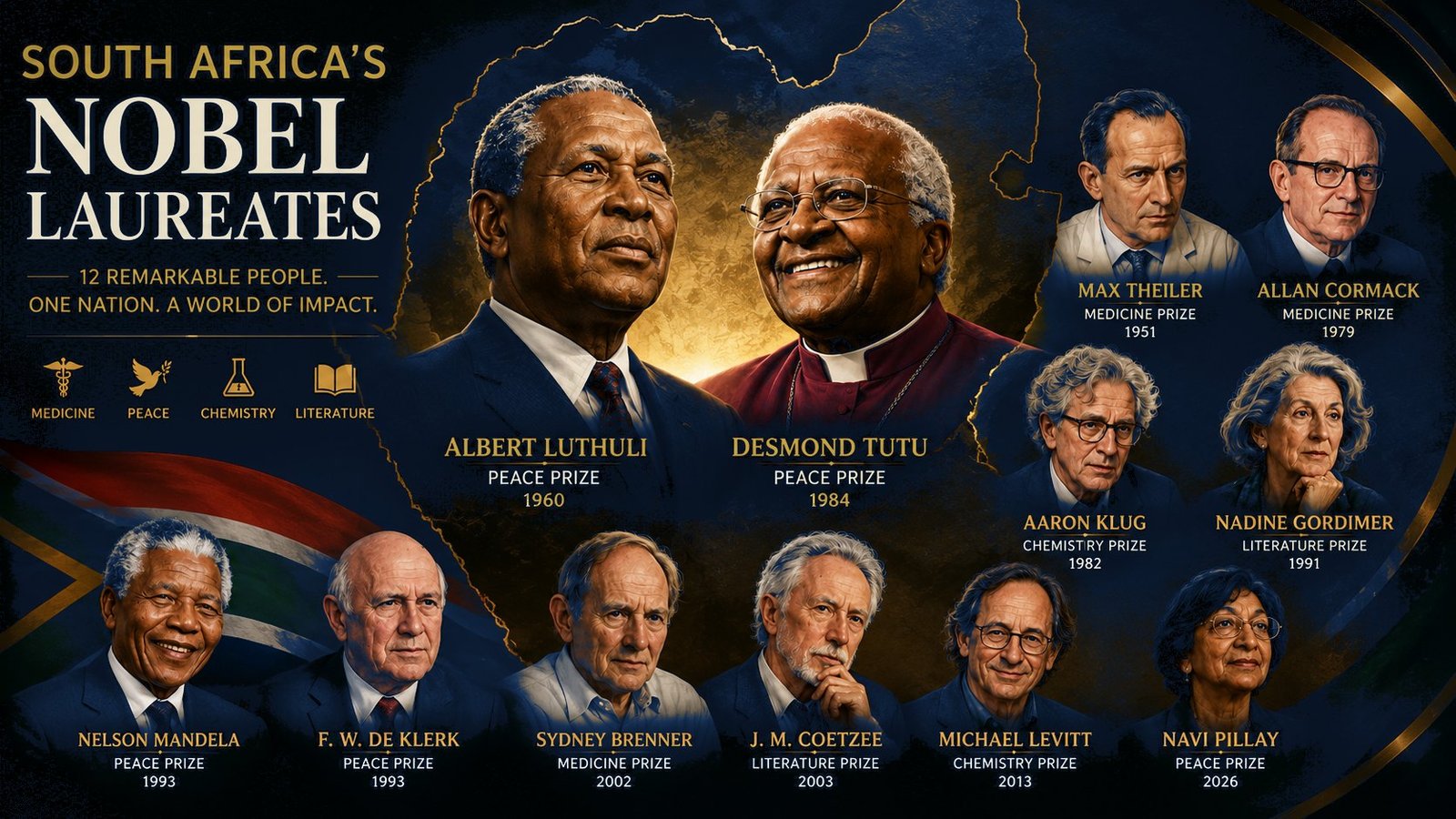
South Africa’s Nobel laureates, 1951 to 2026.
On 9 October 2026 the Norwegian Nobel Committee named Navi Pillay as this year’s Peace laureate, honouring her work for peace and international law. Born in Durban, she became a lawyer, a human rights lawyer at that, and her early work was defending Nelson Mandela and others who stood up against apartheid, as the Committee’s announcement records. I read the news the way I read most things, by asking what came before it, and what it means for younger generations of human rights activists. South Africa’s name has been called in Oslo for the Peace Prize before: for Inkosi Albert Luthuli in 1960, for Desmond Tutu in 1984, and for Nelson Mandela and F.W. de Klerk, jointly, in 1993. Each of those earlier South African announcements came in October, in the Foundation’s own records: Luthuli’s in October 1961, Tutu’s on 5 October 1984, and Mandela’s and de Klerk’s on 15 October 1993. The weeks after this year’s announcement are the natural time to go back and ask what, in each case, the Committee thought it was honouring.
My answer is that it did not honour a victory. In 1960 and in 1984 one could say there was none to honour. As I read it, it honoured a discipline: the decision, taken by these two men again and again under provocation, to answer a violent system by non-violent means, and to say so aloud. In my reading, it honoured that discipline in two people, a chief and a bishop, and its chairmen spoke openly of the pressure the discipline was under. Its own texts are worth reading closely, because they also record what that discipline never promised.
In a way, this year’s prize also honours the human spirit that soars high above adversity: a stubborn refusal to cower and cringe in front of injustice, no matter how powerful or majestic the perpetrators. It is the powerful force that whispers to the weary heart: you are not small, and truth is not fragile. It is the quiet courage that keeps standing when the ground gives way, the steady hand that keeps reaching for what is right when the world offers every reason to let go. In that reaching, it reminds us all that peace comes as no gift from above. It is a light carried forward, one brave soul at a time, whatever sacrifice is demanded of one.
None of our laureates received their awards in easy circumstances. Pillay’s award was no easier to come by in 2026 than Luthuli’s was in 1961. The contexts differ vastly, but what each of them had to do, to endure steadfastly and to defy the forces that sought, and often still seek, to plunge the world into turmoil, is not for weak hearts. Whether in 1961, 1984, 1993 or 2026, the challenge remains to stand up to the forces of evil and darkness and speak truth to power.
One noticeable difference is that the four earlier South African laureates were honoured for the struggle against apartheid and for its peaceful ending, and their fight for justice was waged chiefly within one country, South Africa. Pillay, standing on the shoulders of those who went before her, stood on a global stage and was recognised for her fight for peace and justice around the world.
This does not diminish the awards of her fellow South African predecessors. On the contrary, it creates a thread that recognises the full worth of their sacrifice, so that a woman, on a global stage, could now receive this Award for her fight for global peace and justice. At the OAU summit in Tunis in June 1994, Mandela told the heads of state and government of Africa:
“Finally, at this summit meeting in Tunis, we shall remove from our agenda the consideration of the question of apartheid South Africa.”
Nelson Mandela, statement to the OAU Meeting of Heads of State and Government, Tunis, June 1994
In my reading, that freed South Africans to stop being domestic fighters for justice and to become global fighters for the justice they had won through painstaking sacrifice.
Pillay knew the cost of tyranny, and she fought against it relentlessly in South Africa. What she gave South Africa, South Africa gave back in turn, by sending her to the world as a global citizen. On that stage she raised South Africa’s banner and humanity’s banner high, reminded the world what it means to lack peace and justice, and pointed us to what it means to live in them. The sacrifices of South Africans, and of Africans broadly, gave the world a South African and African citizen, and now a global citizen and champion of global peace and justice.
In this article I focus on Peace laureates. That does not mean the other laureates born in South Africa, in medicine, literature and chemistry, are not worth the mention; space requires selectivity.
A prize that arrived a year late
The Committee made no award in 1960. It found that none of that year’s nominations met the terms of Alfred Nobel’s will and kept the prize back. In December 1961 it presented the 1960 prize to Luthuli, at the same ceremony at which it honoured Dag Hammarskjöld, the Secretary-General of the United Nations, with the prize for 1961. Hammarskjöld had died that September, so his was a posthumous award.
The Committee’s chairman at the time, Gunnar Jahn, told the audience in Oslo who Luthuli was. He had taught for seventeen years, and in 1935 had been called to become a chief. He joined the African National Congress in 1944 and was elected its president in 1952, an office he held until the government banned the organisation in 1960. What Jahn wanted the hall to understand, however, was a method. Luthuli, he said, had always been categorically opposed to violence, and the question the world should ask was whether South Africa’s oppressed majority, by their suffering and their patience, could show that human rights might be won without it. Jahn then imagined the day on which the struggle might sink into bloodshed, and asked that Luthuli be remembered on that day as a man whose way was “unwavering and clear”.
Luthuli gave his own account of why the prize had come to him, the next day, and it was not success. South Africans, he told Oslo, might stand farther from victory than any other people in Africa. Nothing the government had done to the movement had turned it from the course it had chosen, a course of disciplined resistance, and he closed the thought with a sentence I have not been able to improve on: “It is for this, I believe, that this award is given.” The editors of the published lecture add two details. He was asked to bring his wife to the platform, which had never been done before. And he ended by singing Nkosi Sikelel iAfrika in Zulu.
What Jahn feared, and what Luthuli said in 1964
Jahn’s warning was not idle. On 12 June 1964 eight men were sentenced to life imprisonment in the Rivonia trial: Nelson Mandela, Walter Sisulu, Govan Mbeki, Ahmed Kathrada, Raymond Mhlaba, Andrew Mlangeni, Dennis Goldberg and Elias Motsoaledi. Luthuli’s statement on the sentences, dated the same day, is still on the ANC’s own website. It defends the movement’s long record of militant, non-violent struggle. It also says that, in the face of an uncompromising white refusal to abandon a policy that denied people their freedom, no one could blame “brave just men” for seeking justice by violent methods. The man the Committee had honoured for non-violence kept faith with his own method, and he said that no one could blame those who had turned from it.
The bishop and the last resort
That is the complication a careful reader has to hold. The Committee did not say that non-violence had been proved to work, and Luthuli did not claim that it had. Twenty-three years later, the chairman of the Committee spoke of that difficulty directly. Egil Aarvik, presenting the 1984 prize to Desmond Tutu, acknowledged that the repression was so brutal that “a violent rebellion would be an understandable reaction”. That people should choose the peaceful road all the same was, in Aarvik’s account, what made the choice remarkable. He reminded his listeners of a television image: Tutu in a Johannesburg suburb, after what Aarvik described as “a massacre of the black population”, telling a frightened and bitter congregation not to hate, and to choose the peaceful way to freedom. Aarvik did not name the suburb or the date, and I have kept to his words rather than supply them.
The Committee’s press release, dated Oslo, 5 October 1984, describes him as General Secretary of the South African Council of Churches, and says that the means by which the campaign against apartheid was conducted was “of vital importance for the whole of the continent of Africa”. That is the Committee’s claim, and it is a careful one: the means would matter.
Tutu himself did not pretend that the choice was easy, or that violence was incomprehensible. In his Nobel lecture of December 1984 he said that the South African Council of Churches opposed all violence, both the violence of a repressive system and the violence of those who sought to overthrow it, and that it nevertheless understood those who said they had been left with a last resort. He added that the primary violence in South Africa was apartheid’s own: the forced removals, the inferior schooling, the detention without trial, the migrant labour system. And he gave the sentence that has outlived the occasion: “There is no peace because there is no justice.”
What Tutu offered in place of violence
Tutu described the last resort, and he named an alternative to it. Installed as Bishop of Johannesburg in February 1985, he gave notice that if the government had not begun dismantling apartheid within 18 to 24 months, “I will myself call for punitive economic sanctions”, and he asked what other option was left. Sojourners reported in its February 1985 issue that he had told a Johannesburg press conference that a campaign of “persuasive pressure”, in which foreign companies would press the government for reforms, was the country’s “last chance to avert a bloodbath”, the magazine’s quoted words. In April 1986, about fourteen months after that notice, earlier than the shortest period he had named, he made the call. The Christian Science Monitor reported that he had “ushered in April with a public call for international economic sanctions”, which it found surprising for coming just before the election of the Anglican Church’s new leader. He was not the first of the two to ask. In the same 1964 statement quoted above, Luthuli appealed to governments to impose sanctions on South Africa.
What followed is a matter of record. In June 1986 the Commonwealth Eminent Persons Group, as the Monitor reported, saw sanctions as the only peaceful way to bring change. President Reagan vetoed the Comprehensive Anti-Apartheid Act on 26 September, arguing in his veto message which said he had no quarrel with the bill’s declared purpose, that sanctions would fall first on Black workers and that more unemployment would feed violence. The House overrode him on 29 September by 313 to 83 and the Senate on 2 October by 78 to 21, according to the Senate’s veto records.
Whether this worked has been argued ever since. Philip Levy, in a 1999 Yale paper, found that the part sanctions played in ending apartheid was probably very small and that their principal effect was probably psychological, while allowing that sanctions cannot be ruled out as a cause and offering the communist bloc as an alternative explanation of the change. How Sanctions Work, edited by Neta Crawford and Audie Klotz, presents them as having hurt the regime, directly and indirectly, in its publisher’s summary. I do not claim that sanctions ended apartheid. I will say only this much: Tutu offered pressure as a way of changing apartheid reasonably peacefully, as he put it to that press conference, Reagan argued that the pain would fall first on Black workers and feed violence, and the two sources I read, an abstract and a publisher’s summary, both from 1999, read the effect differently.
Of course, for those of us involved in the struggle, we know that international sanctions, boycotts and isolation were all part of the international mobilisation pillar of the struggle, and that the oppressed employed other pillars as well to defeat the beast of apartheid. Except for de Klerk, the other laureates each played a part in our long journey to free ourselves from tyranny.
One idea, three citations
Set the three South African citations side by side and the same idea sits inside each. The 1960 prize went to Luthuli “for his non-violent struggle against apartheid”. The Committee’s 1984 press release placed Tutu in “the non-violent struggle for liberation”. In 1993 the Committee honoured Mandela and de Klerk for “the peaceful termination of the apartheid regime”. Over thirty-three years the Committee’s own wording kept returning to the means. A method, a moral witness and an ending are three different things, and I do not think the three citations contradict one another. I read them as one long argument that how a conflict is conducted shapes what can be built after it.
Where South Africa stands
Numbers do not make an argument, but they give it a scale. I counted every Nobel Peace Prize award from 1901 to 2026, so that a person who won twice counts twice and a shared prize counts once for each winner, in the Nobel Foundation’s own laureate records, by the country the Foundation records as the laureate’s residence at the time of the award. Where it records none, I used the country of birth.
| Country (as the Foundation places it in Africa) | Peace laureates |
|---|---|
| South Africa | 5 |
| Egypt | 2 |
| Liberia | 2 |
| Tunisia | 1 |
| Ethiopia | 1 |
| Democratic Republic of the Congo | 1 |
| Ghana | 1 |
| Kenya | 1 |
| Africa, all countries | 14 |
| World, all countries with a listed country | 115 |
For the Foundation’s own record, see All Nobel Peace Prizes.
South Africa has five of Africa’s fourteen Peace laureates. In the world it stands joint fourth, level with Sweden and behind only the United States, the United Kingdom and France. Four of the five are the names I have been reading in this piece. A count says how often Oslo has looked south. It cannot say why, and the Committee’s own words, quoted above, are where that answer is.
The fifth name
That brings me back to this month’s announcement. The Committee’s text on Pillay is about institutions, not movements. It warns that the system of international law is under pressure, and it puts its case in three words: “Peace requires justice.” I could not read that sentence without hearing Tutu in Oslo, forty-two years earlier. I take the two to be one argument conducted across four decades. A person can discipline himself, as Luthuli did, and as Tutu asked a country to, but discipline is a held breath and cannot be held for ever. What lets a society breathe out is a settled way of hearing grievances and answering wrongs. In 1984 the Committee said that the means mattered for a continent and for peace in the world. In 2026 it said something close about the rule of law.
I do not want to flatten any of this into a lesson in patience. Luthuli’s was not the patience of a man claiming that it had paid off; he told Oslo that South Africans might stand farther from victory than any other people in Africa. Tutu’s was not the patience of a man who thought violence incomprehensible; he told Oslo that the Council of Churches understood those who had been left with a last resort. What the Committee’s citations honoured in 1960 and 1984, before apartheid ended, was non-violence, chosen by two men who, in their own words, understood what the alternative was and why others chose it.
Nobody in South Africa today is asked to hold to non-violence against the apartheid state, which banned and detained. We are asked something less dramatic and not much easier: to hold to the means, in Parliament, in our organisations and in the plain work of making institutions answer to the people they serve, when anger would be quicker and the grievance is real.
Luthuli told Oslo that, whatever support came from abroad, South Africa’s freedom could not arrive as a gift from outside. South Africans would have to make it themselves. No prize, however well meant, and no committee, however respected, can make a country’s freedom for it. They can only recognise, as late as a year if need be, those who are making it. The work of making it is ours.
For South African and African youth, the Peace Award is no celebration of pacifism. Faced with fascism and Nazism, the world’s peoples took up arms to defeat them, and in that moment judged that there was no other option. The end of that war, however, required the quick establishment of the institutions of peace, lest war and conflict become embedded in our social fabric.
The lesson of our laureates for the young is this.
Peace is still winnable from the margins. A South African laureate shows that the world’s most divided, unequal and historically wounded societies can produce solutions the whole planet needs. Peace is no luxury of the stable Global North. It is a practice forged where injustice is rawest.
Peace is a mandate, and it is no monument. For South African youth, the prize should be a debt to be cashed: a standard against which to measure their own institutions, a reminder that reconciliation without justice is fragile, and a call to lead beyond protest by building the coalitions, institutions and everyday solidarities that make peace durable.
For global youth facing climate stress, inequality, polarisation and war, South Africa’s hard-won grammar of dialogue, truth-telling and shared sacrifice is a method that can be exported. Peacemaking is a skill set and no nation’s birthright, and the next generation inherits both the blueprint and the obligation to improve it.
In one line: the laureates we honour in this article tell the young that hope is a discipline, and that what they inherit is a commission, and no celebration.
“The future is not an accident.”
Dr Malusi Gigaba is a Scholar-Statesman, an ANC NEC Member, a former Cabinet Minister of the Republic of South Africa, a Member of Parliament, and a member of both the Portfolio Committee on Trade, Industry and Competition and the Portfolio Committee on Justice and Constitutional Development.