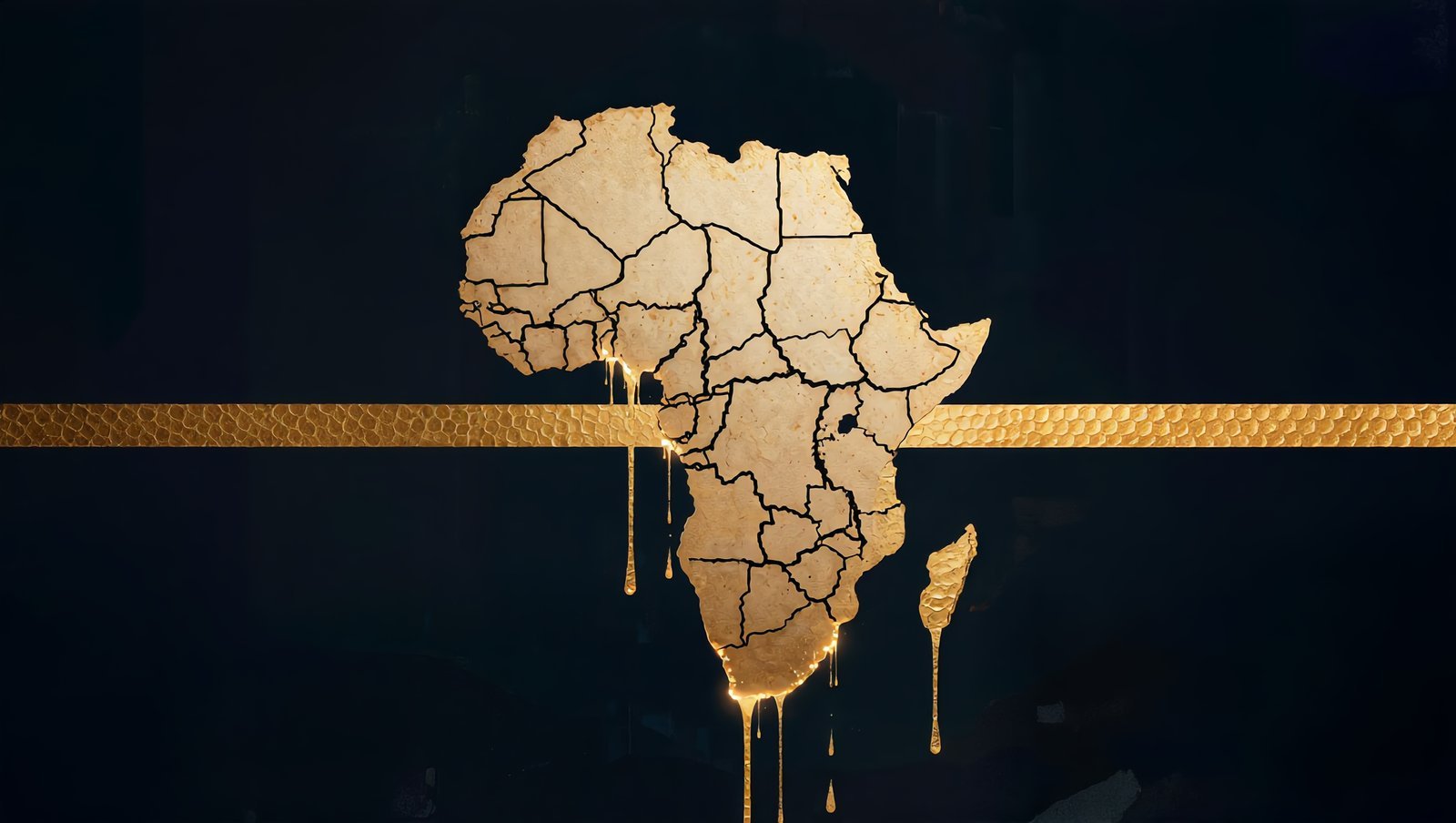
Introduction: The great betrayal of unity
The question of African unity has never been a mere academic curiosity; it is the single most consequential political question facing three hundred million souls condemned to poverty by design. The natural expectation, the logical expectation, was that once independence was achieved, unity should come naturally. That Africans, having thrown off the yoke of colonial bondage, would immediately recognise that their survival depended on standing together. After all, this was precisely how independence was achieved, through unity – united action, unity in action and action in unity.
Yet this has not been so. And the blood of millions, the wasted potential of generations, and the continued plunder of a continent's riches are the price we have paid for this failure. And, the price has been severe!
The history of African division is not an accident. It is not a regrettable byproduct of cultural differences or linguistic barriers. It is the calculated outcome of imperial design, perpetuated by a native elite too craven, too compromised, and too dependent to break free. In the end, imperialism and neocolonialism are just as responsible as the native elite and the countless other collaborators for dividing the African people.
The Original Sin: Compromise at Addis Ababa
When the Organisation of African Unity was formed in May 1963 in Addis Ababa, the continent stood at a crossroads. Two factions faced each other across an ideological chasm that represented nothing less than two visions of Africa's future – one of genuine liberation, the other of managed dependence.
The Brazzaville Group (later the Monrovia Group) advocated for a gradualist, functionalist approach to African unity. They favoured loose intergovernmental cooperation, respect for existing colonial borders, and a non-confrontational stance towards former colonial powers. Their leading figure, Félix Houphouët-Boigny of Côte d'Ivoire, held that Africa's future lay in continued partnership with France and the West, warning that without it the continent risked isolation and dependence on other external powers. This group – comprising former French colonies and conservative, pro-Western states – wanted to remain within the sphere of influence of their former colonisers.
The Casablanca Group, formed at their conference in January 1961, advocated for a radical, immediate, and centralised form of political unity, a "United States of Africa". Led by Kwame Nkrumah, Gamal Abdel Nasser, Modibo Keita, Ahmed Ben Bella, Sékou Touré, and Morocco's King Mohammed V – who died in February 1961, shortly after; his son Hassan II carried Morocco's seat forward into the 1963 Addis Ababa founding – they were strongly anti-colonial, anti-imperialist, and often pro-Soviet or neutralist. They called for immediate liberation of all remaining colonies, elimination of neocolonial ties, and creation of an African High Command.
The compromise that emerged was a victory for the gradualists. The Monrovia Group's model – sovereignty-respecting, cautious, deferential to colonial borders – triumphed over Nkrumah's radical unification. The Casablanca Group's influence was reduced to forcing the inclusion of strong anti-colonial and anti-apartheid language – words without the structural power to back them.
This was the original sin. The moment when Africa chose the comfort of national sovereignty over the necessity of continental power. Needless to say, the Monrovia Group's views were sponsored in the imperial citadels themselves, paid for through power, comfort and security offered to the collaborators. And we have been paying for it ever since. For, this is precisely what power does: it offers incentives to some among the people as a reward for their collaboration.
It is now a matter of historical record that many of these progressive Pan-Africanists were assassinated or overthrown at the instance of former colonial motherlands who eschewed the prospects of genuine African unity. The European powers would not tolerate the end of colonialism and the abolition of the legacy of Berlin. To them, Africa had to remain divided, and by whatever means necessary.
The machinery of underdevelopment: How Europe Made Africa Poor
Walter Rodney's analysis in How Europe Underdeveloped Africa remains the most devastating indictment of the colonial project. His central thesis – that Europe's development and Africa's underdevelopment are two sides of the same coin – is not merely historical observation but a living reality that continues to shape every aspect of African existence.
Colonialism arose from the need to expand capitalism beyond Europe. It involved conquering lands, seizing resources, and exploiting labour to continue primitive accumulation as it waned in Europe. By the 15th century, Europe's superior labour and technology enabled it to exploit Africa through trade. So-called international trade was merely Europe's overseas expansion, controlled by Europeans who owned most ocean-going vessels and financed commerce across four continents.
Europe's ability to dictate Africa's role in global production was greatly facilitated by the continent's small political units and many internal divisions – divisions that colonial powers deliberately maintained and exacerbated. A key trait of Afro-European trade was that its scale was set outside Africa. This pattern persisted through later colonial and neocolonial trade.
The Gambia is a case study in exactly this kind of deliberately maintained division. Britain held only the lower reaches of the Gambia River, valued purely as a 300-kilometre trade artery into the interior, while France controlled the surrounding territory that became Senegal. Neither power had any interest in the economic coherence of the resulting unit. The 1889 Anglo-French Convention fixed the boundary at roughly the range of a cannon shot fired from a gunboat on the river – about ten kilometres on each bank – producing a narrow sliver of a state wrapped entirely inside Senegal but for a short stretch of coastline. It remains the smallest country on the African mainland, built around a river its only neighbour also depends on, with no economic logic as a standalone unit. More than a century after that convention, remittances from its diaspora account for close to a third of its GDP, foreign aid runs into the hundreds of millions of dollars a year, and a tourism sector built for a European package-holiday market remains among its largest sources of foreign exchange. This is not, in any meaningful sense, a sovereign economy; it is a territory that survives on transfers from elsewhere, exactly as it was designed to. (See: World Bank remittance data)
The evolution toward national capitalism was halted when indigenous societies encountered more advanced capitalist systems, disrupting the natural economies and social structures of native peoples, seizing their land, resources, and labour. They imposed the more developed political and social systems of the colonising nations onto these already underdeveloped indigenous systems. As a result, the bourgeois class was restricted exclusively to the colonisers themselves, which explains the "underdeveloped" state of today's African bourgeoisie.
Likewise, trade with Europe stunted African economies, preventing regional economic integration. It blocked local production from expanding across regions and fostering significant inter-regional trade. Instead, European trade actively dismantled existing inter-territorial links across the continent.
Colonial powers disrupted pre-existing African trade networks, redirecting them to serve European interests. The situation worsened when Europeans inserted themselves as intermediaries primarily to expand the slave trade, ultimately subordinating entire local economies to that destructive system. Trade with Europe therefore discouraged independent African technological innovation and generated little demand for European imports beyond firearms. This relationship helped advance European technology while causing stagnation, and even decline, in Africa. Due to both the nature of global trade and deliberate European policies, Africa was denied access to humanity's broader scientific progress.
The result was structural dependency. Many free trade zones in developing countries have enabled pseudo-integration that facilitates multinational corporate penetration and links African economies to distant coastal ports – originally for moving captives and ivory, subsequently for transporting minerals from pit-to-port for export of raw materials.
The widening technological divide between Europe and Africa reflected capitalism's tendency to concentrate wealth and power in some regions while creating poverty and dependence in others. Key investment zones – Algeria, Egypt, South Africa, and Congo – aside from the Suez Canal and mines, largely focused on producing agricultural staples for European industries.
The blood-soaked foundation: How colonialism funnelled Africa's wealth to Europe
Let us be explicit about colonial Africa's purpose: it was part of a global capitalist system designed to extract surplus and send profits back to Europe. Colonialism existed to repatriate wealth, not merely exploit. For Africa, this meant consistent export of surplus produced by African labour and resources.
African labour was extremely cheap, yet the surplus extracted was immense. Colonial employers paid starvation wages, forcing workers to grow their own food to survive. The main beneficiaries were the mining company shareholders in Europe and North America. They collected huge annual dividends from gold, diamonds, manganese, and uranium extracted from South Africa by African labour.
For years, even the capitalist press lauded Southern Africa as an investment destination yielding super profits. They certainly still do view it as such. Southern African mining conglomerates operated across the Southern African region, extracting as much profits as they could, and still do, from their mining interests and agriculture. Cheap labour was sourced from South Africa's neighbours, Mozambique and Lesotho, to work in South African mines, with South African capitalists paying particularly the Portuguese government per worker. Though no longer formalised, this export of African labour continues. This illustrates how Portuguese colonialism collaborated with foreign capitalists to maximise exploitation.
In the final analysis, colonialism strengthened the ruling class of Western Europe and capitalism as a whole. The profits that built European welfare states, funded industrialisation, and financed technological innovation were extracted from African soil by African hands.
The neocolonial trap: independence without power
The transfer of political power in the 1960s was meant to signal the end of exploitation. Instead, it marked the beginning of a far more insidious form of domination – neocolonialism.
Nkrumah warned us, in his 1965 study Neo-Colonialism: The Last Stage of Imperialism:
“… if Africa was united, no major power bloc would attempt to subdue it by limited war... It is only where small States exist that it is possible, by landing a few thousand marines or by financing a mercenary force, to secure a decisive result.”
— Kwame Nkrumah, Neo-Colonialism: The Last Stage of Imperialism
That was why the Casablanca Group had from the outset advocated for a centralised form of political unity, a "United States of Africa", as well as immediate liberation of all remaining colonies, elimination of neocolonial ties, and creation of a centralised military force. To them, the outcome of the Berlin Conference was not only the carving up of Africa, but what Ali Mazrui, writing on the Berlin Conference's legacy, termed "the European curse of artificial nation-states" – small, balkanized, and economically unviable, exactly the vulnerability the Casablanca Group feared.
At the 1999 African Renaissance Conference, renowned African academic Dialo Diop pointed out:
“The experience accumulated since independence by the unsustainable microstates born of the fall of colonial empires shows that African peoples’ aspirations to sovereignty, political democracy, and economic and social welfare have been shattered against a wall of dependence and authoritarianism, incompetence and corruption, thus creating the need for a second liberation of Africa.”
— Dialo Diop, African Renaissance: The New Struggle
Djibouti shows what that vulnerability looks like in practice. French Somaliland existed for a single reason: to give France a coaling station and naval foothold on the Bab-el-Mandeb strait, the chokepoint through which roughly thirty percent of world shipping still passes, mirroring Britain's position across the water in Aden. At independence in 1977, France kept a garrison there under a defence pact. What is instructive is that the dependency did not end with decolonisation – it evolved. Djibouti's economy today runs substantially on renting the same strategic ground to whichever power will pay: hosting fees from France, the United States, China, and others together account for roughly a tenth of GDP, and the port and logistics activity tied to that military and transit role approaches seventy percent of GDP. Most of that rent flows to the state and to elite-linked interests; ordinary Djiboutians see little of it, and poverty and unemployment remain high. Sixty years after Mazrui's diagnosis, the small state created to hold a strait for one empire now survives by holding it, at a price, for several. (See: U.S. Congressional Research Service)
The consequences of these small, divided, and vulnerable states would endure for generations, continuing to facilitate foreign domination and the extraction of capital and profits. "Divide and rule" has always been a core strategy of imperialist, colonial, and neocolonial powers in their dealings with colonised countries and peoples. A united people are far more difficult to conquer.
The emergence of neocolonialism was made possible by the newly independent states' lack of an economic foundation and internal divisions, combined with support from imperialist powers for the former ruling class and betrayal by segments of the new political elite. Neocolonialism refers to ongoing domination by foreign capital, which facilitates exploitation rather than development. Under neocolonialism, investment actually widens the gap between wealthy and impoverished nations.
Neocolonialism is the worst form of imperialism: it grants power without accountability to its practitioners and imposes exploitation without recourse on its victims. It functions by splitting former unified colonial territories into small, non-viable states that cannot develop independently, forcing them to depend on the former imperial power for defence and internal security. Their economies and financial systems remain tied to the former coloniser, much like in colonial times.
Small states, unless they unite, are forced to sell primary goods at developed nations' prices and buy manufactured goods at their set rates. As neocolonialism blocks optimal development, developing countries cannot build markets large enough for industrialisation or gain financial leverage to demand fair prices for their goods.
Africa has some of the world's largest mineral deposits – the richest continent on paper. Yet, despite holding essential industrial minerals and metals, it lags far behind others in industrial development. No African country has a single integrated industry based on these resources. If used for its own development, these resources could modernise the continent. Instead, they have been, and continue to be, exploited primarily for the benefit of overseas interests.
The International Division of Labour: Africa's permanent subordination
The International Division of Labour (IDL) dictates which countries specialise in producing what, based on factors like resources, capital, technology, and labour costs. Historically, shaped by colonialism, it positioned Africa as a supplier of raw materials and a market for manufactured goods from the industrialising "Global North."
To this day, Africa remains locked into a primary-sector role, trapped in "commodity dumping." It has become a destination for second-hand goods – used clothing, electronics, vehicles – from the North. While providing cheap access, this kills local manufacturing potential. A thriving textile sector cannot compete with cheap imported used clothes. The continent exports unprocessed commodities while importing high-value manufactured goods, pharmaceuticals, and technology. This leaves African economies highly vulnerable to volatile global commodity prices.
Africa has been incorporated through low-wage factory labour – "low-road" jobs where African workers are seen as cheap, disposable labour for global brands. While previously dominated by the minerals-energy complex, Africa's abundance of critical minerals – lithium, cobalt – needed for the green energy transition is reinforcing its extractive role. Without domestic processing and manufacturing, the continent risks exporting its green future for little local benefit.
The pattern is not abstract. The Democratic Republic of the Congo alone supplies an estimated seventy percent or more of the world's mined cobalt, the mineral without which no lithium-ion battery can be manufactured at scale. Yet almost none of it leaves Congolese soil ready for a battery. It is exported as cobalt hydroxide – a raw, semi-processed intermediate – and shipped principally to China, which now accounts for the large majority of global cobalt refining capacity and converts that hydroxide into the battery-grade chemicals that power the electric vehicles and smartphones of the industrialised world. The country that holds the ore captures the smallest share of the value chain; the country that holds the refinery captures the rest. It is the same arrangement that carried gold, diamonds, and manganese out of Southern Africa a century ago, updated only in the name of the mineral and the destination of the ship. (See: USGS 2025 Mineral Commodity Summary: Cobalt)
Unless Africa gains greater control over its critical minerals and fully leverages the green transition to industrialise its economy, develop advanced skills and technology, and break free from the minerals-energy complex, the shift toward a green economy and the next industrial revolution will only deepen inequality and entrench Africa's vulnerable, subordinate position in the global division of labour.
This pattern created a structural dependency that persists today. Africa's core challenge is to break out of its peripheral role, to move up the value chain by processing its own resources, developing regional manufacturing hubs, and building a more diversified, knowledge-based economy. Without this, the global division of labour will continue to extract value from Africa rather than generating value within it.
The Washington Consensus: The final betrayal
Norwegian economist Erik Reinert put it plainly in How Rich Countries Got Rich and Why Poor Countries Stay Poor:
“History reveals how rich countries got rich by methods that by now had generally been outlawed by the ‘conditionalities’ of the Washington Consensus… To receive support from the rich countries, poor countries had to refrain from using the policies the rich countries had used and often still use. These are the ‘conditionalities’ of the Washington Institutions.”
— Erik Reinert, How Rich Countries Got Rich and Why Poor Countries Stay Poor
After securing its own wealth through protectionism and state intervention, the West imposed a new set of laissez-faire rules on poorer nations, preventing them from following the same path. The rules of global capitalism were rigged. Africa, more than any other region, was forced into a deindustrialisation trap, leaving it as the “worst victim” of this policy reversal.
This is not to deny Africa's own agency, nor the complicity of its many of its leaders who, over the decades, have betrayed the continent's noble dream of full independence. Indeed, we cannot attribute all of Africa's post-independence struggles solely to external forces while ignoring internal factors such as corruption, weak institutions, civil wars, poor infrastructure, and flawed governance. After all, the remarkable rise of China and the United Arab Emirates, along with the success of East Asia – many of whose countries were also once colonies – demonstrates that nations can overcome underdevelopment and forge their own path toward progress.
However, the fact remains that the Washington Consensus and its structural adjustment programmes (SAPs) played a debilitating role in Africa. In the developing world, the Washington Consensus was championed by the World Bank and IMF, which advocated for privatisation, trade liberalisation, and contraction of the state. Developing countries were told to privatise SOEs to generate revenues, boost business confidence, attract infrastructure investments and foreign aid, and boost economic growth.
But, the promised private sector investment and donor funding did not materialise. One after another, African governments kept their part of the bargain: privatising, sticking to Structural Adjustment Programmes, and committing to fiscal austerity that restricted the main source of infrastructure finance, the state. However, infrastructure investments and foreign aid did not come, but instead the capital stock declined. In the end, the countries that managed to attract higher private investment for infrastructure were those that maintained higher levels of public investment.
As a result, Africa faces an infrastructure financing gap of roughly $70–$110 billion per year. Closing this gap is considered the continent's single biggest developmental challenge, requiring a massive increase in not only private investment, better tax collection, and significant de-risking of projects through multilateral guarantees, but it requires the mobilisation of public resources (such as pension funds and public expenditure) at a scale yet unseen.
Neoliberalism integrated Africa further into international value chains – commodity chains and financial chains – while surplus continued to be drained from our economies. It had a static effect on our societies, destroying the social fabric. Our societies became extremely polarised between the obscenely rich and extremely poor, leading to high levels of poverty, unemployment, and inequality.
The net result? Africa is more dependent today than at the time of independence and thus hardly makes its own decisions.
The post-colonial state: A weak instrument for a massive task
Tanzanian academic, Professor Issa Gulamhussein Shivji argues that the post-colonial state inherited a colonial economy integrated vertically to metropolitan countries but internally disarticulated, with no relations between various sectors oriented towards external demands and interests. These structures result in surplus being siphoned from our countries, which remain sites of surplus production, while metropolitan countries become sites of accumulation.
While first-generation leaders did try to address these problems, the neoliberal onslaught plunged many African countries into heavy debt burdens, becoming vulnerable. They implemented import substitution industrialisation, subsidising basic needs, developing social sectors, expanding the state. Many developed "State Capitalism" where local bourgeois interests attempted to react against foreign capital through nationalisation. But the Third World state bourgeoisie has been unable to overthrow the continuing domination of foreign capital. Its attempts at nationalisation have been half-hearted, hedged around with concessions to former owners.
Zambia is the textbook case. Kenneth Kaunda's Mulungushi Reforms of April 1968 nationalised private retail, transport, and manufacturing interests through the newly created parastatal, INDECO. The Matero Reforms that followed in August 1969 saw the state acquire a fifty-one percent controlling stake in the country's two dominant copper mining firms, Anglo American Corporation and Roan Selection Trust, renamed Nchanga Consolidated Copper Mines and Roan Consolidated Copper Mines; both were folded, two years later, into the new umbrella parastatal, the Zambia Industrial and Mining Corporation. On its face, this was the assertion of sovereign control over the resource upon which the colonial economy had been built. In substance, the former owners were compensated through long-dated bonds, repayable over eight to twelve years at interest, and the technical, managerial, and marketing dependence on the very companies that had been "nationalised" persisted for years afterward. Even Kaunda's initial impulse was as much tactical as doctrinal – a manoeuvre to outflank a domestic political rival's radicalism as much as a settled ideological commitment. This is the shape state capitalism took across much of the continent: real, and not nothing, but hedged, negotiated, and only ever a partial rupture with the arrangement it claimed to end. (See: Journal of Southern African Studies)
The question of "development" in post-colonial Africa has received much attention, but often misses a vital point.
The weakness and diversity of pre-independence movements, lacking a clear class structure, allowed colonialism to establish an "overdeveloped" state apparatus – a powerful bureaucratic-military machine designed for metropolitan control. At independence, the indigenous bourgeoisie, too weak to subordinate this apparatus, left the state relatively autonomous. This autonomy is key, as postcolonial states must not only mediate between domestic and foreign capital but also act directly as an engine of economic development, often appropriating surplus for bureaucratically directed growth.
This dynamic is the central problem for postcolonial transformation: the state's superstructure is overdeveloped relative to its economic base. The ANC's theory of the National Democratic Revolution (NDR) explicitly confronts this. Unlike the classic European model where economic shifts precede political revolution, in South Africa, political power (1994) came first. Apartheid deliberately prevented an alternative economic system from developing "in its womb." Therefore, the new society must be consciously built by a vanguard movement (the ANC) after taking power. This explains the difficulty of transformation and justifies the ANC's dominant role; the project is a precarious, top-down construction, not an automatic process, and its success depends entirely on the movement's continued conscious action.
Afrikaner nationalism provides a crucial counter-example. It succeeded because it built economic power first. Beginning in the 1920s, a unified Afrikaner movement, driven by cultural and economic associations, forged a middle class with real ownership in key sectors. By 1948, this class could subordinate the colonial state apparatus to its own political and economic project – apartheid. This contrasts sharply with the position of the black majority in 1994, who lacked a significant independent bourgeoisie.
This weakness creates a "dual power" situation. The black middle class is trapped between the state (dependent on its policies and patronage) and the entrenched white bourgeoisie, which retains control of the economy and dictates the terms of inclusion. Consequently, the black bourgeoisie lacks independent economic roots and is subject to both white capital and state largesse, inevitably fostering corruption.
That is why the notion of a "patriotic (black) bourgeoisie" was both premature and naive. What has been presented instead is a narrative suggesting that for a bourgeoisie to be genuinely patriotic – much like the European bourgeoisie is to Europe, or the white bourgeoisie was to apartheid South Africa – it must have emerged from the indigenous economic and political system. It must be independent, exercise autonomous control over productive forces, and consequently possess an independent political agenda that is represented within the state and aligned with the objectives of the dominant class.
Overcoming this requires a drastic strategy – learning from East Asian state-led development while adapting to local conditions, such as the ANC's unique mass-party base. The ultimate challenge is to transform the state from an inheritance of colonial control into a developmental instrument that can consciously build a new socio-economic order, a task made far more difficult by the absence of a prior economic revolution.
The failure to achieve this serves two broad purposes. First, it consolidates the power of the former ruling class within a neocolonial framework. Second, over time, it erodes the solidarity that once united anticolonial movements, as elites compete over access to resources, while the poor sink deeper into poverty and inequality widens. This fragmentation creates divisions among the newly independent forces. The neocolonial economic ruling class exploits these divisions, and with the support of their international allies, ensures that the former anti-colonial forces remain divided – broken into ever smaller political and social factions – and are always available to carry out tasks for the neocolonial powers, of course, at a price.
The unfinished test: AfCFTA and the choice Africa still has not made
Sixty-three years after Addis Ababa, the question the Casablanca and Monrovia blocs fought over has returned, this time in the register of trade rather than political union. The African Continental Free Trade Area entered into force on 30 May 2019, its operational instruments were launched in Niamey in July of that year, and preferential trading under its rules formally commenced on 1 January 2021. In April 2024, the African Union declared the Area to have entered its full operational phase. By May 2026, fifty-four of the continent's fifty-five states had signed the agreement and forty-nine had deposited instruments of ratification, with Somalia's ratification pending to make fifty. In February 2026, the outstanding Rules of Origin on automotive products and on clothing and textiles were finally adopted, completing the Rules of Origin framework, alongside the annexes to the Protocol on Intellectual Property Rights. (See: tralac's AfCFTA ratification tracker)
This is real progress, more than the OAU ever achieved on the economic front across its thirty-nine years of existence before the African Union succeeded it in 2002. But the pattern of the last seven years should give no comfort to anyone who has read this history. Rules of origin negotiated clause by clause, protocol by protocol, over years; sovereignty guarded at every turn by governments unwilling to cede tariff revenue or expose domestic industries to continental competition; a continental market not yet delivering visible relief for the cobalt exported by the tonne and returned, refined, as a finished battery – these are the Monrovia instinct in economic form. The instinct that hesitates before the harder, structurally binding form of integration whenever the easier, sovereignty-preserving form is available.
Whether AfCFTA becomes the mechanism through which Africa finally processes its own minerals, builds its own regional value chains, and captures the value it produces – or whether it becomes another Addis Ababa, a continental instrument rich in aspiration and thin on structural power – is not yet decided. It is being decided now, in the incomplete implementation of a rules-of-origin framework only seven years old, in the same continental institutions where the compromise of 1963 was struck.
Conclusion: unity or perpetual servitude
The question of African unity has never been more urgent. The continent continues to pay a heavy price for its historical exploitation by Western capitalism, which has stripped it of the means to industrialise. Western industrialisation, which advanced production methods and reinvested growing profits into manufacturing and metals, has dramatically widened the gap between Africa and the West.
Africa's progress remains slow due to disunity. Its economic development depends on economic size, not just resources or population. Nkrumah was right: if Africa were unified, no major power would try to subdue it. Decisive results are only possible against small states.
The blocking of skills and technology under imperialism has perpetuated the international division of labour. Developing countries lack internal cohesion in production and exchange. Trade ties that once linked them are broken. Instead, all linkages are with the metropolitan economy, shaped solely by its own interests – incompatible with the independence and genuine development of developing countries.
The core development challenge stems from dependency on metropolitan economies, weak internal integration, and lack of technology. The solution is to break historical ties with imperialist powers and build connections among developing economies, beginning at the continental level.
Africa has been made to turn on itself – divided into small, non-viable states, pitted against each other, its resources plundered, its people impoverished. The beneficiaries are clear: the shareholders in London, New York, and Paris; the multinational corporations that extract Africa's wealth; the global capitalist system that maintains Africa in perpetual subordination.
The cost of division is measured in the bodies of Africans who die preventable deaths, in the children who go hungry, in the potential that is never realised. Every year that Africa remains divided is another year of plunder. Every border that separates us is a wall that protects the interests of our exploiters.
The question is not whether Africa should unite. The question is whether Africa will unite before it is too late – or continue to bleed, divided and conquered, until there is nothing left to take.
The choice is ours. The time is now.
Unity or perdition. Solidarity or slavery. There is no middle ground.
“The future is not an accident.”
Dr Malusi Gigaba is a Scholar-Statesman, an ANC NEC Member, a former Cabinet Minister of the Republic of South Africa, a Member of Parliament, and a member of both the Joint Standing Committee on Defence and the Portfolio Committee on Trade, Industry and Competition.