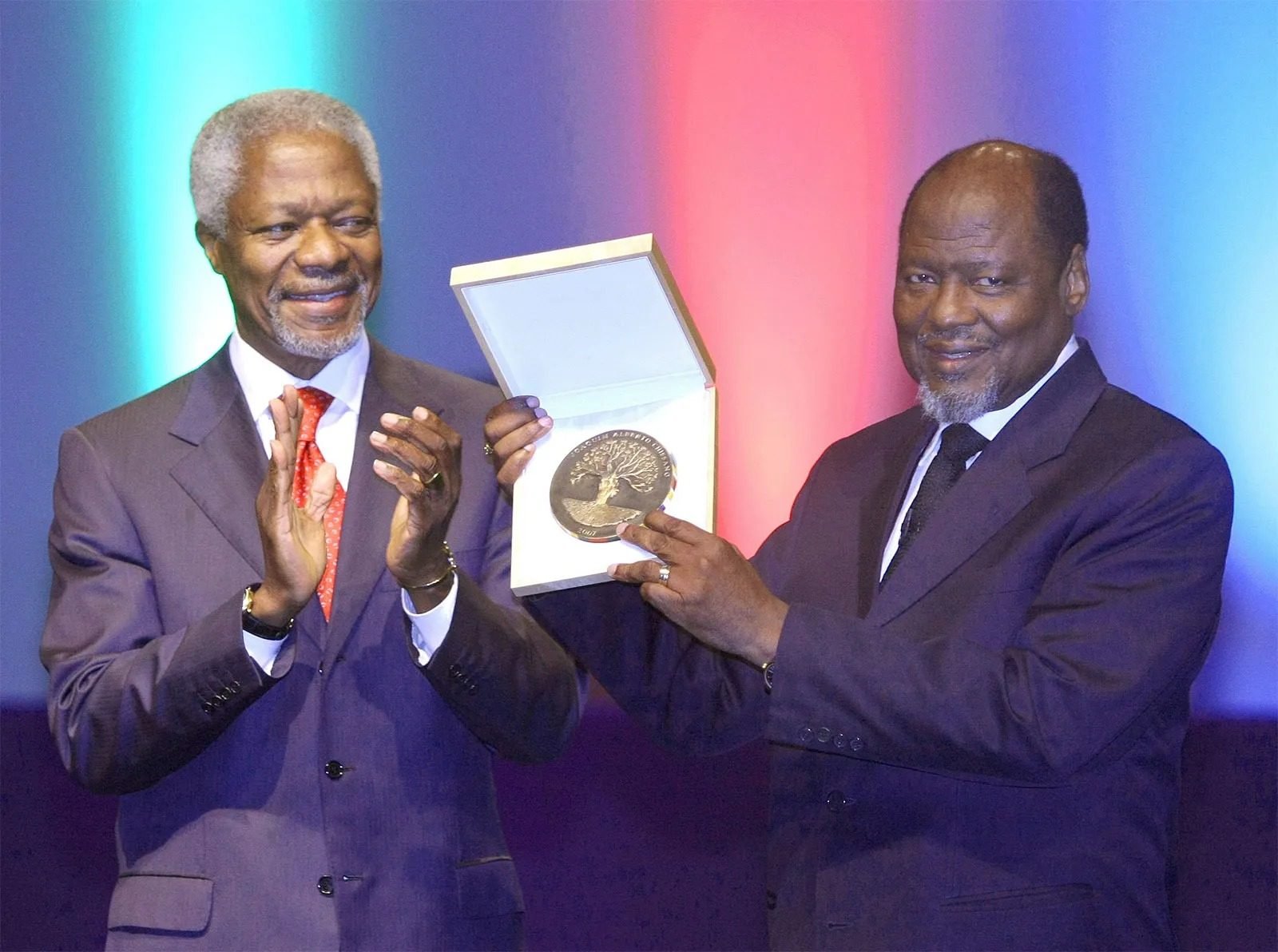
Joaquim Chissano (right) receives the first Mo Ibrahim Prize from Kofi Annan, chair of the Prize Committee, in Alexandria, Egypt, 26 November 2007.Source: Britannica
Joaquim Chissano turns eighty-seven on 22 October 2026. He was born on that day in 1939, CIDOB records, in the village of Malehice, in the district of Chibuto, in Gaza Province. I want to ask what his life puts to us, because it is not the question people usually ask about a former president. They ask what he held. I want to ask what he built, and what it took, because a peace is not a feeling. It is a set of arrangements that enemies agree to live inside.
The movement that made him
Most South Africans know Frelimo as a name from the history of our own liberation. Fewer of us know what it was, or where Chissano stood in it.
Frelimo, the Frente de Libertação de Moçambique, the Mozambique Liberation Front, was founded in Tanzania in 1962. Its first president was Eduardo Mondlane. Chissano joined that year, as Socialist International’s profile of him records. He went to Lisbon to study in 1960. In 1961, CIDOB records, his affiliation with the independence movement forced him to leave Portugal.
His rise was quick. By 1963 he was in the movement’s leadership, heading its education department and serving as secretary to Mondlane. In 1968 its Second Congress re-elected him to the Central Committee. In 1969 he became its permanent representative in Tanzania. In 1977 the Third Congress elected him to the Central Committee and to the Permanent Political Committee, later the Politburo.
It was not a safe movement in which to rise. In February 1969 Mondlane was assassinated. Independence came in 1975. In September 1974, Socialist International’s profile records, Chissano was named prime minister of the transitional government that was to guide the country to independence. Under President Samora Machel he was then foreign minister. Then came the war. Renamo, the Mozambican National Resistance, which Socialist International’s profile says the apartheid regime in Pretoria supported, went to war with the government in the years after independence.
In October 1986 Machel was killed. In November Frelimo chose Chissano to succeed him, and he took office as head of state. Forty years after the crash, on 19 October this year, Mozambique and South Africa marked the anniversary at the Samora Machel Monument and Museum at Mbuzini, under the South African Government’s theme, “Commemorating Lifelong Dedication to the People of Southern Africa: Honouring All Victims of the Mbuzini Tragedy.” President Daniel Chapo of Mozambique spoke, as did South Africa’s Minister of International Relations and Cooperation, Ronald Lamola, on behalf of President Cyril Ramaphosa. Machel’s widow, Graça Machel, was among those present, as Inside Politics reported. Mozambique bore a heavy cost for standing with our own liberation struggle, and it is right that we remember the man who led it then.
He was a liberation movement’s man, chosen in a hard hour, to lead a country already at war. Everything that follows is what he did with it.
What Rome required
The movement itself had changed under his leadership. In 1989, as the Christian Science Monitor reported in 1990, Frelimo officially abandoned Marxism. In 1990 Mozambique adopted a new Constitution which, ACCORD records, contains the principles of a multi-party system, separation of powers and guarantees for human rights. In doing so he was changing the very system that brought him to power, so that his people and country could enjoy peace and stability.
On 4 October 1992, in Rome, Chissano and Afonso Dhlakama, President of Renamo, signed the General Peace Agreement, meeting under the chairmanship of the Italian Government, with mediators from the Sant’Egidio community among those named on its record. I have gone to some lengths to set out what the agreement contained, because the achievement is in the detail.
It had seven protocols. It required a single new national army, the Mozambican Defence Force, of 30,000, drawn half from the government’s forces and half from Renamo’s. It allowed Renamo to begin operating as a political party from the day of signature. It gave Renamo the right to nominate one third of the members of the National Elections Commission. And it put the United Nations in the chair of the commission that supervised the ceasefire.
That is what a peace between enemies looks like on paper: not a handshake, but an army to be merged, a party to be registered and an election to be run, each with a clause.
The United Nations then had to deliver it. The mission, ONUMOZ, demobilised more than 76,000 soldiers from both sides and recovered about 155,000 weapons. It oversaw the return of 1.3 million refugees, in what UNHCR described as the biggest operation it had ever undertaken in Africa, among the 3.7 million people the war had displaced. Its mandate ended at midnight on 9 December 1994.
The first test: 1994
The first multiparty elections were held on 27 to 29 October 1994, with turnout above 85 per cent despite a one-day boycott by Renamo. Chissano won the presidency with 53.3 per cent to Dhlakama’s 33.7 per cent. In the Assembly, Frelimo took 129 of 250 seats and Renamo 112. Renamo charged irregularities, and then, in the State Department’s words, accepted the outcome.
Read that result slowly. The movement that had fought the war now held 112 seats in the national parliament. That is what the Rome protocols were for. The new Parliament and the President were inaugurated on 8 and 9 December 1994.
The harder test: 1999
The second test was harder, and I would be failing you if I made it sound easy. Polling ran from 3 to 5 December 1999. The National Elections Commission announced that Chissano had won 52.29 per cent to Dhlakama’s 47.71 per cent. Renamo rejected the result and contested it through legal channels.
The Carter Center, whose observers were present, was candid in its final report. Its observers “were not provided sufficient access to verify the final tabulation,” and for that reason it could not give the process an entirely positive assessment. It also said, at the time, that it had “not seen evidence of serious irregularities that would affect the election’s outcome,” and it described Renamo’s contesting of the results through legal channels as “positive signs of a nascent democracy.”
A disputed result, a candid observer, and a contest conducted in an institution rather than on a battlefield. That is not a perfect election. It is what a peace looks like when it is being used.
The handover
Chissano chose not to seek a third term in 2004. On 2 February 2005, in Maputo, Armando Guebuza was sworn in as President. Chissano had led Mozambique since 1986.
The Prize Committee of the Mo Ibrahim Foundation, which in 2007 made him the first winner of its Prize for Achievement in African Leadership, gave the decision its own weight. It said his decision not to seek a third term showed that “institutions and the democratic process were more important than personalities.” More about this award later in this article.
The years after
On 30 November 2006 the United Nations Secretary-General informed the Security Council that he had appointed Chissano as Special Envoy for the areas affected by the Lord’s Resistance Army. In March 2007 the Council welcomed the efforts he had undertaken.
On 22 October 2007, his sixty-eighth birthday, the Mo Ibrahim Foundation announced him as the first winner of the Mo Ibrahim Prize for Achievement in African Leadership. No African leader had won it before him, because it had never been awarded. The Foundation was set up by Dr Mo Ibrahim, the founder of Celtel International, and the Prize is worth US$5 million over ten years and US$200,000 a year for life after that.
The winner is chosen by an independent Prize Committee. In 2007 it had six members: its chair, Kofi Annan, the former Secretary-General of the United Nations; Martti Ahtisaari, former President of Finland; Aïcha Bah Diallo, a former Minister of Education of Guinea; Ngozi Okonjo-Iweala of the World Bank; Mary Robinson, former President of Ireland; and Salim Ahmed Salim, a former Prime Minister of Tanzania and former Secretary-General of the Organisation of African Unity.
What does the Prize ask of a winner? The Foundation’s own page lists, today, a former African head of state or government who left office in the last three years, was democratically elected, served the constitutionally mandated term and demonstrated exceptional leadership. The 2007 announcement describes the Committee’s method rather than that list: it assessed every sub-Saharan African leader who had left office in the previous three full calendar years, using the Ibrahim Index of African Governance and other sources on economic and social development, peace and security, human rights, democracy and the rule of law.
Why Chissano? The Committee said it was greatly impressed by his achievements in bringing peace, reconciliation, stable democracy and economic progress, and it valued his decision to step down rather than seek a third term. Annan called his role in “leading Mozambique from conflict to peace and democracy” his “most outstanding contribution.” That is the Committee’s judgement, not mine, and it rests on the record above.
The Prize is not given often. In 2024 the Foundation recorded that it had been awarded seven times since its launch, and one of those was an honorary award to Nelson Mandela. The other six, on the Foundation’s list of Laureates, went to Chissano in 2007, Festus Mogae of Botswana in 2008, Pedro Pires of Cabo Verde in 2011, Hifikepunye Pohamba of Namibia in 2014, Ellen Johnson Sirleaf of Liberia in 2017 and Mahamadou Issoufou of Niger in 2020. That is the company the Committee placed him in.
At Alexandria, in Egypt, on 26 November 2007, Chissano accepted the Prize and said what he thought the work was: “We committed ourselves to end the war, build peace and transform the economy.” And then, as a task and not a boast:
“We need to develop and root in our societies a culture of peace.”
Joaquim Chissano, Alexandria, 26 November 2007
I plan to dedicate a full article to the Ibrahim Index of African Governance and its impact on the African continent soon.
When a peace is tested again
Agreements do not end history, and an honest account has to say so. In October 2013, after government forces took Renamo’s base at Sathunjira, a Renamo spokesman, Fernando Mazanga, told Bloomberg: “The attack definitely puts to an end the Rome peace agreement and from now on we cannot assure what will happen.” The government said it had acted after a Renamo attack on an army post. In September 2014 President Armando Guebuza and Afonso Dhlakama signed a deal that ended the first round of fighting. It resumed from late 2015, and at the end of 2016 Dhlakama announced a provisional ceasefire agreed by telephone with President Nyusi. On 6 August 2019, President Filipe Nyusi and Renamo’s leader, Ossufo Momade, signed the Accord for Peace and National Reconciliation in Maputo. Among the witnesses named on the document is Joaquim Alberto Chissano, former President of Mozambique. Twenty-seven years after Rome, the man who signed it was in the room again.
That does not diminish what was made in Rome. It tells us what a peace is: not a possession, but a practice. It has to be kept, and kept again, by the people who come after.
He has not stood down from that work. In July 2025 the African National Congress presented him with a portrait at its Liberation Movements Summit, in honour of what it called his “lifelong contribution to the liberation of the African continent.” In April 2026 he represented Mozambique at the swearing-in of President Denis Sassou Nguesso of the Republic of Congo, in Brazzaville, carrying a letter from President Daniel Chapo. In May, as chairperson of the Africa Forum, the body of former African heads of state, he took part in signing a Letter of Understanding with the Arbitration Foundation of Southern Africa to set up a conflict resolution centre in Johannesburg. In July the Joaquim Chissano Foundation launched its Strategic Plan for 2026 to 2035 in Maputo. On 12 October, at the Universidade Europeia in Portugal, he gave a lecture on leadership, peace and development, and was honoured for his contribution to peace, reconciliation and the consolidation of democracy, with the Portuguese head of state present. And on 17 October the newspaper Observador published an interview with him, held in Lisbon, in which he backed Mozambique’s national inclusive dialogue and called for peace, reconciliation and tolerance. Asked what advice he would give President Chapo, he said:
“Eu já lhe dei muitos conselhos e ele está a seguir muitos deles. Quando ele me pede, nunca fui lá dar um conselho que ele não me peça, porque eu penso que ele está no caminho certo.”
“I have already given him much advice, and he is following much of it. When he asks me, I never went to give advice he has not asked for, because I think he is on the right path.”
Joaquim Chissano, interview with Observador, 17 October 2026 (translation from the Portuguese)
I quote him here for what he said about his own part, not as a view on any government.
What peace achieved
The war lasted sixteen years, and it was not only Mozambique’s war: the Christian Science Monitor wrote in 1994 of the apartheid government in my own country, which “once armed Renamo.” The United Nations counted 3.7 million people displaced. In 1988, about one child in four died before the age of five, on the World Bank’s figures.
Then the peace held, and the country moved. On the same figures, the economy grew by about 8 percent a year between 1993 and 2015, and life expectancy rose from 45 years in 1992 to 63 in 2022.
It did not make Mozambique safe. Then came a series of shocks, which the World Bank lists as the hidden debt crisis, an insurgency in the north, cyclones and the pandemic. The undisclosed borrowing was put by the IMF at US$1.37 billion. Over the last decade growth averaged about 3.4 percent a year, and poverty, which had fallen to 48 percent in 2015, stood at 63 percent by the end of 2022.
The peace of 1992 did not make Mozambique rich. It made Mozambique possible: a country in which growth could be counted in years of 7 and 8 percent instead of years of war. What it has not done, by itself, is make that growth reach everyone.
Why say all this today, on his birthday, and not on the anniversary of a battle or a death? Because a peace is the one achievement of a leader that cannot be put in a museum.
What Chissano built was not a legend, but a sequence: an agreement, an election, a handover. Above all else, he built a legacy he bequeaths to future generations of Mozambicans and of African people as a whole. Each of its parts was written down, supervised and tested in public. Whoever sits at the next table on this continent, and whoever stands in the next queue to vote, is inheriting that method.
Long live African champion
As the example of Joaquim Chissano demonstrates, those who seek and make peace either in their countries or globally do so not because they are cowards or pacifists. Mostly, it is women and men that themselves have participated courageously in war, who understand the cost of war, its destruction of life and property, as well as its destabilisation of families, communities and societies, and who therefore reject it as an enduring solution. Having witnessed firsthand the devastation that conflict leaves in its wake, they choose negotiation, dialogue and reconciliation not out of weakness but out of a hard-won conviction that peace, however difficult to achieve, remains the only foundation upon which lasting development and human dignity can be built.
Chissano had devoted his early years to the struggle for freedom and to securing it, and he had lived through decades of war and civil strife in Mozambique. He watched the people to whom he had dedicated his life’s work of liberation being reduced to victims of war, dying even after freedom had been won, their communities and villages burned to ashes, and themselves displaced across their country and region by the dogs of war. He knew he had not dedicated his entire life to witnessing endless war and conflict; yet, like any genuine and courageous war hero, he was prepared to make whatever compromises were necessary to bring the conflict to an end, and to build a lasting peace for the people he had fought so long to free.
So let me say it plainly, as one African to another: I wish Joaquim Chissano excellent health and long life. And I ask that we treat the peace as the unfinished work that it is.
“The future is not an accident.”
Dr Malusi Gigaba is a Scholar-Statesman, an ANC NEC Member, a former Cabinet Minister of the Republic of South Africa, a Member of Parliament, and a member of both the Portfolio Committee on Trade, Industry and Competition and the Portfolio Committee on Justice and Constitutional Development.