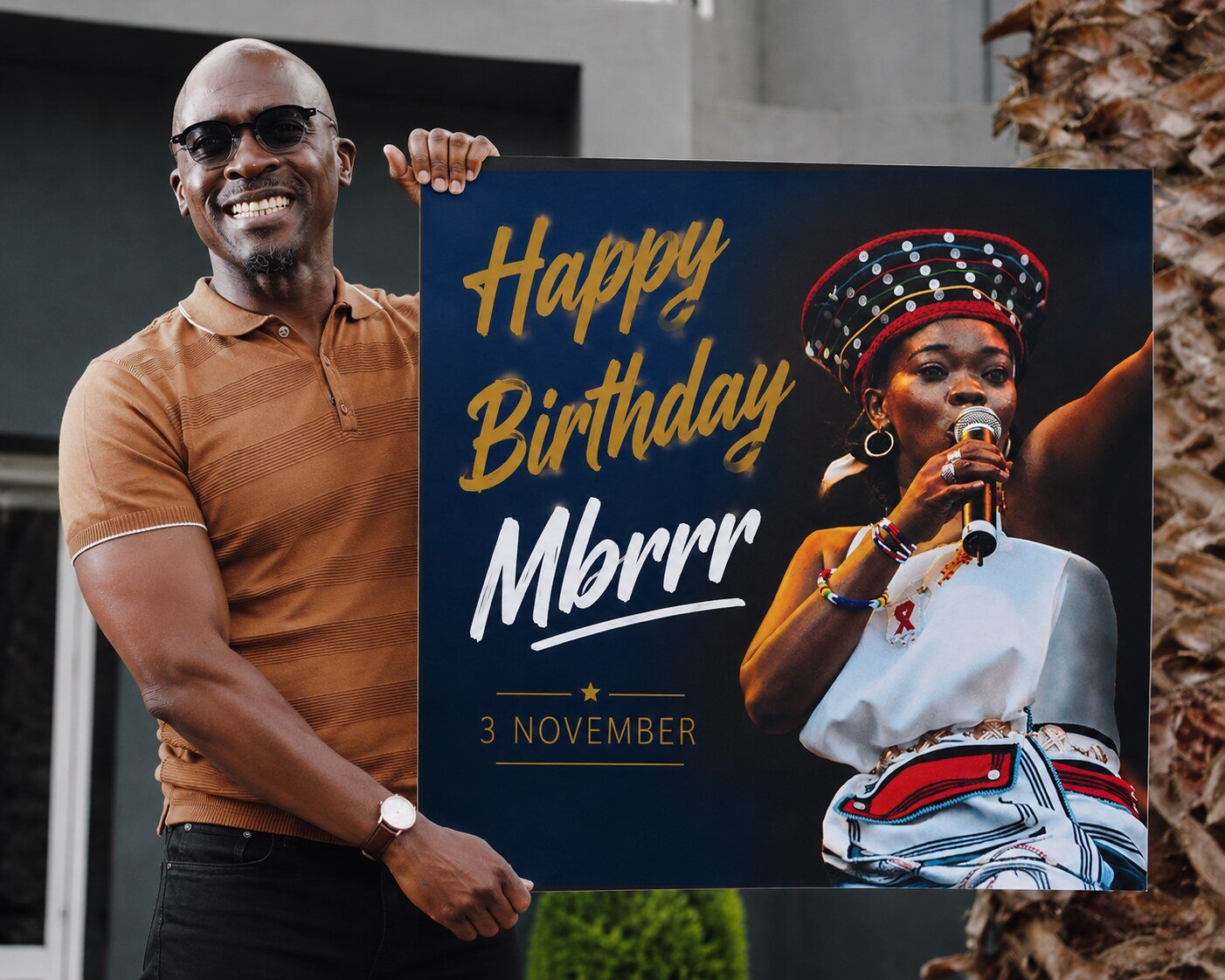
On 3 November, Brenda Nokuzola Fassie would have turned 62. She was born in Langa, the Cape Town township, in 1964, and she died in 2004, at 39. I want to ask a question about her that is easy to skip, because her music is so easy to dance to. What does a pop song carry that a speech cannot?
My answer is that Brenda Fassie did not need a slogan. She was not a protest singer in the textbook sense, and she was not an apolitical one either. She was something harder to file and harder to silence: a pop star whose hits could carry a refusal.
A voice before it was a career
The record is consistent about where it began. She was named after the American country singer Brenda Lee, and she was performing as a small child, with her mother at the piano. When the producer Koloi Lebona went to Langa to hear her for himself, he found that everyone there was already talking about her. He recalled, in a report by Sapa, South Africa’s news agency, carried by the Mail & Guardian, that there was something special about her voice, and he put it this way: “I knew it was the voice of the future.”
That was a producer’s judgement, and the market agreed with him. Brenda and the Big Dudes released Weekend Special in 1983. The Mail & Guardian records it as the fastest-selling record of its time. Pop success came first.
The song, which the group had recorded in South Africa, was remixed in New York, and the remix entered Billboard’s Hot Black Singles chart in the United States in 1986. A song made at home had found an American ear. The Mail & Guardian records that the Big Dudes toured the United States, the United Kingdom, Europe, Australia and Brazil.
Defiance with a beat
In 2023 Pieter Labuschagne published an analysis in the South African Journal of Cultural History of one of her songs, Bhuti Ngiceli Ilift in your Zola Budd. Zola Budd was a white teenage runner from Bloemfontein. The Sowetan dates the record to 1987, on her self-titled album, and calls it a dancefloor anthem and now a pop classic. I searched the Sowetan, the Dictionary of South African English and South African History Online for its sales, chart position and radio play, and found no figure for any of them. I can only offer my own memory: it was on high rotation for a long time when it came out. Labuschagne writes that the song captured the imagination of the black community, that Budd’s speed came to be equated with that of minibus taxis in township streets, and that taxis were named Zola Budd taxis. He reads the song as sport bridging a racial divide.
As a black South African, I note that the name Zola comes from the Xhosa language, where it means to be calm. It was highly unusual then, as it still is, for a white South African to carry a black indigenous name. I wonder whether Ms Budd’s popularity in the townships was helped along by her first name.
I read something further beside that reading. Brenda had her ear on the ground. The township was already making a famous runner’s name its own, and her song caught the imagination of the black community. That, I think, is what made her relatable, and a large part of what made her successful. She sang about everyday life.
The song the state banned
In the last years of apartheid, the voice found a subject. Black President was a tribute to Nelson Mandela while he was still in prison. She sang it, and the apartheid government banned it. The Guardian’s obituary records the ban. The New York Times called it her anthem to Mandela in jail and placed it in a line of South African freedom songs: the harder-edged addition of her generation to the religious liberation songs of its elders.
There is an irony here that I do not want to pass over. The Guardian’s obituary dates the song’s release to 1990, and on 11 February 1990 Mandela walked free after 27 years of incarceration. The state could release the man. It could not bear the song. A broadcast report of 4 September 1990, almost seven months after his release, still describes the tribute as banned in South Africa.
I should say what became of the ban of Black President itself, and here I can only reason from the record. I have found no account of when it ended, or of whether it was ever formally lifted. The Sowetan wrote in 2021 that the song “only enjoyed airplay after 1990.” My own conclusion is this. A ban on a song about a prisoner could not outlive the prisoner’s release for ever, and the report I found shows it outliving it by months. I suspect the ban then fell away without ceremony, not because anyone repealed it, but because it had stopped making sense.
What happened next is the part I find most instructive. The obituary records that she stopped singing in English, and it quotes her: “I am proud to be an African.” The Guardian’s obituary goes further than the pledge: it says all her later songs were in Zulu, Xhosa and Sotho. A claim about all of them is the easiest kind to test, so I have tested it.
The one scholar of her work I could read, Philippe Gervais-Lambony, writing in a 2017 article in the journal ACME (in French; the rendering is mine), notes that Black President itself was in English. He describes the Africanisation of her lyrics as beginning on her records of the early 1990s and as now total. Memeza, as I know it, is an album entirely in isiZulu. I searched the Sowetan, Okayafrica, Daily Maverick, South African History Online and the Sunday Times Heritage Project for a sales or radio-play ranking of her individual songs, and found none. So I took ten of her hit singles from 1992 to 2000, and I set them down in order of release: I Straight Lendaba, Boipatong, Amagents, Kuyoze Kuyovalwa, Ngeke Um-confirm-e, Sum’bulala, Memeza, Vul’indlela, Nomakanjani and Thola Amadlozi.
I followed her music closely in those years, and all ten were sung in a mix of indigenous languages and township slang. Boipatong was about the massacre in that township. On 17 June 1992 about 300 armed men attacked the Joe Slovo informal settlement there, and the song dates from the same year. Read the titles, listen to the songs, and decide for yourself whether she kept her word.
A singer whom the state had tried to silence chose which languages she would sing in, and she chose the languages of her own people.
How far the voice travelled
The Mail & Guardian also records that her popularity spread through most of Africa, and I find the details below more telling than any chart position.
Her 1996 album Now Is the Time carried two duets with the rumba star Papa Wemba, of what was then Zaire. In 1999 she won a Kora Award as Africa’s best female artist. In March 2001, a report carried by allAfrica described her arrival in Kenya. The speakers in the airport lounge were playing Vulindlela, she danced down the aircraft steps, and in the lounge she sang Nkosi Sikelel’ iAfrika. A South African star had landed in Nairobi to find her song already playing.
Time magazine, reaching for a comparison the world would recognise, headlined its profile of her “The Madonna of the Townships”. The world needed an American name to understand her. The townships never did.
Hearing all of her
There is a temptation to reduce her to one song and one decade. It would be easy, and it would be wrong. A banned anthem, a changed language, a taxi joke and a continental prize do not make a catalogue of four different artists. They make one: a body of work in which the refusal and the joy are the same gesture.
In 2004, after her death, the South African Music Awards named her album Memeza, which means “shout”, the best-selling release of the decade, and Vulindlela the song of the decade. Both awards came after she had died. I read that as a country that listened late.
That is the work that remains for us. It is not to build a monument to one voice. A bronze of her was made for the Sunday Times centenary heritage project and first installed in Newtown, in Johannesburg, in 2006. It was restored in 2019 and returned to the Market Theatre precinct. It is to ask, of the next voice, whether we will hear it before it has to be banned. We should let our artists sing in the languages of our people and of our continent, and we should have the grace to listen. Brenda Fassie sang for a generation. The least we can do is hear all of what she said.
“The future is not an accident.”
Dr Malusi Gigaba is a Scholar-Statesman, an ANC NEC Member, a former Cabinet Minister of the Republic of South Africa, a Member of Parliament, and a member of both the Portfolio Committee on Trade, Industry and Competition and the Portfolio Committee on Justice and Constitutional Development.