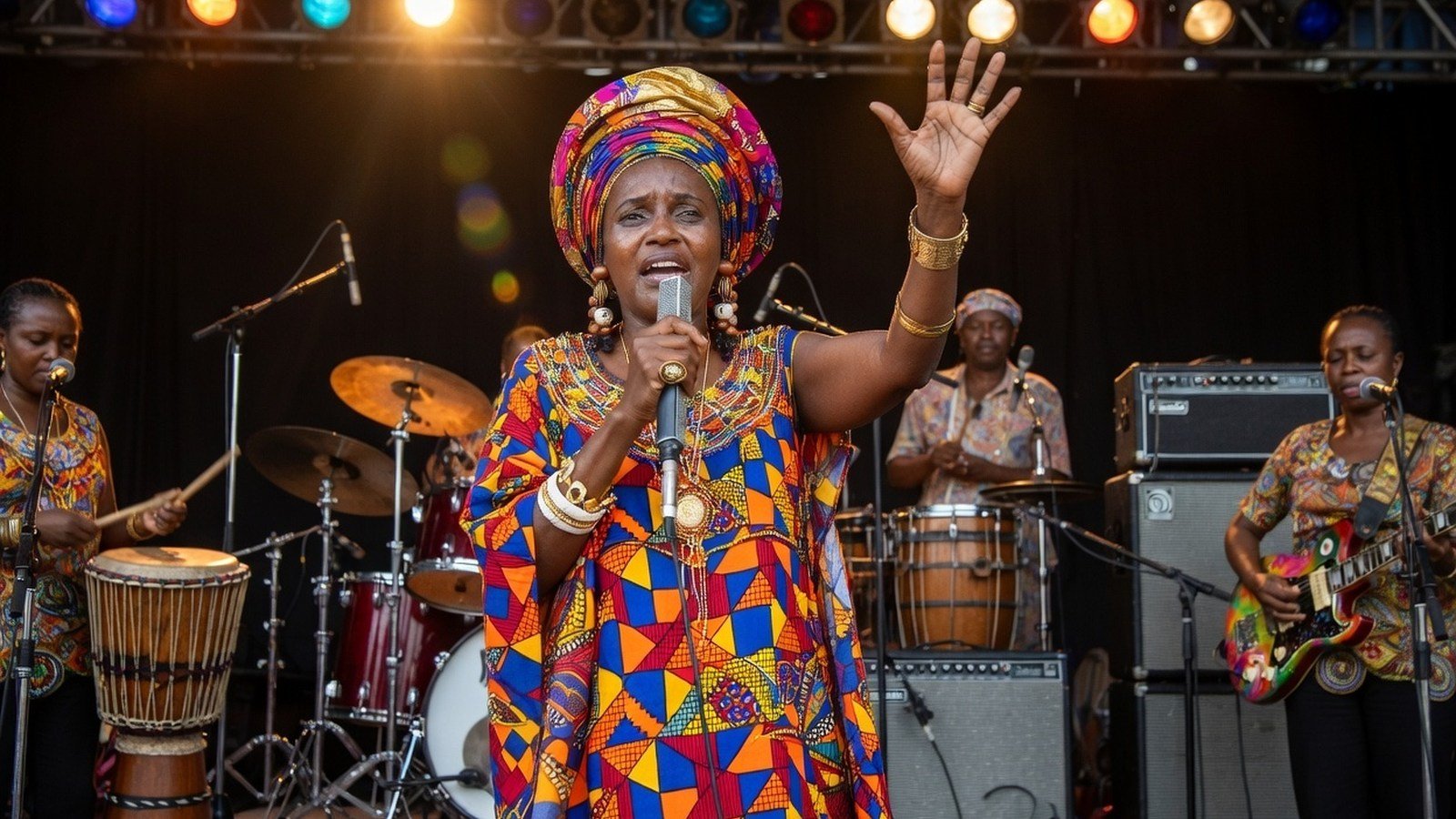
This past Wednesday, the 4th of March 2026, was Miriam Makeba's 94th birthday. Mama Afrika's birthdate inspired this article, which reflects on the role of arts and culture in the eventual toppling of the apartheid regime.
There is a tendency to speak about Miriam Makeba as though she used her music to support the liberation struggle. The framing is generous, and it is wrong. She did not support the struggle from the side. She was inside it. The stage was not a place she went to when the politics were done. It was where she fought.
In 1959, Makeba left South Africa for the Venice Film Festival, where Lionel Rogosin's Come Back, Africa – in which she appeared – was having its premiere. The following year, her mother died. When she tried to return home to attend the funeral, she discovered that the South African government had cancelled her passport. She had not yet appeared at the United Nations. She had not yet delivered any speech to the world. The state moved against her because of what she was doing, not because of what she was saying.
That distinction is worth holding onto.
Three years later, in 1963, she stood before the UN Special Committee Against Apartheid and spoke. She asked the assembled delegates: would you act differently, would you keep silent and do nothing if you were allowed no rights in your own country because of the colour of your skin? Following that testimony, the South African government revoked her citizenship. First the passport. Then the identity itself. Two distinct acts of state, three years apart. The government turned her into a symbol of what it intended for all Black South Africans. She turned it back on them.
She spent more than three decades in exile. She performed across the world – New York, Lagos, London, Paris, Conakry – singing in Xhosa and Zulu to audiences who had never set foot in South Africa. She did not argue against apartheid. She made people feel what it had done to her people. That is a different kind of pressure. And it worked, because the state understood that it worked, which is why the response kept escalating.
Hugh Masekela left South Africa in 1960, in the months after Sharpeville. He spent three decades in exile – in London, New York, and eventually Los Angeles. His music did not announce itself as political. It did not need to. Every album, every performance, was a statement that Black South African culture was alive, coherent, and far too large to be erased by any government's design. When the apartheid state's project was cultural erasure, simply sustaining the culture was resistance. He said it clearly: "South African music has been in limbo because of apartheid. Exile and the laws have parted us and caused a lack of growth. If we'd been free and together all these years, who knows what we could have done?"
Abdullah Ibrahim and Jonas Gwangwa had been forced out of the same formation as Masekela. All three were founding members of the Jazz Epistles, the ensemble that recorded the first jazz long-play album by Black South African musicians in January 1960. Sharpeville dismembered that formation months later: mixed-race gatherings were banned, venues were closed, and the musicians scattered into exile across different years and different cities. Ibrahim – then known as Dollar Brand – left in 1962, settling first in Zurich, where Duke Ellington heard him play and produced his first international album. His composition "Mannenberg," recorded in Cape Town in 1974, became what many describe as the unofficial anthem of the anti-apartheid struggle. He later said of the departure: the ANC had asked them to go abroad and preserve a culture that was in danger of disintegrating.
Gwangwa followed a different path to the same commitment. By 1980, at the personal request of ANC President Oliver Tambo, he was leading the Amandla Cultural Ensemble – the ANC's touring performance company – across more than forty countries. In June 1985, South African security forces bombed his home in Gaborone. He co-composed the score for Cry Freedom two years later and received an Oscar nomination. He described Amandla as the work he was proudest of, not for what it won him, but because it was for the people.
Harry Belafonte came to this differently. He was an American artist, shaped by the civil rights movement, who understood early that apartheid was not a South African problem contained within South African borders. It was part of the same architecture of racial domination he was fighting at home. He sustained a deliberate, long-term relationship with the ANC. He provided financial support. He mentored young South African artists arriving in exile – Masekela among them – and he connected the anti-apartheid movement to American civil rights audiences in a way no South African exile could do alone. In 1988, he brought together artists from across the world at Wembley Stadium to mark Nelson Mandela's 70th birthday. What made the event significant was not its size but its clarity: art deployed as argument, at the moment the argument most needed making.
Caiphus Semenya and Letta Mbulu represented something else: the interior dimension of the cultural campaign. Semenya was born in Alexandra township in 1939. The two met during the King Kong musical, and in December 1964 they left South Africa together and settled in Los Angeles. Semenya arranged for Belafonte, then collaborated with Quincy Jones on Roots and The Color Purple. Mbulu toured with Cannonball Adderley, kept a South African musical voice alive in the American recording industry for nearly three decades, and raised two sons in a house where Zulu and Sotho were enforced at the front door because their father had decided that his home was a republic of South Africa, regardless of its address. She said, years later, that the sun would not set without them thinking about home. They returned in 1991.
A reasonable objection deserves a direct answer. The objection goes: cultural resistance was symbolic. It did not end apartheid. The armed struggle, mass action, and economic sanctions did that. The musicians were powerful voices, whose voices became the echoes — but voices alone do not change governments; they became not just witnesses of the suffering, the humanity and struggle of the oppressed, but they themselves became equally the tools of the struggle employed to mobilise the oppressed and fire them with courage and enthusiasm to endure the difficult challenges of the struggle, inspire the exiles in distant bushes in the camps with the memories of home so that they do not despair, as well as mobilise the international community to support our struggle.
The answer is not a full rebuttal. It is a clarification. Apartheid depended on two things simultaneously: domestic repression and international normalisation. Economic growth required foreign investment, trade partnerships, and diplomatic acceptance. Cultural resistance attacked the second directly. When the ANC first called for a cultural boycott in December 1958 at the All African People Conference in Accra, they understood this. A decade later, on 2 December 1968, the UN General Assembly formalised it – Resolution 2396 requested all states to suspend cultural, educational, and sporting exchanges with the apartheid regime. That resolution did not emerge from nowhere. It emerged from years of pressure built partly by artists who had made apartheid impossible to ignore, and made South Africa's government impossible to defend.
The cultural boycott was not a mood. It was a mechanism with a resolution number and a register of violations. And the government's response to Makeba – passport first, citizenship three years later – is the clearest evidence that they knew it was working.
Thus, the use of music, arts, and culture was not merely a byproduct of the anti-apartheid struggle; it was a central weapon in mobilising both the masses within South Africa and the international community. It served to unify, articulate pain and resistance, and humanise the struggle in a way that political speeches alone could not. That is why President OR Tambo established Amandla Cultural Group to ensure that the South African refugees abroad were kept inspired and that the international community understood our humanity, as well as our message, and thus were mobilised to support our struggle.
Artists like Mama Afrika, Caiphus Semenya, Letta Mbulu, Abdullah Ibrahim, Jonathan Butler and Hugh Masekela, as well as Harry Belafonte, to mention but a few, played no less an important role in that effort. They understood the call of duty, and jumped into action with their voices and musical instruments as their weapons of war. They infused their music with the rhythms and struggles of South Africa. Their sophisticated, often instrumental, music became a language of sophisticated resistance for urban Black communities.
To understand better, take "toyi-toyi" and the struggle songs, including Enoch Sontonga's Nkosi Sikel' iAfrika (later part of the national anthem), which were sung at funerals, rallies, and in prisons, expressing collective sorrow, anger, and hope. Toyi-toyi'ng combined rhythmic movement with powerful lyrics to intimidate the state and energise protesters. Listening to it, and most of all, participating in toyi-toyi was enchanting and fired the participants with unbelievable courage to face any eventuality.
As well as the above, music, arts and culture broke racial barriers even domestically when one considers the role of people like the late PJ Powers, Johnny Clegg and Sipho Mchunu, performing during a time of intense segregation. This was a living protest.
Poets like Mongane Wally Serote and Oswald Mbuyiseni Mtshali wrote in stark, visceral language about township life, police brutality, and the yearning for freedom. Their work was circulated in underground publications and recited at gatherings. Younger poets like Mzwakhe Mbuli chose a more direct form of confrontation as they were not in exile, to do their poems at rallies and marches, directly confronting apartheid brutality and inspiring the youth.
Miriam Makeba ("Mama Africa") and Hugh Masekela, once exiled, became global superstars. Their music introduced the world to South African sounds, and their personal testimonies in interviews and concerts put a human face on apartheid's atrocities. Makeba's address to the UN in 1963 was a landmark moment.
Meanwhile, people like Percy Mtwa, Mbongeni Ngema, and Barney Simon, John Kani and many others used satire, parody, and stark realism to critique apartheid, often performed in townships with minimal sets, making them accessible and powerful. This also placed them often beyond the omnipresent radar of the apartheid regime.
International artists such as Bruce Springsteen, Bob Dylan, U2, UB40 and many others used their immense talents to raise both awareness and funds for the anti-apartheid movement. This brings to mind the 1988 Nelson Mandela 70th Birthday Tribute Concert at Wembley which was broadcast to over 600 million people in 60 countries. It globalised the demand to "Free Nelson Mandela"—a chant that became ubiquitous—and made cultural support for the ANC mainstream.
In addition, in refusing to perform in South Africa, international artists reinforced the cultural boycott, which further isolated the regime culturally and psychologically.
Without a shadow of doubt, arts and culture served a vital role in fostering the following,
- Unity and solidarity by creating a shared identity and purpose among the oppressed,
- Moral clarity by simplifying the complex political issue into a clear struggle between justice and oppression,
- Psychological Warfare by undermining the apartheid state's legitimacy and boosting the morale of activists,
- International Pressure which made apartheid a burning moral issue in Western capitals, contributing to the economic and cultural sanctions that crippled the regime, and
- Preservation of the humanity of the oppressed in the face of a system designed to dehumanise them. Art asserted the dignity, creativity, and spirit of Black South Africans.
Music, arts, and culture provided the emotional and moral architecture for the anti-apartheid movement. They turned a political struggle into a universal human rights crusade, giving the masses inside South Africa a voice and giving the world outside a reason to listen, care, and ultimately, to act. The global anti-apartheid movement is one of the clearest examples in history of how culture can be weaponised for profound political change.
Of course, this is not to compile a comprehensive treatise on the role of music, arts and culture during the struggle, but it is to acknowledge a royal songstress, Mama Afrika, and the role she played to ensure that we got our freedom.
None of these artists chose their political role. The state assigned it when it cancelled passports, revoked citizenship, and banned recordings. What they did with what remained – the exile, the stage, the audience – was deliberate. Each found their own ground. Makeba made herself visible at a moment when visibility was precisely what the apartheid government sought to deny Black South Africans. Masekela kept the sound alive when the state's intention was silence. Ibrahim composed the culture into an anthem and proved that exile did not mean erasure. Gwangwa organised the struggle itself, turning an ensemble into a structured instrument of liberation deployed across forty countries. Belafonte translated the fight into language that American power could hear. Semenya and Mbulu held the interior together.
Makeba said it plainly: "People say I sing politics, but what I sing is not politics, it is the truth."
International Women's Day is a useful moment to ask a harder question. The artists of Makeba's generation had no ambiguity about what the battlefield looked like. The government told them, explicitly, with rubber stamps and revocation orders. Does this generation of African artists understand the battlefield as clearly? They have the platforms. They have the audiences. They have freedoms Makeba spent three decades fighting for.
The stage is still a battlefield. The question is whether those standing on it know it.
“The future is not an accident.”
Dr Malusi Gigaba is a Scholar-Statesman, an ANC NEC Member, a former Cabinet Minister of the Republic of South Africa, a Member of Parliament, and a member of both the Joint Standing Committee on Defence and the Portfolio Committee on Trade, Industry and Competition.