Illustration: an image made for this article, not a photograph.
This November the calendar holds two Nigerian writers, and it holds them six days apart. Ken Saro-Wiwa died on 10 November 1995; Chinua Achebe was born on 16 November 1930. On this Sunday, 22 November, I want to read them side by side, and I want to read them on one question only: what does a writer do with a language she did not choose?
I will say the one hard fact plainly and then leave it. Saro-Wiwa was found guilty by a special tribunal appointed by Nigeria’s military, and hanged on 10 November 1995 with eight others. Amnesty International calls the trial blatantly unfair. In June 2025 Nigeria pardoned them posthumously, a step Amnesty says falls short of the full exoneration they deserve. This piece is about the sentences he wrote, not the sentence that was passed on him.
Kampala, June 1962: the room where the question was set
The question did not begin with either writer. It was put to a room, on a hill in Kampala, nearly four months before Uganda became independent.
In June 1962 the Conference of African Writers of English Expression met at Makerere. The report’s introduction, signed by Mphahlele, says the conference was organised by the Mbari Writers’ and Artists’ Club of Ibadan, with Makerere’s Department of Extra-Mural Studies under Gerald Moore as hosts, and sponsored by the Congress for Cultural Freedom in Paris. Forty-five people took part, 29 of them writers.
Who came? From Nigeria, Achebe, Wole Soyinka, J.P. Clark, Gabriel Okara and Christopher Okigbo. From the South African exile, Mphahlele, Bloke Modisane and Lewis Nkosi. From Kenya, Grace Ogot and Rebeka Njau. From the United States, Langston Hughes. And a Makerere undergraduate, then James Ngugi and later Ngũgĩ wa Thiong’o, who asked Achebe to read the manuscripts of his two novels.
What did they argue about? The first item was the question in plain words: what is African literature? Is it writing by Africans, or writing about Africa, or writing in African languages? The language clause is the one this piece follows. Okigbo rooted it in African soil, experience and feeling. Hughes pointed to the author and the theme. Okara said he thought in his vernacular and translated into English to keep the flavour of what he meant. Bernard Fonlon of Cameroon, in his account of the meeting, argued that African English would be shaped by African languages, and that writers should guide the shaping.
Language was not the only quarrel. Negritude, the movement begun in 1930s Paris by Léopold Sédar Senghor of Senegal, Aimé Césaire of Martinique and Léon-Gontran Damas of French Guiana, affirmed a shared Black identity and culture against the colonial claim that Europe’s was superior, and much of it was written in French. At Kampala it came under attack. They quarrelled, too, over whether South African exiles were rooted or uprooted. They divided into working parties on the novel, the short story, drama and poetry, and they read to one another from their work.
What came out of it? Not a definition, and no resolution. Fonlon, who was there, reports only a spontaneous, unanimous feeling that the gathering had been worthwhile. The Nigerian critic Obiajunwa Wali, writing the following year in Transition, judged that its one concrete achievement was that writers and their patrons got to know one another. Everything else came later, and it came from the argument the room left unfinished.
Who was left out, and what followed
A conference defines a literature by whom it seats. Ngũgĩ wrote years later in his own account that the title itself “automatically excluded those who wrote in African languages”. He named two writers who could not qualify: Shaaban Robert, the Kiswahili poet, and Chief D.O. Fagunwa, who wrote in Yoruba. Writers in Arabic and French were not delegates either; French-speaking Africa sent observers, not participants.
Then there is the name Wali raised. Amos Tutuola, the author of The Palm-Wine Drinkard (1952), had an international reputation that came before Achebe’s. At home, many critics derided his English as ungrammatical. Wali called his absence from Kampala a “tacit omission”, and offered his own reasons: critics had grouped Tutuola with the Negritude school, and he had won acclaim abroad through an English that fitted neither the Ibadan nor the Makerere mould. The reviewer Gautam Bhatia, in The Wire in 2018, reports that Mukoma wa Ngũgĩ, in The Rise of the African Novel, reads it differently: Tutuola was an embarrassment to a generation schooled in the best schools the colonies offered and proud of its mastery of Standard English. Those are readings, not findings. I have found no account in which the organisers gave a reason, and I will not invent one for them. Hold that name. It returns when we reach Saro-Wiwa.
What followed was larger than the meeting. Wali’s essay opened the language argument in print, on the side of African languages, and Mphahlele answered him in print. Achebe went on defending English. In 1986 Ngũgĩ published Decolonising the Mind and went the other way. Meanwhile Heinemann’s African Writers Series, launched in 1962 and, before the year was out, taking on Achebe as its first editorial adviser, published both of the novels Ngũgĩ had asked him to read. It built a canon, and canons harden. The critic Aaron Bady has written that the Makerere writers formed the basis of the African canon, “a kind of self-fulfilling prophecy.” Bhatia adds that Mukoma holds that telling Makerere as the origin of the African novel erases earlier work by Mofolo, Jordan and Plaatje.
The conference has been re-read many times since: by James Currey, writing in 2012, fifty years on; at a meeting at SOAS on its fifty-fifth, in 2017; and by the researcher Anna Adima, who asked in 2020 where the women were. It is now read less as a settlement than as a question that has not stopped being asked.
A language that was given
Achebe was born on 16 November 1930 in Ogidi, an Igbo town in south-eastern Nigeria, and he published Things Fall Apart in 1958, at 27, in English. His publisher, Penguin Random House, says the novel has been translated into 57 languages and has sold over 20 million copies, and calls him admired as the father of modern African literature. Those are the publisher’s figures and the publisher’s description, not an independent count or a ranking. What is certain is the language: English.
Igbo editions do exist, one by Izuu Nwankwọ (Ihe Aghasaa, 2007 or 2008) and one by P.A. Ezikeojiaku (Agharata, 2009), but a recent study reports that both are so little known that a December 2024 Google Scholar search found eight hits for one and four for the other. The delay is worth pausing on. The novel reached French in 1966, Swahili in 1973 and Yoruba in 1997, and the earliest Igbo edition I could find came in 2007 or 2008, roughly fifty years after the English original. The Igbo edition came some forty years after the French, over thirty after the Swahili and about ten after the Yoruba. Achebe was alive when it appeared; he died on 21 March 2013.
Achebe did not pretend that writing in English cost nothing. In the essay collection Morning Yet on Creation Day (1975) he put the objection against himself, and in his own words:
“Is it right that a man should abandon his mother tongue for someone else’s? It looks like a dreadful betrayal and produces a guilty feeling.”
Then he answered it.
“But, for me, there is no other choice. I have been given this language and I intend to use it.”
Read that again. The word is given. Not chosen, not earned, not won. Achebe begins from the honest fact that the language arrived with the colonial state, and he refuses the comfort of pretending otherwise. What he asks of it is not obedience. He asks for a transformation: a “new English, still in full communion with its ancestral home but altered to suit its new African surroundings.”
That is Achebe’s answer. Ownership, not by birth, but by use.
The objection deserves its weight
It would be easy to stop there and call the matter settled. It was not settled then, and it is not settled now. Kampala did not settle it either. Wali’s answer, in Transition the year after the conference, was that any true African literature must be written in African languages, and that the uncritical acceptance of English and French as the medium of educated African writing was misdirected. I have set out that debate, and Ngũgĩ wa Thiong’o’s part in it, in an earlier piece, and I will not retell it here.
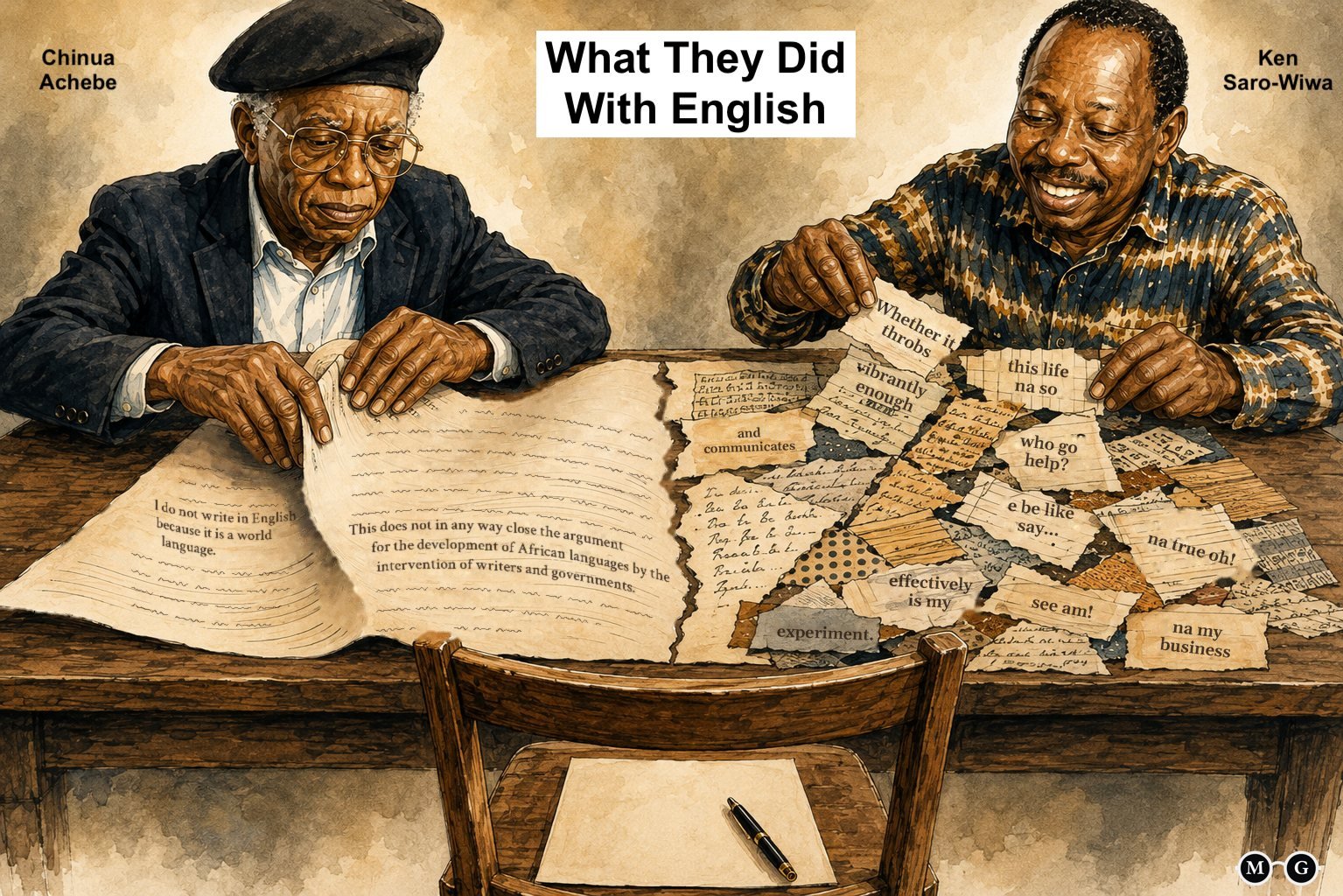
Achebe did not leave it at the guilty feeling. After Ngũgĩ published Decolonising the Mind, he answered him in an essay, “Politics and Politicians of Language in African Literature”, and called Ngũgĩ’s vision a Manichean one. That is a view of the world as a fight between two sides, pure good against pure evil, with nothing in between. But the heart of his answer was not about Ngũgĩ. His reason for writing in English, he said, was not that it is a world language. It was that Nigeria conducts a large part of its daily business in English and, for the foreseeable future, has no choice but to hold its more than two hundred nationalities together through an alien language. And he said that none of this closes the argument for developing African languages by the intervention of writers and governments. I take that last sentence as the hinge of this piece.
What I want to note is narrower. Achebe’s “guilty feeling” shows that he took the objection seriously and did not dismiss it. He did not win the argument by silencing it. He lived inside it.
A language that was broken
Saro-Wiwa gave a third answer, and it is the one we read least.
Like Achebe, he wrote mainly in a language that was not his first. The scholar Íde Corley notes that he used English, not his first language, Khana, to make his views known at home and abroad.
In 1985 he published Sozaboy: A Novel in Rotten English in Nigeria, through Saros International Publishers, the press that Corley says he set up himself. In his author’s note he described the language he had chosen:
“a mixture of Nigerian Pidgin English, broken English and occasional flashes of good, even idiomatic English.”
He did not defend it as correct. He called it “disordered and disorderly.” And then he did something I find rare in a writer: he handed the verdict to the reader.
“Whether it throbs vibrantly enough and communicates effectively is my experiment.”
Remember Tutuola, whose English many critics at home derided as ungrammatical. Saro-Wiwa listed broken English among his own ingredients, named it as such, and asked the reader to judge the result. I do not claim a line from one to the other; I only put them in the same room.
His readers have not agreed on what that language is. Corley reports that critics first celebrated him for giving a spoken language the standing of a literary one, then grew more cautious. The narrator, she writes, does not appear to switch between Pidgin and standard English the way a real speaker would, and the language can seem as arbitrary as the word rotten announces. Dianne Feeley, reviewing the novel in Against the Current in 1996, read it the other way: a chaos that only appears chaotic, held under control, and the glossary at the back is her evidence. I do not need to settle that quarrel. It is enough that he named the language, listed what went into it, and put it in front of us to be judged.
Now set Achebe and Saro-Wiwa beside each other. Achebe bends English until it carries his world. Saro-Wiwa breaks it, and builds from the pieces. Not a monument to be preserved, and not a prison to be fled, but material.
Neither of them treated the language as sacred. Neither of them treated it as shameful. Each treated it as something a writer works.
What the two answers leave open
I want to be careful about what I take from these pages, because it is easy to ask a writer to answer questions that belong to someone else.
Both writers answered the writer’s question. They showed that a person can take an inherited language and make it do work it was never built to do. That is a literary achievement, and it was won one sentence at a time.
Both were honest about what the inheritance had cost them. Achebe wrote that his choice looks like a dreadful betrayal, and that for him there was no other choice. Saro-Wiwa called his language disordered, and offered it as an experiment. Both did the work anyway.
But a nation cannot do for its children what a novelist does for her sentences. Statistics South Africa reports that in the 2022 Census, isiZulu was the most widely spoken home language, used by 24.4% of people aged one and older. That is the highest figure, so no language is spoken at home by more than a quarter of us. How many of those speakers find their language in the statute book, the textbook and the bookshop? Igbo, Achebe’s own language, waited roughly fifty years for the earliest edition of Things Fall Apart that I could find. No novelist can close that distance alone. It is a question of budgets, curricula and institutions.
So here is my position, and I draw it from their pages, not onto them. What a writer does with a language is answered by the writer, in the work. What languages a country gives its children is answered by the state, in what it chooses to fund. Achebe and Saro-Wiwa answered the first. The second is ours.
A generation of writers made the given language their own. The task that remains is to make sure that no child in this country has to meet Achebe’s question as a betrayal, because the language of her home has been given the standing, the books and the classrooms that the other languages were handed from the beginning.
“The future is not an accident.”
Dr Malusi Gigaba is a Scholar-Statesman, an ANC NEC Member, a former Cabinet Minister of the Republic of South Africa, a Member of Parliament, and a member of both the Portfolio Committee on Trade, Industry and Competition and the Portfolio Committee on Justice and Constitutional Development.