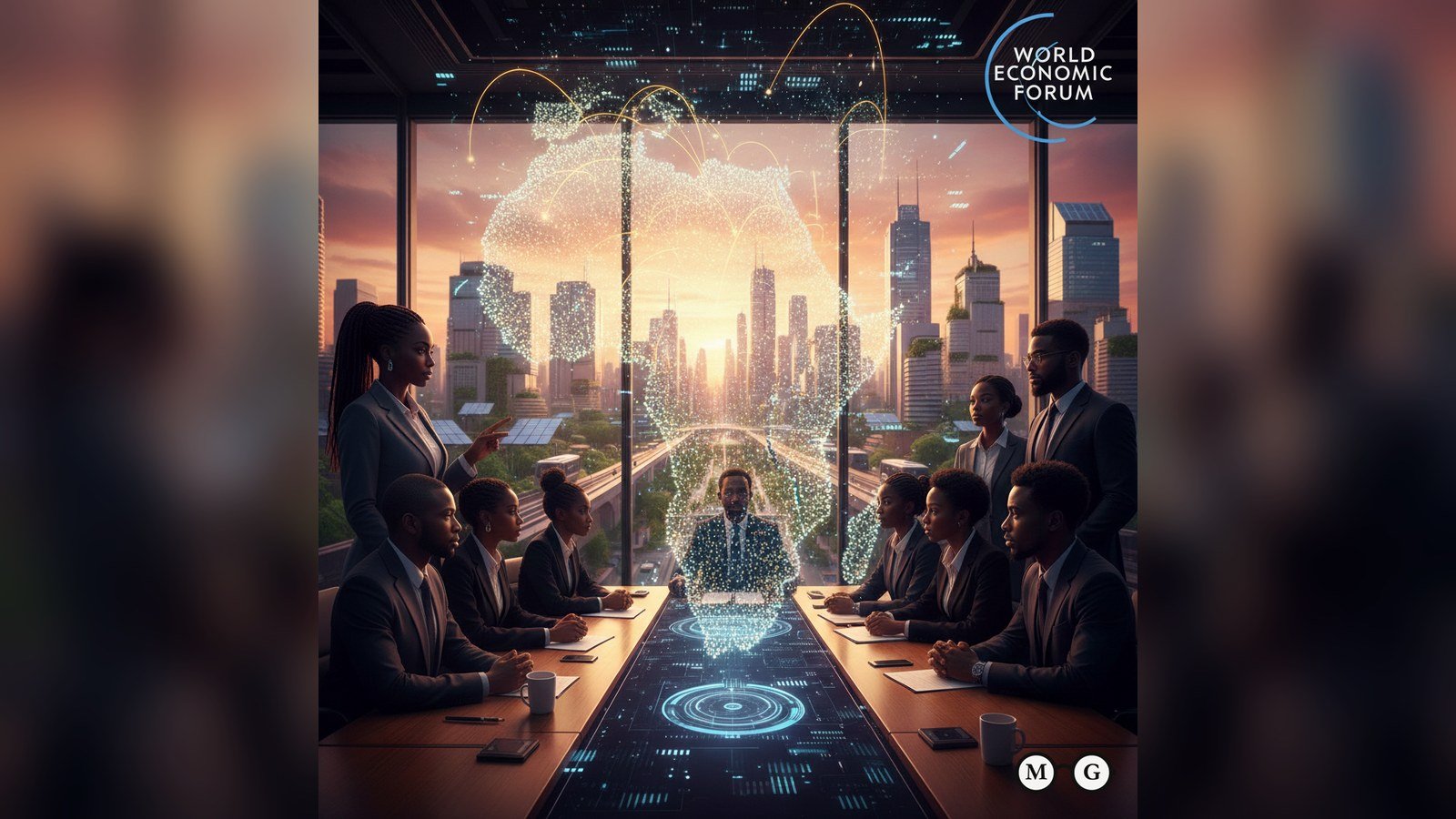
The 2026 Annual Meeting of the World Economic Forum in Davos took place against an unusually candid backdrop. As global leaders, central bankers, and business executives reflected on a year marked by geopolitical shocks, trade fragmentation, and strategic realignment, one recurring theme stood out. As Christine Lagarde - the President of the European Central Bank (ECB) - cautioned during the Global Economic Outlook session, policymakers now face a fundamental responsibility - to distinguish signal from noise in an increasingly volatile global environment.
That framing matters. It suggests that the question confronting Africa today is no longer whether the global order is changing - that is now self-evident - but how the continent positions itself in a world defined by multipolarity, the emergence of new powers (as in, away from the US-led capitalist versus the USSR-led socialist polars), unilateral action by powerful states, and deepening uncertainty. As Van Jackson and Brenes state it in their book, "The Rivalry Peril: How Great-Power Competition Threatens Peace and Weakens Democracy", the rivalry between the great powers is driven more by security fears rather than economic competition. This is, on the one hand, counterproductive in that it is based on the flawed belief that economic tools such as sanctions and tariffs, which have been escalated and applied haphazardly under the Trump administration, can easily compel its adversaries to comply with American demands or expectations. As we now know it, this is not the case.
On the other hand, it presumes that the US can bully even its allies to align with its foreign priorities, which also clearly will not work in the long run. Actually, this bully-boy approach has hardened China's attitude, brought China closer to the US's allies, and helped forge new strategic relations with countries such as Canada that would have in the past not considered this option. Even the EU are reconsidering their options in the wake of US belligerence. This rivalry is spiralling into a security dilemma that will be very hard to manage, but one in which China, which speaks less and seems more interested in defending multipolarity and multilateral rules and institutions, is increasingly viewed as the saner of the two leaders of the different polars.
Within that context, the strategic value of global convening platforms such as Davos deserves renewed scrutiny, not as neutral spaces, but as arenas of negotiation, leverage, and influence.
From Integration to Resilience: A Changed Global Landscape
In 2018, the prevailing global mood still rested on the assumption that integration and multilateral dialogue would ultimately be rewarded. Multilateralism, though contested, remained the dominant organising principle of global economic governance. The emphasis was on attracting investment, aligning domestic reforms with global norms, and deepening participation in global value chains. The world was still focused on economic recovery, with increasing anxiety over emerging challenges such as AI, the rise of fintech and the rising power of China and India.
As a participant in those engagements in 2018, what struck me was not only the access and dialogue that Davos offered, but also its limits. African leaders were present and visible, yet rarely agenda-setting. The language of reform and competitiveness often masked a deeper asymmetry. African economies were encouraged to liberalise and integrate, while major powers retained the latitude to protect strategic interests when it suited them. This reminded me of a speech by President Thabo Mbeki years ago, where he decried the fact that Africa was marginal and rarely mentioned in global media and multilateral forums, except in reference to civil wars, coups, famine and diseases-epidemics. This cannot be attributed to world leaders and platforms alienating Africa, it is a question African leaders and social motive forces themselves must answer – how do we place Africa at the cutting-edge of global dialogue! This is a challenge to our agency!
That tension, present but often understated in 2018, has since become explicit.
By 2026, it has become explicit. The global economy is now openly described as shock-prone and multipolar. Unilateral trade actions, the erosion of rules-based norms, and the politicisation of supply chains are no longer hypothetical risks. Resilience has overtaken efficiency as the organising economic principle. As Dr Ngozi Okonjo-Iweala - the Director-General of the World Trade Organization (WTO) - noted, while the global trading system remains more resilient than many assume, over-dependence on single markets or suppliers now represents a strategic vulnerability rather than a strength.
For Africa and the broader Global South, this shift is not entirely new. Many developing regions have long operated in a world where predictability was scarce and leverage unevenly distributed. What is new is that this reality is now being experienced, and acknowledged - by the traditional centres of power themselves.
Africa as a Negotiating Caucus, Not a Collection of Margins
The central strategic question, then, is how Africa responds. The answer does not lie in withdrawal from global forums, nor in uncritical participation. It lies in acting with coherence, scale, and clarity of interest.
Africa's strength in the current moment is not individual market size, but collective relevance. Demographics, critical minerals, energy transition inputs, and future consumer markets all converge on the continent. As Wamkele Mene - the Secretary-General of the African Continental Free Trade Area Secretariat - has emphasised, continental integration is not an abstract aspiration - it is the mechanism through which Africa converts fragmentation into bargaining power.
In a world where regions increasingly matter as much as individual states, Africa's ability to function as a negotiating caucus - aligned internally, pragmatic externally - becomes a strategic asset. This is particularly true as unilateralism resurfaces and the rules-based order shows signs of selective application.
The new geopolitical environment as well as Africa's history of colonial divisions, and how that legacy denied intra-African trade, which today still remains very low, must challenge us to cast our eyes beyond national interests in their narrow sense and prioritise regional cooperation both within the Continent as well as in terms of our global trade, economic and political engagement. This is very difficult to achieve, as many of our leaders and countries are often happy to out-compete one another in what they regard as a "global beauty pageant" for trade attraction.
Youth, Economic Agency, and the Markets of the Future
One of the more sobering reflections at Davos 2026 was the risk that growth optimism could breed complacency. As Dr Okonjo-Iweala warned, headline growth figures obscure widening disparities - within countries and across regions - especially as technological change accelerates unevenly.
For Africa, this reality intersects directly with the question of youth economic agency. The continent's young population is often framed narrowly through the lens of unemployment. That framing is insufficient. Economic agency speaks not only to jobs, but to ownership, entrepreneurship, and participation in value creation.
Africa's youth will constitute a significant share of the global labour force and middle-class consumers in the coming decades. Whether they become passive recipients of external investment or active shapers of domestic and regional economies will depend on policy choices made now - particularly those that support enterprise, regional trade, and industrial capability.
Davos, Power, and the Limits of Dialogue
None of this implies that the World Economic Forum is a neutral or benevolent space. Davos reflects global power asymmetries as much as it convenes dialogue. Discussions around conflict, sanctions, and economic coercion - including the treatment of countries such as Venezuela - reveal the limits of moral consensus in global forums. While the speech of the Canadian Prime Minister received much-deserved attention, there was silence in global media covering the event on the injustice suffered by the people of Venezuela, Palestine, Cuba, Western Sahara, unilateral and unprovoked US attack on Nigeria and the threat this poses to all developing countries, in pursuit of their rare earth minerals, oil, or forced compliance.
When all is said and done, while the EU is rightfully aghast about the issue of Greenland, their silence on the above other countries is not only deafening, but will forever be remembered by progressive humankind as a blight on their conscience and claims to moral stature. But, the EU is only about their members' interests.
Yet, it would be a mistake to dismiss platforms such as WEF outright. As several speakers at Davos observed, even the most powerful actors continue to seek dialogue precisely because no country, however dominant, can resolve today's structural challenges alone. The question for Africa is not whether to attend, but how to attend - with what posture, priorities, and alliances.
Looking Ahead
Africa's path to prosperity in the new economy will not be gifted by global forums, nor secured through rhetoric alone. It will be shaped by how effectively the continent converts scale into influence, youth into economic agency, and integration into resilience.
Davos 2026 made one reality unmistakable. The global economy will not return to the certainties of the past. For Africa, that is not a reason for retreat. It is an invitation to reposition deliberately and collectively. Whether the continent remains present but peripheral, or emerges as a negotiating force in its own right, will depend on leadership choices made now.
For Africa and the broader Global South, the multipolar future must not be an accident.
“The future is not an accident.”
Dr Malusi Gigaba is a Scholar-Statesman, an ANC NEC Member, a former Cabinet Minister of the Republic of South Africa, a Member of Parliament, and a member of both the Joint Standing Committee on Defence and the Portfolio Committee on Trade, Industry and Competition.