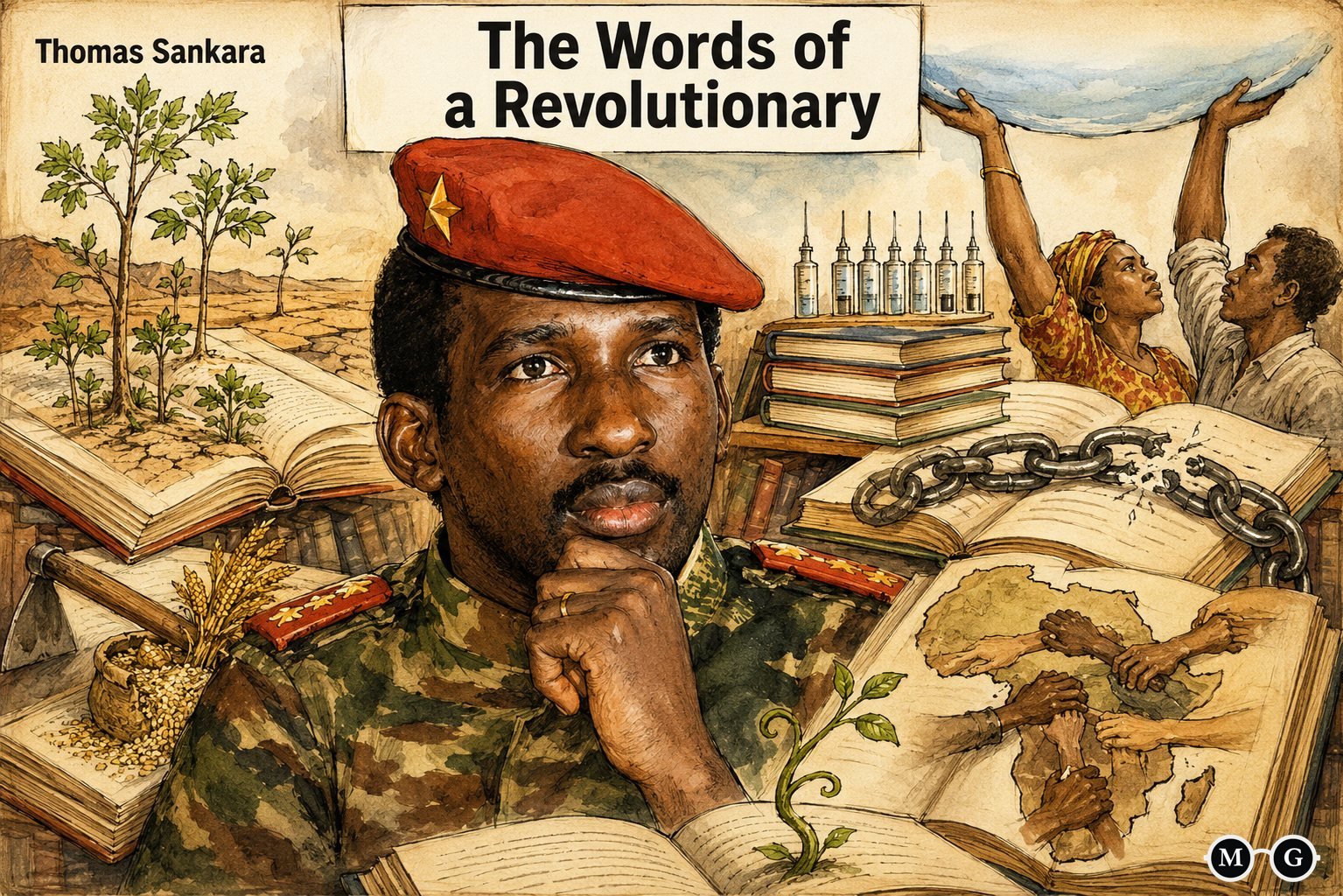
Illustration: an image made for this article, not a photograph.
In the Preface of Thomas Sankara Speaks: The Burkina Faso Revolution 1983–1987, Mary-Alice Waters says,
Sankara was not only a leader of the people of Africa. He was not only a spokesman for the oppressed and exploited of the semicolonial countries. He gave leadership to working people in the imperialist world as well. In the last decades of the twentieth century, proletarian leaders with the world stature of Thomas Sankara, Maurice Bishop of Grenada, and in a similar way Malcolm X in the United States, have emerged from the ranks of the oppressed peoples of all lands-even the most economically undeveloped-to give leadership to the international struggle for national liberation and socialism. And thus to take their rightful place in history.
This piece takes a different tack. Rather than charting a leader’s delivery record, we bring together his thinking across a range of key topics, illuminating the library of ideas underpinning his worldview.
The Making of an Anti-Imperialist
Thomas Sankara was born in December 1949 in Yako, in the centre of what was then Upper Volta and is now Burkina Faso. His father was an assistant policeman, one of the few local men employed by the colonial administration, and the family later moved to Gaoua, in the south-west, where Sankara began school. He was among the very few African children of his time to complete high school, in Bobo-Dioulasso. He went on to the military school at Kamboinsé, one of the rare routes to higher education for young people of his generation in sub-Saharan Africa. While he trained in Madagascar, a mass uprising of workers and students toppled the government in 1972, and the scale of that mobilisation left a deep mark on him. It was there, too, that he first met Marxism, through study groups and conversations with French students who had taken part in the upheaval of May 1968. Later, in France in the late 1970s, while training as a paratrooper, he combed bookshops for revolutionary literature and read Karl Marx and V.I. Lenin.
He rose to prominence as a lieutenant during the border conflict with Mali in December 1974 and January 1975, a war he later called “useless and unjust”. In the years that followed he found common cause with other junior officers and soldiers who chafed under the conditions that imperialist rulers in Paris, backed by landlords, businessmen, chieftains and politicians at home, kept in place. In 1982 he resigned a government post to protest the regime’s repressive policies and was briefly jailed. Then, on 4 August 1983, some 250 soldiers led by Captain Blaise Compaoré marched from an insurgent base at Pô to the capital, Ouagadougou. Jean-Baptiste Ouédraogo’s regime fell in a popular uprising, and Sankara became president of the new National Council of the Revolution.
The Revolutionary Government
Over the next four years the government under Sankara’s leadership mobilised peasants, workers and young people for far-reaching economic and social change. With broad popular support it ended the tribute payments and compulsory labour owed to village chiefs. It nationalised the land so that rural families, some 90 percent of the population, would have access to the fruits of their labour, and it raised the prices peasants were paid for basic food crops.
It launched tree-planting and irrigation projects to hold back the desert, ran mass immunisation campaigns and brought basic health care to millions of people. By 1985 infant mortality had fallen from 208 deaths per 1,000 live births at the start of the decade to 145. Where 92 percent of people could not read, it began literacy campaigns in local languages.
A New Society
On August 4, 1983, Sankara issued a Proclamation titled “A Radiant Future for Our Country,” in which he pointed out that the army had taken over power in order “to restore independence and liberty to our country and dignity to our people.” The purpose of the National Council of the Revolution (NCR) was “to defend the interests of the Voltaic people and to achieve their deep aspirations for liberty, for genuine independence, and for economic and social progress.”
Sankara’s commitment was concrete policy, not rhetoric: land distribution, rural infrastructure, health care, and mass mobilisation through Committees for the Defence of the Revolution. This distinguished him from leaders who ‘wave the flag of revolution while safeguarding their privileges’. The test of revolutionary authenticity is whether it improves the lives of the most oppressed: giving them land, health care, education, dignity.
In a speech celebrating the fourth anniversary of the Burkinabe revolution on August 4, 1987, Sankara said:
Our revolution will have a reason to exist only if it can respond concretely to these questions. As long as the revolution cannot bring material and moral happiness to our people, it will be no more than the activity of a bunch of people—a collection of people of some merit or other—but really just a bunch of mummies who represent nothing but a lifeless collection of decaying values, incapable of moving and driving forward, incapable of transforming the reality we confront. The revolution is happiness. Without happiness, you cannot talk about success. Our revolution has to answer these questions concretely.
In an October 2, 1983 speech, Sankara explained that theirs was a revolution
unfolding in a backward, agricultural country where the weight of tradition and ideology emanating from a feudal-type social organisation weighs very heavily on the popular masses. It is a revolution in a country that, because of imperialism’s domination and exploitation of our people, has evolved from a colony into a neocolony.
It is a revolution occurring in a country still characterised by the lack of an organised working class conscious of its historic mission, and which therefore possesses no tradition of revolutionary struggle. It is a revolution occurring in a small country on the continent, at a time when, on the international level, the revolutionary movement is coming apart day by day, without any visible hope of seeing a homogenous bloc arise capable of giving a stimulus and practical support to nascent revolutionary movements.
This was a difficult period of the aggressive ascendance of the Reagan – Thatcher neoliberal framework driven through the multilateral development institutions, the World and IMF. Late during the decade Soviet and Eastern European socialism would collapse, with devastating effects on the revolutionary movement.
In this October 2 speech, Sankara would characterise the Voltaic revolution as exhibiting “a dual character: It is a democratic and a popular revolution.”
He said:
Its primary tasks are to eliminate imperialist domination and exploitation; and to purge the countryside of all the social, economic, and cultural obstacles that keep it in a backward state. Its democratic character flows from this. It draws its popular character from the full participation of the Voltaic masses in the revolution, and their consistent mobilisation around democratic and revolutionary slogans that concretely express their own interests in opposition to those of the reactionary classes allied with imperialism. The popular character of the August revolution also lies in the fact that, in place of the old state machinery, new machinery is being built, capable of guaranteeing the democratic exercise of power by the people and for the people. Our present revolution as characterised above, while being an anti-imperialist revolution, is still unfolding within the framework of the limits of the bourgeois economic and social order.
The dual character of the Voltaic revolution meant that it had to resolve the socio-economic problems spawned by colonialism through the popular participation of the ordinary masses. This meant, particularly, the peasantry, which was dominant in Upper Volta at the time because, as Sankara explained, there was as yet no significant class-conscious working class to speak of.
The peasantry
Sankara understood that in Burkina Faso, the peasantry was central to the revolution:
Because of the past and its present situation, the peasantry is the social layer that has paid the highest toll for imperialist domination and exploitation. … Nevertheless, the peasantry has a stake in the revolution and, in terms of numbers, is its principal force.
Both Sankara and Mbeki converge on a devastating diagnosis: Africa’s peasants, those who produce the most wealth, remain the most exploited and politically marginalised. Sankara’s Marxist analysis reveals the peasantry’s dual character as petty bourgeois smallholders, a social layer that, in his words, “has paid the highest toll for imperialist domination,” making them, by their numbers and suffering, the principal force for revolution.
Mbeki complements this by showing how post-colonial elites systematically extract peasant surplus through marketing boards and taxation. They divert savings toward elite consumption and repressive state apparatus, and import goods rather than create local markets, leaving peasants impoverished and without incentive to invest.
Where Sankara’s answer was concrete policy (land distribution, rural infrastructure, healthcare, and mass mobilisation through Committees for the Defence of the Revolution), Mbeki emphasises the missing ingredient of political organisation to represent peasant interests. Both recognise that without transforming the material conditions of those who feed the nation, African states will continue serving elite consumption rather than broad-based development. The unfinished task remains: building a society where those who produce wealth also enjoy it.
Sankara’s analysis of the peasantry reveals the fundamental contradiction of neocolonial society: those who produce the most wealth, the peasants, receive the least, while the bourgeoisie and foreign masters enrich themselves through peasant labour. The urban worker may suffer from the “swindle” of taxed wage increases, but the peasant suffers far more, enduring daily expropriation, humiliation, and neglect. The illiteracy rate among peasants reached 98 percent, rural infrastructure was absent, and schools were poorly adapted to local realities. This poverty is structural, not accidental: resources flow not to those who need them but to those who can pay or steal.
Sankara traces the peasantry’s political character through Marxist analysis: capitalism has dissolved collective property, producing a petty bourgeois smallholder who nonetheless “has paid the highest toll for imperialist domination.” This dual character, petty bourgeois in production relations, yet among the most exploited, defines their revolutionary potential. Though the youth flee the countryside for cities promising progress, they find only unemployment and vice, while the countryside loses its most dynamic elements.
Sankara insists the peasantry, despite petty bourgeois characteristics, “has a stake in the revolution and, in terms of numbers, is its principal force.” Their suffering gives them objective interest in transformation; their numerical weight makes any revolution that ignores them merely a reshuffling of elites.
The neocolonial challenge
At the same time, Sankara was well aware of the fatal pitfalls of the native petty-bourgeoisie and the middle-strata as a whole; that they could not be relied upon as a revolutionary class.
As they went about revolutionising Voltaic society, the weight of neocolonialism weighed heavily on his mind. He would regularly address the neocolonial challenge, in order to conscientize the popular masses of the obstacles that lay ahead. The revolution was not a linear project whose success would be measured only by its triumph over the forces of colonial rule.
In this regard, he said:
In essence, neocolonial society and colonial society do not differ in the least. Thus, we saw the colonial administration replaced by a neocolonial administration identical to it in every respect. The colonial army was replaced by a neocolonial army with the same characteristics, the same functions, and the same role of safeguarding the interests of imperialism and its national allies. The colonial schools were replaced by neocolonial schools, which pursued the same goals of alienating the children of our country.
He described how local elites enriched themselves:
With the support and blessing of imperialism, Voltaic nationals set about organising the systematic plunder of our country. With the crumbs of this plunder that fell to them, they were transformed, little by little, into a genuinely parasitic bourgeoisie that no longer knew how to control its voracious appetite.
Sankara further detailed the character of this parasitic class: “Driven only by their own selfish interests, they no longer hesitated at employing the most dishonest means, engaging in massive corruption, embezzlement of public funds and properties, influence-peddling and real estate speculation, and practicing favouritism and nepotism.” This is what accounted for “all the material and financial wealth they’ve been able to accumulate on the backs of working people.” Not satisfied with living off the fabulous incomes derived from their ill-gotten wealth, “they fight tooth and nail to monopolise political positions that will allow them to use the state apparatus for their own exploitative and wasteful ends.”
Never did they let a year go by
without treating themselves to extravagant vacations abroad. Their children desert the country’s schools for prestigious educations in other countries. At the slightest illness, all the resources of the state are mobilised to provide them with expensive care at luxurious hospitals in foreign countries.
All this unfolded “in full view of the honest, courageous, and hard-working Voltaic people, mired nonetheless in the most squalid misery. While Upper Volta is a paradise for the wealthy minority, for the majority—the people—it is a barely tolerable hell.”
Sankara identified three layers within the Voltaic bourgeoisie: the state bourgeoisie, the comprador bourgeoisie, and the middle bourgeoisie:
- The State bourgeoisie (political-bureaucratic bourgeoisie) enriched itself illicitly through political monopoly, using the state apparatus to extract surplus value from workers just as capitalists use means of production. This class will never willingly give up its privileges or passively accept revolutionary change.
- The comprador bourgeoisie, whose business activities tie it to imperialism, will fiercely oppose the revolution, since eliminating imperialist domination would kill “the goose that lays the golden egg”. Corrupt merchants who hoard food for speculation and economic sabotage are an example.
- The middle bourgeoisie which both competes with and is displaced by imperialism, thus spawning grievances against it, yet its fear of the people may push it toward an alliance with imperialism. Since imperialist domination prevents it from fulfilling its national-bourgeois role, some members may support the revolution under certain circumstances, objectively aligning with the people’s camp, but revolutionaries must remain mistrustful, as opportunists will rally to the revolution under this guise.
Thus, while the first two will fiercely oppose the revolution, the third vacillates and must hence be treated with vigilance.
This view was consistent with how Frantz Fanon had, in The Wretched of the Earth, described the fatal weakness of the national political and economic elite. Fanon described the post-colonial national elite as a mere “transmission line” between the nation and camouflaged neocolonial capitalism, incapable of transforming society.
No credible African commentator has praised the black middle class’s post-colonial role. Yet it has a historic mission to redeem itself by playing a progressive, even revolutionary, part in building a genuinely post-colonial Africa, though whether it can, and what that would require, remains open.
Moeletsi Mbeki points out that during the post-colonial era, the manufacturing sector has been dominated by Western multinationals and non-African business owners, while indigenous entrepreneurs were viewed as a potential threat and thus suppressed. My own observation, which others have also made, is that privatisation and the mismanagement of parastatals after independence left Africa unable to take advantage of the commodity boom, and that it de-industrialised further.
Africa lacks the independent middle stratum that drove modernisation elsewhere; the brief colonial-era black elite was decimated after independence. Post-apartheid, the black elite adopted statist models to break white corporate power, but instead found itself co-opted through such schemes as BEE (in South Africa), meant to pacify radical (structural) economic transformation. The reformist programme characterised of small asset transfers was aimed at gaining influence over ruling parties’ economic policy, enabling capital flight, securing government contracts, and shielding oligarchs from foreign competition while exposing manufacturing to it.
The post-colonial national middle class thus became a key part of the reparations ideology: viewing the state as owing it high-paying jobs and assets, and itself as consumers rather than producers. Unlike entrepreneurial Asian elites, the black elite treated the state as distributive rather than developmental. At best it joined existing enterprises rather than creating new ones, which confined the black middle class largely to managing redistribution and a few parastatals, with minimal role in the productive economy.
The native middle class has thus been consumptive, a part of the parasitic consumptive economy, rather than a driving force of structural transformation towards being a part of the productive sector.
Women’s Emancipation
On International Women’s Day, March 8, 1987, Sankara delivered one of his most powerful speeches on women’s liberation:
Comrades, the night of August 4 gave birth to an achievement that was most beneficial for the Burkinabè people. But this selfish happiness is an illusion. There is something crucial missing: women. They have been excluded from this joyful procession.
This theme of women’s exclusion from the revolution’s gains was one Sankara had articulated since the revolution’s earliest days.
In his Political Orientation on Women, delivered on October 2, 1983, Sankara had already laid out the fundamental principle:
The genuine emancipation of women is one that entrusts responsibilities to women, that involves them in productive activity and in the different fights the people face. The genuine emancipation of women is one that compels men to give their respect and consideration. Emancipation, like freedom, is not granted, it is conquered. It is for women themselves to put forward their demands and mobilise to win them.
He had also emphasised the revolution’s role in creating the conditions for this struggle:
For that, the democratic and popular revolution will create the necessary conditions to allow Voltaic women to achieve total and complete fulfilment. For could it be possible to eliminate the system of exploitation while maintaining the exploitation of women, who make up more than half our society?
He continued in 1987:
The revolution’s promises are already a reality for men. But for women, they are still merely a rumour. And yet the authenticity and the future of our revolution depend on women. These are vital and essential questions, because nothing whole, nothing definitive or lasting can be accomplished in our country as long as a crucial part of ourselves is kept in this condition of subjugation—a condition imposed over the course of centuries by various systems of exploitation.
Sankara demanded a fundamental transformation:
Starting now, the men and women of Burkina Faso should profoundly change their image of themselves. For they are part of a society that is not only establishing new social relations but is also provoking a cultural transformation, upsetting the relations of authority between men and women and forcing both to rethink the nature of each.
He was unsparing in his analysis of men’s complicity:
To fight and win, women must identify with the oppressed layers and classes of society—workers, peasants, and others. The man, however, no matter how oppressed he is, has another human being to oppress: his wife. Saying this means, without any doubt, asserting a terrible fact.
Sankara articulated the stakes with prophetic clarity:
Comrades, no revolution—starting with our own—will triumph as long as women are not free. Our struggle, our revolution will be incomplete as long as we understand liberation to mean essentially that of men. After the liberation of the proletariat, there remains the liberation of women. Comrades, there is no true social revolution without the liberation of women. May my eyes never see and my feet never take me to a society where half the people are held in silence. I hear the roar of women’s silence. I sense the rumble of their storm and feel the fury of their revolt.
Ultimately, as he said in October 1983:
The revolution and women’s liberation go together. We do not talk of women’s emancipation as an act of charity or out of a surge of human compassion. It is a basic necessity for the revolution to triumph. Women hold up the other half of the sky.
In that regard, therefore:
The question of women’s equality must be in the minds of all decision-makers, at all times, and in all the different phases of conceiving and executing plans for development. Conceiving a development project without the participation of women is like using only four fingers when you have ten. It’s an invitation to failure.
Confronting Imperialism
Sankara was unflinching in his analysis of imperialism’s machinations. In a speech made on March 26, 1983, at a mass rally in Ouagadougou, he warned: “Imperialism is wondering how to break the bond that exists between the CSP and the people.”
In my reading, imperialism’s strategy was to divide the masses from the Council of Popular Salvation (CSP), because this unity threatens imperialism’s economic interests of continuing to plunder their former colonies through neo-colonialism. Imperialism in Africa has been worried about the unity of the oppressed, and about the unity of the oppressed with their popular front for national liberation. It has worried too about the unity and solidarity of the African people across the continent, the Africa Diaspora and developing and progressive world as a whole.
Hence, imperialist countries deploy limitless and unfathomable resources to achieve the goal of disunity. They ensure that the masses turn around to view the national liberation which led the struggle for independence as their enemy, and turn their support away from it towards neo-colonial and pro-imperialist organisations.
Among others, imperialism tried to convince the Burkinabe that the CSP was going to halt the normal functioning of the state apparatus by getting rid of certain high-level government employees, including soldiers, who were corrupt and not hard-working. Clearly, these were either remnants or agents of the old colonial regime whom the old order was trying hard to protect and keep within the system to continue their service to it.
It also accused the new government of seeking to nationalise the economy, restricting the freedom of expression and the press, and forging relations with countries such as Libya, which the imperialists clearly did not favour. Imperialism expected its enemies to become the enemies of Upper Volta as well. Sankara refused that logic. In 1990 Nelson Mandela would refuse it in almost the same terms, telling ABC’s Ted Koppel it was a mistake to think that ‘their enemies should be our enemies’.
Once more, to borrow from Nkrumah,
The intention is to hold back the progress of the developing countries. Where circumstances favour the establishment of ventures of a more than token industrial character, the aim is to see that they are made haltingly. The over-riding objective is to induce a merely fractional increase in the industrial scope of the new nations in order that they may continue to provide the sinews of imperialism’s greater concentration of forces for the final tussle of strength within itself and against socialism… All the powerful imperialist nations are decided that the new States shall develop along the capitalist path, the provisioners of imperialism’s vital needs, the source of its super profits.
Imperialism, he pointed out, was everywhere, spreading its ideas through culture, misinformation and propaganda. It got us to think like it does, to submit to it and to go along with all its manoeuvres. In my own reading, it was spilling the blood of the innocents just as surely in South Africa, Angola and Mozambique.
Sankara was well aware of the dangers that lay ahead. He warned that imperialism would “move on to a violent phase… It is imperialism that has armed those who are killing our brothers in South Africa. It is imperialism that assassinated the Lumumbas, the Cabrals, and the Kwame Nkrumahs.”
In an interview with Intercontinental Press, conducted in Ouagadougou on March 17, 1985 and published in New York on April 29, 1985, Sankara said:
Our big difficulty then is imperialism, which tries to dominate us from within as well as from outside our country. Through their multinationals, their big capital, their economic power, they try to control us by also influencing our discussions, our national life. They create difficulties and try to strangle us, for example, by using an economic blockade. At the same time, and hand in hand with this, they try to plot against us, against our internal security.
In this excerpt, he underscored the multifarious facets of imperialism: political domination, economic control, strangulation by blockade and plots against national security. To fight imperialist aggression, the revolution must be armed on all these fronts.
Decades earlier, Nkrumah had identified various mechanisms through which imperialism, in its neocolonial phase, was going to perpetrate its dominance of former colonies. One of these included the multilateral aid and establishment of military bases in various African States, which either consented or were coerced into consenting to it.
Yet another one of these involved breaking up independent states into non-viable micro-states which were “in theory, independent and [had] all the outward trappings of international sovereignty.” In reality, however, their “economic system and thus [their] political policy [was] directed from outside.” Thus imperialism – neocolonial control – was “exercised through economic or monetary means”.
These states, emphasised Nkrumah, were “incapable of independent development and must rely upon the former imperial power for defence and even internal security. Their economic and financial systems are linked, as in colonial days, with those of the former colonial ruler”. Thus Nkrumah warned against Africa’s balkanisation, which he regarded as a “major instrument of neocolonialism… found wherever neocolonialism is practiced”.
In later stages, imperialism would become more belligerent and carried out a campaign of civil wars, coups and assassinations against anti-colonial leaders, among them Lumumba, Cabral and, by overthrow, Nkrumah. Nkrumah himself, echoing Sankara, would have earlier said, “It is in the long run that its consequences are likely to be catastrophic for them”.
According to Nkrumah, “Africa is a paradox which illustrates and highlights neo-colonialism. Her earth is rich, yet the products that come from above and below her soil continue to enrich, not Africans predominantly, but groups and individuals who operate to Africa’s impoverishment.”
In illustrating the above point, Nkrumah highlighted how France deliberately fragmented its West and Equatorial African colonies into small, weak states and then maintained economic control over them after independence. The Loi-Cadre of 1956 and the 1958 referendum dismantled the former federations, forcing each territory to decide its status separately: a “balkanisation” that left France, not the federations, as the legal inheritor of power.
When Guinea alone voted against the constitution, France stripped the territory of everything of value (administrators, teachers, documents, even light bulbs) and cut off financial support, trade, and pensions. The remaining states, pressured internally to seek independence, were forced to accept French “aid” even for recurrent expenses, preserving all the military, financial, commercial, and economic links of the colonial era.
French aid, though proportionally the world’s largest, functioned originally as a levy on French taxpayers benefiting French firms. In exchange for guaranteed markets and prices for African primary products, the states had to import fixed quantities of uncompetitive French goods and restrict imports from outside the franc zone, making a mockery of inter-African trade.
Although this arrangement eventually stopped profiting France, the Jeanneney Report and the European Common Market’s new Convention of Association pushed France to redeploy aid and phase out preferential treatment, threatening the viability of economies like Senegal’s built on guaranteed markets. In 1965 Nkrumah described the currencies of most of the Francophone states as fixed to the French franc, with operation accounts in the French Treasury that could be blocked at any time, as happened with Guinea. Yet, paradoxically, these states often follow U.S. rather than French foreign policy, because international financial control can override the nominal neo-colonial master.
African independence has thus largely been illusory: every former colony, including South Africa, is subject to some degree of neo-colonial pressure, and the real distinction is between states that accept neo-colonialism and those that resist it. Even apparently colonial situations (Portuguese Africa, Somalia, Rhodesia) are really neo-colonial in nature, sustained by great-power arrangements, African disunity, or nominal colonial status that shields racialist minority rule.
Nkrumah warned that,
The less developed world will not become developed through the goodwill or generosity of the developed powers. It can only become developed through a struggle against the external forces which have a vested interest in keeping it undeveloped. Of these forces, neo-colonialism is, at this stage of history, the principal.
In the 1985 Intercontinental Press interview quoted earlier, Sankara said that imperialism, “which is worldwide and which isn’t located in just this or that country, must be fought with a system that we are going to fashion together.” Cuba, he added, offered “very valuable” lessons in “the courage, the determination to always involve the people.”
Internationalism and African Solidarity
Led by Sankara, the Burkinabè Revolution charted a course of internationalist solidarity with those fighting oppression worldwide. Sankara championed the struggle of the people of Western Sahara and actively organised support for the fight against apartheid in South Africa and for the Palestinians’ struggle.
At a press conference in August 1984, held after the celebration of the revolution’s first anniversary, at which Upper Volta was renamed Burkina Faso, Sankara articulated his vision of Pan-Africanism:
We don’t have a chauvinist view of things, and we condemn sectarianism. For those reasons we see borders as administrative lines, perhaps necessary in order to limit each country’s sphere of activity and enable it to see things clearly. But the spirit of liberty and dignity, of counting on one’s own resources, of independence, and of consistent anti-imperialist struggle should blow from north to south and from south to north, crossing borders with ease.
He elaborated on his practical approach to African unity, describing efforts to mediate regional conflicts. Sankara was preoccupied with assisting to resolving conflict between Ghana and Ivory Coast, as well as improving relations between those two countries, countries in the Sahel region and between Burkina Faso and Mali. He was always outspoken on Burkina Faso’s relationship with its neighbours, countries such as Libya. He was equally outspoken on Burkina Faso’s support for the liberation struggles in South Africa, Namibia, Western Sahara, Zimbabwe, as well as the national sovereignty of Cuba, Nicaragua and other countries. Burkina Faso was one of the very first countries in the OAU to recognise the Saharawi Arab Democratic Republic (SADR) and endorse its OAU membership.
Sankara firmly rejected racial divisions within the Pan-African movement:
We’re not opposed to Black Africans getting together, since the reality is that there are Black Africans and white Africans, but we don’t know exactly what this would accomplish. We don’t know what purpose it would serve to keep repeating that we are Blacks, as if the problems facing the OAU are due to the fact that there’s a two-colour OAU, and that we should be thinking of forming a single-colour OAU. This is surrealism, which produces a certain kind of painting that we don’t find appealing.
Addressing the conflicts in Western Sahara and Chad that threatened continental unity (SADR is the Saharawi Arab Democratic Republic), he asserted:
You and Jeune Afrique seem to be saying that the conflict in Western Sahara—we call it the conflict between the SADR and Morocco, just so we understand each other—and to a lesser extent the conflict in Chad, could explain why the OAU is beginning to come apart. It’s a little as if these two questions, Chad and the SADR, were ones that involve non-Black Africans and that by tossing them out of the OAU, we could harmoniously find ourselves back among Black Africans. I’m not sure relations between the SADR, which is African and mostly white, and certain Black African countries are worse than between some Black African countries and other Black African countries. So it’s not a question of colour.
Regarding African unity, he declared: “With regard to how we conceive of the OAU, there is no room for the colour-sensitive. There is only one colour—that of African unity.”
On apartheid South Africa, Sankara was uncompromising:
Racist South Africa will never cease being a poison, a thorn in the side of all Africans. As long as this thorn, this barbaric, backward, and anachronistic ideology—apartheid—has not been removed, racism will not cease. So there’s no room to hem and haw, to change positions on that question. The ways and means to resolve this problem are tactical questions for each country. But fundamentally, the fight against racism must continue. Furthermore, tactics and strategy should not be confused with one another.
He acknowledged the particular burden borne by frontline states while urging vigilance:
That’s why, while avoiding giving lessons or criticising our Angolan and Mozambican comrades, we do remind them of their duty to struggle against racism, and that whatever tactics they use, they must wage a permanent fight against that racism. Any other position would be a negation of the sacrifices made by the African martyrs. It would also be a negation of everything being done today and everything done yesterday. At the same time, we don’t hesitate to criticise the other African states for having failed to offer effective, genuine, and concrete support to these countries at the front, who have watched over everyone’s security with regard to racism. It’s because Mozambique dared to support other struggles that what used to be Rhodesia is living a different reality today? It’s because Angola stands guard against South Africa that the rest of us, as far away as Western or North Africa, can escape the direct threat of racism. But, if those two countries should fall, if the Frontline States were to collapse, it would mean a steady, dangerous, and incursionary advance of the racists’ real borders. So we can only encourage both countries to continue their fierce struggle against racism, against racist South Africa. And while we’re at it, we can only hope that they exercise all the necessary vigilance. When you deal with the devil, you must take care to have a spoon with a very long handle—long enough, at any rate.
When asked about South Africa’s precondition for Namibian independence (the withdrawal of Cuban troops from Angola), Sankara exposed the hypocrisy:
The precondition South Africa raises is a red herring, because it has dealings with countries, including African countries, that have foreign troops on their soil. Why is there no problem in these cases? Why do they want to prevent Angola from calling on troops that it feels make a useful contribution, and give useful support? It’s their right. Calling on Cuban troops is a question that involves Angola’s sovereignty. It’s to the Cubans’ credit that they agree to go die for another country when they too have dangers on their doorstep and on their coastlines. As far as the question of the presence of foreign troops in this or that country is concerned, we think there are countries that have the right to raise the question and others that don’t have the right, especially when they have foreign troops in their own countries. Cuban troops are no less legitimate than those seeking to extend their policy of domination.
In a 1985 interview with Mongo Beti, Sankara reflected on Nkrumah’s legacy:
Faced with the ravages and other abuses of imperialism, Nkrumah had every reason to place all his hopes in the unity of the continent, as everyone today notes with bitterness. Nevertheless the idea remains, and it falls to us, to African patriots, to struggle everywhere and at all times for its realisation. It falls to all Pan-Africanist people to give Africa hope by taking up the torch of Nkrumah.
Speaking at the United Nations General Assembly on October 4, 1984, Sankara expressed solidarity with oppressed peoples worldwide:
Our revolution in Burkina Faso embraces the misfortunes of all peoples. … We wish to be the heirs of all the world’s revolutions and all the liberation struggles of the peoples of the Third World. … Just as Monroe proclaimed ‘America to the Americans’ in 1823, we echo this today by saying ‘Africa to the Africans,’ ‘Burkina to the Burkinabè.’
In remarks greeting Daniel Ortega on 27 August 1986, Sankara placed Nicaragua beside the other struggles he backed. He said he opposed apartheid in South Africa and Zionism in Palestine alike. He protested the aggression against Nicaragua as he protested that against Libya and the Frontline States, and denounced the invasion of Grenada as he did the occupation of Namibia. He said he would not stop until those peoples obtained justice.
At the Non-Aligned Summit in Harare on September 3, 1986, Sankara addressed the fundamental division in the world:
We believe the world is divided into two antagonistic camps: the camp of the exploiters and the camp of the exploited. In principle, every national liberation struggle is part of the camp of the exploited… We can receive help without becoming subjugated. We can forge alliances and remain independent and nonaligned. We can proclaim ourselves part of the same school of thought as others while preserving our autonomy. Such is our deep conviction.
On the question of debt, he was unequivocal:
Burkina Faso knows that the foreign debt is a vicious circle they want to lock us into—to go into debt to pay one’s debt, and go into debt even further. Yet Burkina Faso wants to put an end to this situation. The country knows, however, that alone it can do nothing or practically nothing. It needs at least fifteen other countries in order to resist together and win.
A Legacy of Revolutionary Thought
Thomas Sankara’s words remain a testament to his unwavering commitment to African liberation, women’s emancipation, and international solidarity against imperialism. The foregoing piece underlines Mary-Alice Waters’s statement quoted at the beginning of the article that “Sankara was not only a leader of the people of Africa. He was not only a spokesman for the oppressed and exploited of the semicolonial countries. He gave leadership to working people in the imperialist world as well.”
His call to action, “Our revolution in Burkina Faso embraces the misfortunes of all peoples”, remains as urgent today as it was during his brief but transformative leadership. Through his words, Sankara continues to challenge us to imagine and fight for a world where, as he insisted, “there is no true social revolution without the liberation of women,” and where African unity, independence, and dignity are not aspirations but realities.
Sankara was not blinded by illusions of his popularity among the Burkinabe. He knew that imperialism would never rest to hatch plans to eliminate him and those they considered a threat to the neocolonial agenda.
Addressing a mass rally in Ouagadougou, on September 11, 1985, he warned that:
We know that right now there are attempts to cook all kinds of plots against our people. In particular, attempts are being made to have the sound of sabre-rattling resonate at our borders. Attempts are being made to create, to unleash an unjust, many-sided war against our Burkinabe people. Attempts are being made to pit the Burkinabe people against other peoples. Attempts are being made to manipulate those who can be manipulated. But as for us, we maintain the serenity, the calm, and the tranquillity of those who have confidence in their strength, who know that the limits of their struggle will be dictated not by the enemy, but by ourselves.
And thus it came to pass that on the fifteenth of October, 1987, Thomas Sankara was killed in Ouagadougou alongside twelve others by the very soldiers who had once marched beside him. He was the man who had renamed his nation Burkina Faso, the land of upright people, and dared to tell Africa it could refuse its debts, feed its children, and govern itself. He was betrayed in a coup that, given the pattern of assassinations of African leaders at the time, one cannot help suspecting was sponsored from abroad and fed by domestic envy. It silenced, at thirty-seven, a voice so electric that even his enemies could not deny its thunder.
Although they buried him in haste and scrubbed his name from the walls, the Burkinabè kept him alive in their songs and their stubborn refusal to forget. A leader who told women to wear what they pleased and peasants to plant what they chose does not die so easily. His murderers took his body, but the revolution he planted had already taken root.
At the Che Guevara commemoration on October 8, 1987, just a week prior to the overthrow of his government and his assassination, he repeated the words Fidel Castro had recounted. After the failed assault on the Moncada garrison, an officer in Batista’s army, as the captured rebels were about to be shot, said simply, “Don’t shoot, you cannot kill ideas.”
At this occasion, Sankara said that
we want to tell the whole world today that for us Che Guevara is not dead. Because throughout the world there are centres of struggle where people strive for more freedom, more dignity, more justice, and more happiness. Throughout the world, people are fighting against oppression and domination; against colonialism, neocolonialism, and imperialism; and against class exploitation… It is true, you cannot kill ideas. Ideas do not die.
Dear friends, we join our voices with everyone in the world who remembers that one day a man called Che Guevara... his heart filled with faith, took up the struggle alongside other men and, in so doing, succeeded in creating a spark that powerfully disturbed the forces of occupation in the world… Che who wanted to light fires of struggle throughout the world.
He proclaimed that even though cut down by imperialist bullets, Che Guevara was not dead. He belonged to all of us “as a heritage belonging to all revolutionaries”. He exhorted the Cuban and Burkinabe people to
remember Che simply as an embodiment of eternal romanticism, of fresh and invigorating youth, and at the same time of the clear-sightedness, wisdom, and devotion that only profound men, men with heart, can possess. Che was the seventeen-year-old youth. But Che was also the wisdom of a man of seventy-seven. This judicious combination is something we should achieve all the time. Che was both the heart that spoke, and the bold and vigorous hand that took action.
Sankara’s commemoration of Che Guevara was thus not an act of static memorialisation but a deliberate rhetorical and philosophical manoeuvre that transformed a foreign revolutionary icon into a living method for Burkinabé liberation. By presenting Che’s imperative to combat colonialism, neocolonialism, and class exploitation as universal rather than culturally specific, Sankara legitimised Burkina Faso’s revolutionary programme through continuity of purpose rather than imitation. He refused the distance that conventional commemoration imposes between past figures and present struggles.
This continuity argument framed revolutionary struggle as a single unbroken human project outlasting individuals, borders, and death: both men understood the individual as expendable to a cause whose endurance confers meaning on death rather than tragedy.
Sankara thus commemorated Che by continuing him: treating his example as an interpretive lens and mirror through which to read present obligations. In doing so he pre-commemorated his own inevitable death, while affirming that burial in Bolivia or Burkina Faso is irrelevant to the survival of the idea.
Commemoration, in this mode, becomes active refusal: a hand-to-hand transmission of example, method, and refusal across nations and generations. It ensures that to understand Che’s call to action is not to honour a dead man but to become the continuation of his argument.
It is in this same manner that we should treat Sankara, not just as a ledger of delivery, but as an embodiment of revolutionary ideas that did not die when his enemies shot him. He is an immortal who continues to live, inspiring generations of African and world progressive revolutionaries to fight on for a new, just and better world.
Sankara’s assassination cut short this project, but his challenge remains: who feeds us? The peasants. Building a society where those who produce wealth also enjoy it remains the unfinished task of genuine liberation.
References
Introduction by Michel Prairie, in Thomas Sankara Speaks: The Burkina Faso Revolution 1983–1987
Fanon, F. The Wretched of the Earth.
Mbeki, M. The Architects of Poverty: Why African Capitalism Needs Changing.
Nkrumah, K. Neocolonialism: The Last Stage of Imperialism.
“The future is not an accident.”
Dr Malusi Gigaba is a Scholar-Statesman, an ANC NEC Member, a former Cabinet Minister of the Republic of South Africa, a Member of Parliament, and a member of both the Portfolio Committee on Trade, Industry and Competition and the Portfolio Committee on Justice and Constitutional Development.